
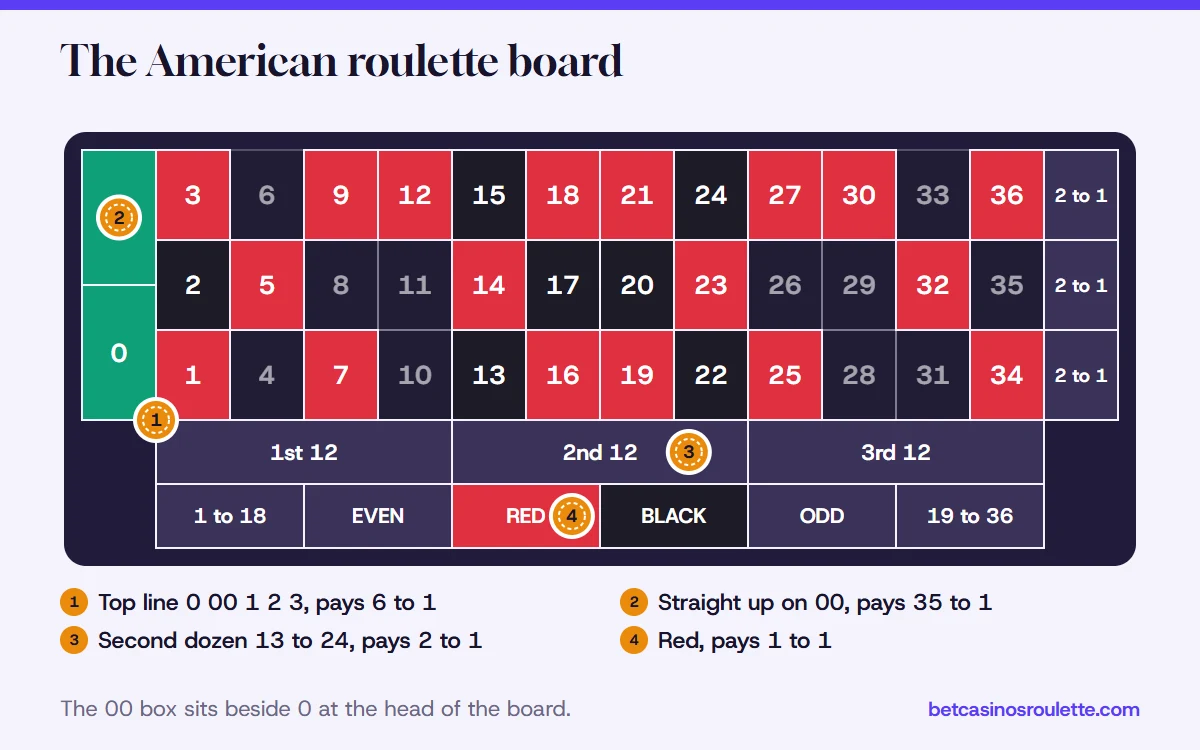
American roulette is the double zero version of the game: the wheel holds 38 pockets (1 to 36, plus 0 and 00), yet the payouts are the same as on a 37 pocket wheel, which leaves the casino a long run share of 5.26% of every unit wagered. That one extra green pocket is the whole story of this page. Below you will learn the rules, read the board, work out the odds in units, and see why the five number bet is the worst spot on the felt. Then you can try it all on the free double zero simulator, which uses play credits only.
At the table
Pockets
38: numbers 1 to 36, a single 0 and a 00House edge
5.26% on almost every bet (2 of 38)Worst bet
Top line, 0 00 1 2 3, at 7.89%Straight up chance
1 in 38, or 2.63% per spinRed or black chance
18 in 38, or 47.37% per spinWhere it is common
Most US tables, including most of Las Vegas
What is American roulette?
Picture a standard roulette wheel, then add a second green pocket marked 00. That is the American game. It is sometimes called double zero roulette or US roulette, and it is the version that fills the majority of US tables. The single zero wheel spread through Europe, while the double zero wheel became the house standard in America.
The extra pocket does not change a single payout. A number still pays 35 to 1, a dozen still pays 2 to 1, and red still pays even money. What changes is how often you win. With 38 ways for the ball to land instead of 37, every bet wins a little less often, while the casino pays the same amount when it does.
How to play American roulette, one round at a time
- Buy in. At a casino table you get wheel chips in a color nobody else at that table has. Each chip is worth whatever you set at the buy in.
- Place your chips. Set them down on a number, across a line shared by two or more numbers, or inside one of the outside boxes. The 0 and 00 boxes take chips just like 17 or 32.
- Wait for the ball. Wheel and ball travel in opposite directions, and "no more bets" comes before it drops.
- Read the result. A small marker, the dolly, gets set down on the number that hit.
- Get paid. The dealer sweeps away the losing chips, then pays each winner. Chips that won stay where they are unless you pick them up.
That is the full set of American roulette rules for a standard table. There is no strategy step where a choice changes the odds. Your only real decisions are which bet to make, how much, and when to stop. For a slower walk through a first visit, read how to play roulette.
The American roulette board and its 00 box
Thirty six numbered boxes run down the board in three long columns of twelve. At the head of the board, above 1, 2 and 3, sit two green boxes, one for 0 and one for 00. A one zero board uses that same spot for a single wide 0 box.
Around the numbers are the outside boxes: three dozens, three columns, and the six even money boxes (1 to 18, even, red, black, odd, 19 to 36). Inside bets go on the numbers or the lines between them.
One bet exists only on this board. A chip on the corner where the 0 and 00 boxes meet the 1, 2 and 3 row covers five numbers at once. Casinos call it the top line or the five number bet, and the name basket is used for it in some places, though that word means other things elsewhere. See the full map of every box on the roulette table layout page.
American roulette odds, payouts and what you get back
Here is each bet on a double zero table, sized at 10 units so the math is easy to follow. "Back if it wins" includes your 10 unit stake.
| Bet (10 units) | Back if it wins | Price | Pockets that win |
|---|---|---|---|
| Single number, straight up | 360 | 35 to 1 | 1 of 38 |
| Split across a line | 180 | 17 to 1 | 2 of 38 |
| Street, or a trio with a zero | 120 | 11 to 1 | 3 of 38 |
| Corner of four | 90 | 8 to 1 | 4 of 38 |
| Top line, five numbers | 70 | 6 to 1 | 5 of 38 |
| Six line, two rows | 60 | 5 to 1 | 6 of 38 |
| A dozen box or a column | 30 | 2 to 1 | 12 of 38 |
| Red, black, odd, even, 1 to 18 or 19 to 36 | 20 | 1 to 1 | 18 of 38 |
A double zero trio takes in 2 with both zeros, or 3 and 2 with the 00. Note that every one of these wins less often than the payout suggests. A straight up bet would need to pay 37 to 1 to be fair on 38 pockets, but it pays 35. Those two missing units out of 38 are the 5.26% edge. The payouts and odds page has the same math for every wheel.
The house edge in units, with a worked example
Say you bet 5 units on black for 40 spins. That is 200 units pushed across the felt in total. Multiply by the edge: 200 times 0.0526 is about 10.5 units. That is the average cost of the session. Some nights you finish ahead, some nights well behind, but over many sessions the results drift toward that number.
Now spread the same 200 units across single numbers instead. The average cost stays the same, about 10.5 units, because the edge is the same on nearly every bet. Only the swings change: you will lose more often, then hit bigger wins.
A few US casinos, mostly in Atlantic City, offer a surrender rule: when 0 or 00 lands, an even money chip gives back half instead of losing it all. That cuts their edge to about 2.63%. It is not the norm, so read the table sign.
American vs European roulette: what the second zero costs
The two games share the same payouts and nearly the same board. The difference between American and European roulette comes down to one pocket, and that pocket nearly doubles the price of playing.
| Question | Double zero wheel | Single zero wheel |
|---|---|---|
| Green pockets | 0 and 00 | 0 only |
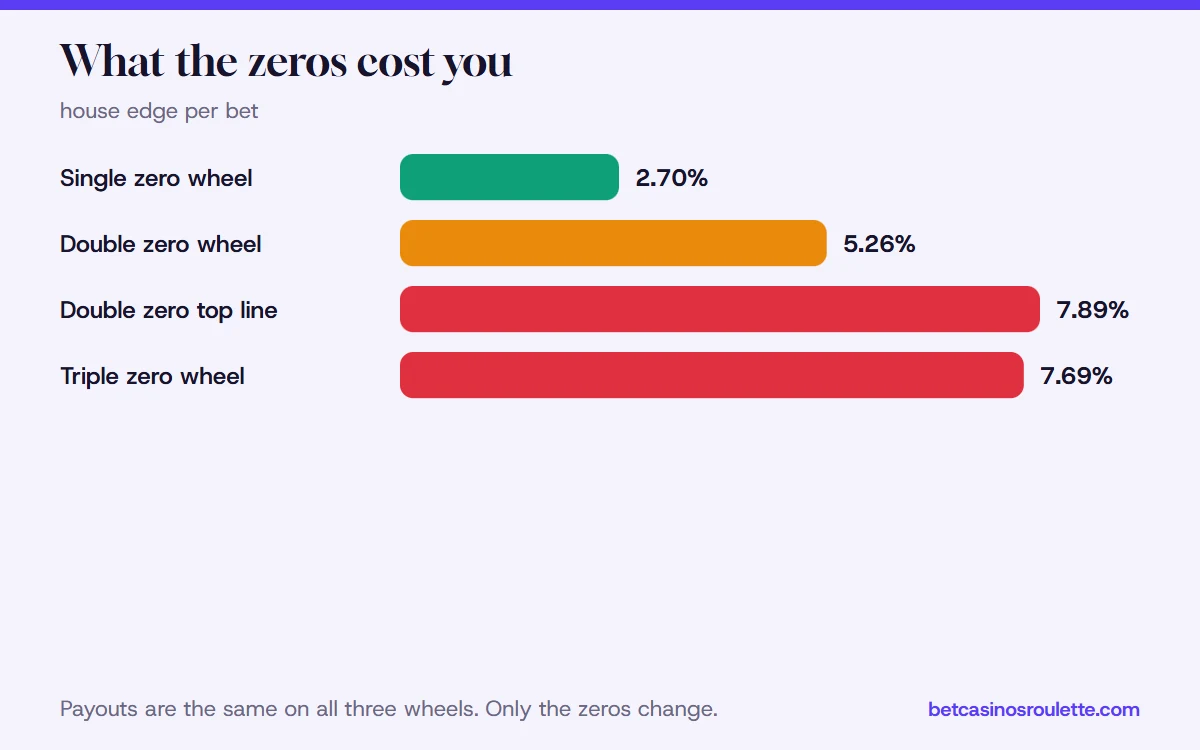
| Edge on a normal bet | 5.26% | 2.70% |
| Average cost of 100 spins at 1 unit | about 5.3 units | about 2.7 units |
| Chance red wins | 47.37% | 48.65% |
| Extra bet | Top line, 7.89% | First four, 2.70% |
| Where you see it | Most US casinos | Europe, the UK, fewer US tables |
If a casino offers both, the single zero table is the better deal on every bet, even when its minimum is higher. Our European roulette guide covers that version in depth, and the triple zero page covers the even pricier third version.
Practice on the free American roulette simulator
The simulator above opens on a double zero table, so you can play American roulette for free with credits that have no value. Nothing is stored and nothing needs a download.
- Pick a chip size: 1, 5, 25 or 100 credits.
- Tap a number, one of the two zeros, or an outside box to place it. Tap again to stack more.
- Press spin. The wheel strip shows where the ball landed, then the payout and your new balance appear.
- Check the history panel: it lists the last 20 numbers with a red, black and zero count.
A test worth running: start with the 1,000 credit balance and bet 10 credits on red for 50 spins. That is 500 credits wagered, so the average cost is about 26 credits. Note your balance, press reset, and run it again. You will see results scatter well above and below that average, and you will notice how often 0 or 00 wipes out every outside bet. When you are done, switch the same test to the single zero simulator and compare.
Playing smart on a double zero table
- Avoid the top line. No other square on this felt costs more.
- Pick bet size by your budget, not by a hunch. Every bet costs the same 5.26% on average, so a smaller bet means a cheaper night.
- Ignore the history board. Ten blacks in a row do not make red due; each spin starts fresh.
- Look for a single zero table first. In Las Vegas they exist, though they are fewer and often carry higher minimums.
Curious whether a betting system changes any of this? It does not, and betting systems shows the numbers.
Questions players ask
What is the difference between American and European roulette?
The American wheel has 38 pockets with both 0 and 00, while the European wheel has 37 pockets with a single 0. Payouts are the same on both, so the extra pocket lifts the casino's cut to 5.26%, up from 2.70%. On top of that, the double zero board adds a five number bet that the single zero board lacks.
What does 00 mean in roulette?
00 is the second green pocket on a double zero wheel. Because it carries no color, parity or range, a 00 result sinks every outside chip on the board. You can bet on it straight up like any number, and it pays 35 to 1.
Is double zero roulette worse for players?
Yes. The same payouts on more pockets mean you win less often for the same return. On average you lose about 5.3 units per 100 units bet, compared with about 2.7 on a single zero wheel.
Can I play American roulette for free?
Yes. The simulator on this page runs a double zero table with play credits, starting at 1,000. It needs no download and stores nothing, so you can practice the bets and watch the edge work without risking anything.
What is the best bet in American roulette?
Every bet except the top line carries the same 5.26% edge, so none is better in the long run. The top line, the five boxes at the head of the board, is the one to avoid at 7.89%. Pick bets for how much swing you want, not for better odds.
Why is American roulette so common in the US?
The double zero wheel became the standard in the United States long ago, and casinos kept it because it earns them more per spin. Single zero tables exist in Las Vegas but are fewer and usually have higher minimums.