
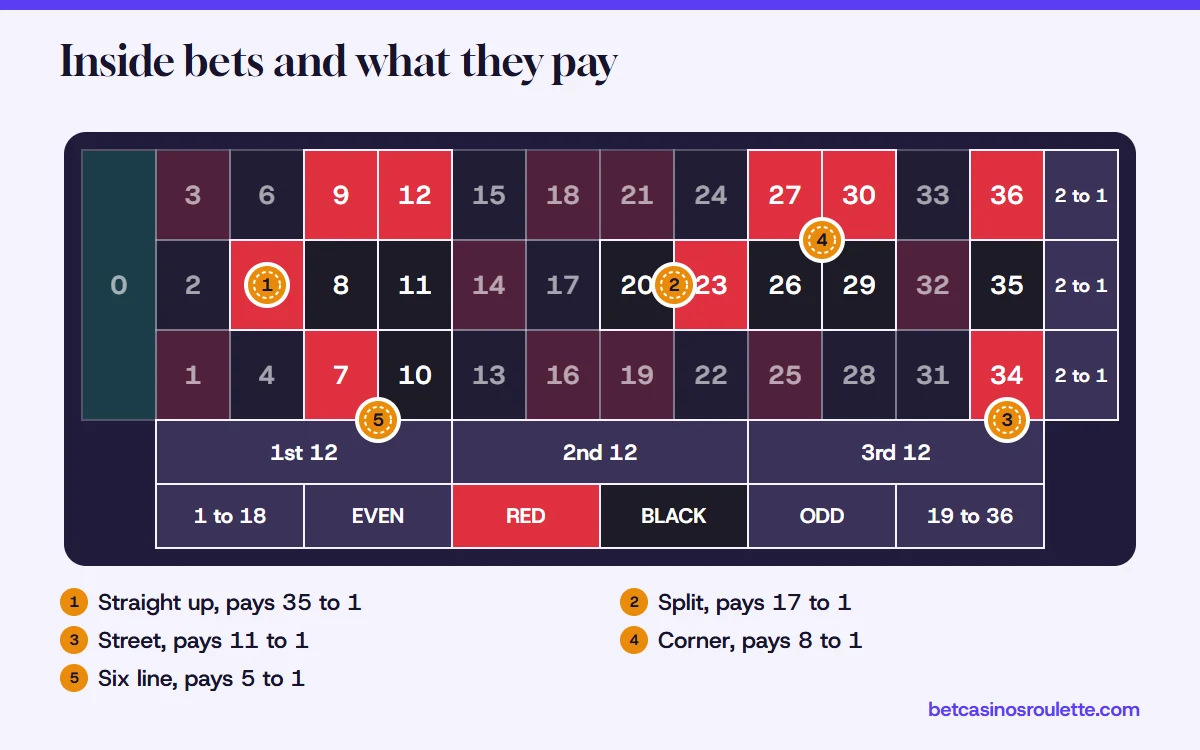
Roulette payouts run from 35 to 1 on a single number down to 1 to 1 on the even money spots like red or odd, and every one of them sits a little below the true odds. That small shortfall is the whole business model of the game. Below you get the full payout chart, the true odds for wheels with one green pocket and with two, a one line rule you can do in your head at the table, and a calculator that checks any bet for you.
I paid these bets for years from behind the wheel. The numbers never change from table to table. Only the wheel does.
At the table
Top payout
35 to 1 on one number. A 1 unit chip comes back as 36 units.Lowest payout
1 to 1 on the six even money boxes: red, black, odd, even, 1 to 18, 19 to 36.Quick rule
Payout = 36 divided by the numbers covered, minus 1. Works for every standard bet.European wheel
37 pockets, house edge 2.70% on every bet.American wheel
38 pockets, house edge 5.26%, or 7.89% on the five number bet.What "to 1" means
Your stake comes back on top of the win.
The roulette payouts chart for every bet
This is the chart dealers learn first. Read it left to right: the bet, how many numbers your chip covers, what the casino pays, and what lands back in front of you on a 1 unit win. The last two columns show how often that bet wins on each wheel.
| Bet | Covers | Pays | Back on a win | Wins, 37 pockets | Wins, 38 pockets |
|---|---|---|---|---|---|
| Straight up | 1 number | 35 to 1 | 36 | 2.70% | 2.63% |
| Split | 2 touching numbers | 17 to 1 | 18 | 5.41% | 5.26% |
| Street or trio | 3 numbers | 11 to 1 | 12 | 8.11% | 7.89% |
| Corner or first four | 4 numbers | 8 to 1 | 9 | 10.81% | 10.53% |
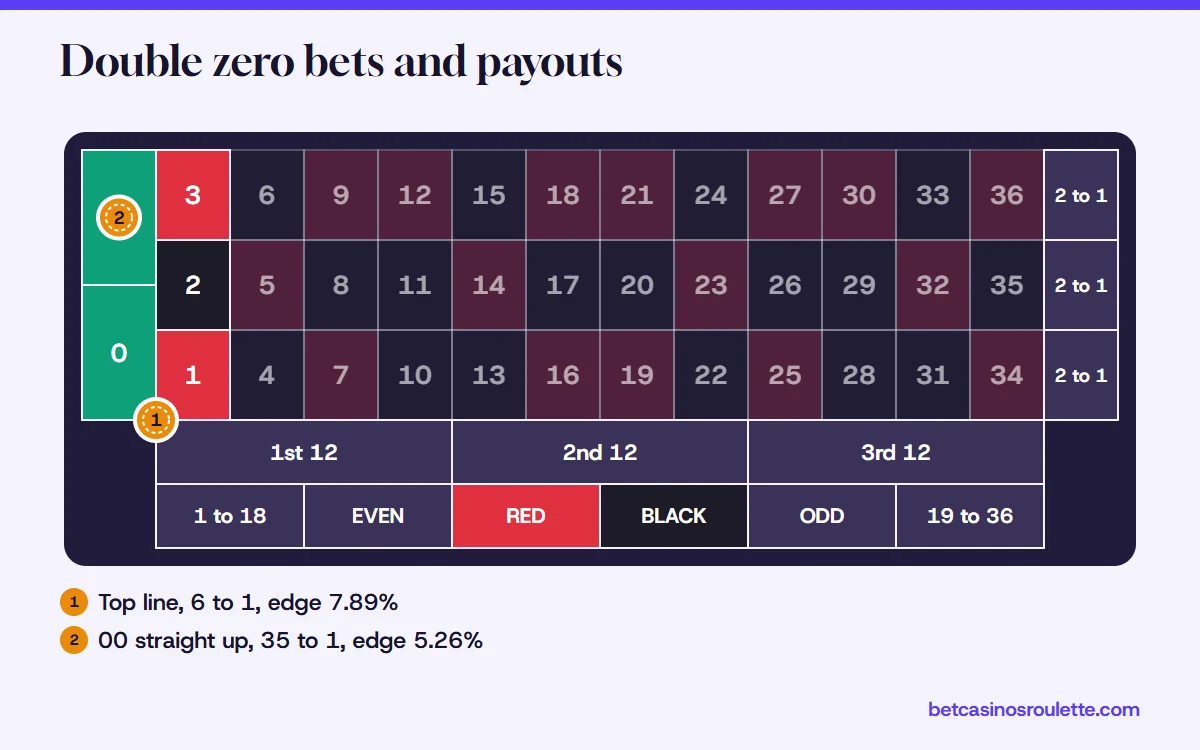
| Top line (0 and 00 plus 1 to 3) | 5 numbers | 6 to 1 | 7 | none | 13.16% |
| Six line | 6 numbers | 5 to 1 | 6 | 16.22% | 15.79% |
| Dozen or column | 12 numbers | 2 to 1 | 3 | 32.43% | 31.58% |
| Any even money box | 18 numbers | 1 to 1 | 2 | 48.65% | 47.37% |
The first four is a single zero bet on 0, 1, 2 and 3. The top line only exists on the double zero layout. Some tables call one of these the basket, and the name changes from casino to casino, so go by the numbers. Where each chip sits on the felt is drawn on the table layout guide, and the full list of bets is on all roulette bets.
Payout versus true odds, and why the gap is the house edge
True odds compare the ways to lose with the ways to win. A single number on a European wheel has 36 losing pockets and 1 winning pocket, so the true odds are 36 to 1. The casino pays 35 to 1. On an American wheel the true odds are 37 to 1, and the pay is still 35 to 1.
| Bet | Fair pay, single zero | Fair pay, double zero | Actual pay |
|---|---|---|---|
| One number | 36 to 1 | 37 to 1 | 35 to 1 |
| Two numbers | 17.50 to 1 | 18 to 1 | 17 to 1 |
| Three numbers | 11.33 to 1 | 11.67 to 1 | 11 to 1 |
| Four numbers | 8.25 to 1 | 8.50 to 1 | 8 to 1 |
| Six numbers | 5.17 to 1 | 5.33 to 1 | 5 to 1 |
| Twelve numbers | 2.08 to 1 | 2.17 to 1 | 2 to 1 |
| Eighteen numbers | 1.06 to 1 | 1.11 to 1 | 1 to 1 |
Now the proof in units. Put 1 unit on each of the 37 numbers of a European wheel. You stake 37 units. One number wins and pays 35, and that chip comes back too, so you collect 36. You are down 1 unit out of 37, which is 2.70%. Do the same on an American wheel: 38 units staked, 36 collected, 2 units gone, which is 5.26%.
Even money bets work out the same way. Over 37 average spins, red wins 18 times. Each win returns 2 units, so 36 come back from 37 staked. The pocket that breaks the tie is the zero. Without zeros, every payout on this chart would be exactly fair.
A roulette cheat sheet you can do in your head
Payouts follow one rule: divide 36 by the count of numbers you cover, then take away 1. That gives the pay "to 1".
- 1 number: 36 divided by 1 is 36, minus 1 gives 35 to 1.
- 3 numbers: 36 divided by 3 is 12, minus 1 gives 11 to 1.
- 6 numbers: 36 divided by 6 is 6, minus 1 gives 5 to 1.
- 18 numbers: 36 divided by 18 is 2, minus 1 gives 1 to 1.
The 36 is the count of numbers 1 to 36. The zeros are left out of the math, which is exactly where the casino makes its money. The rule breaks once: the five number top line should pay 6.20 to 1 by this rule but pays 6 to 1, which is why it costs more than any other bet on the table.
How to use the payout calculator above
The calculator above checks any mix of bets in units, so you can see the payout and the cost before you ever place a chip on a real felt.
- Choose the wheel: European or American.
- Add a bet, pick its type and numbers, and type its size in units.
- Add more bets if you play several at once.
- Read the results: what each bet pays, how often it wins, and the average cost for one spin and for a hundred.
Worked example. Put 10 units on the corner 26, 27, 29, 30 of a European wheel. A win pays 8 to 1, so you get 80 units plus your 10 back. It wins on 4 pockets out of 37, a 10.81% shot. The expected loss is 2.70% of 10 units, about 0.27 units a spin, or 27.03 units over 100 spins. Flip the setting to American and the chance drops to 10.53% while the expected loss rises to 52.63 units per 100 spins. Same chip, same payout, twice the cost.
For a deeper version with stacked bets, see the roulette payout calculator page.
American roulette payouts and the 00 pocket
The double zero table pays the same as the single zero table, bet for bet. Betting directly on 0, or on 00, counts as a straight up bet, settled at 35 to 1 just as any number is. What changes is the count of pockets. The extra green pocket adds a second way for every bet to lose, so the house edge goes from 2.70% to 5.26%.
The American layout also offers the top line: one chip covering both zeros and the numbers 1, 2 and 3, paid at 6 to 1. Over 38 average spins at 1 unit a time, it wins 5 times and returns 7 units each time, 35 units in all. That leaves 3 of 38 units lost, a 7.89% edge. Skip it. Any other bet on the same table costs less.
More on that wheel lives on the American roulette page, and the green pockets get their own guide at green 0 and 00.
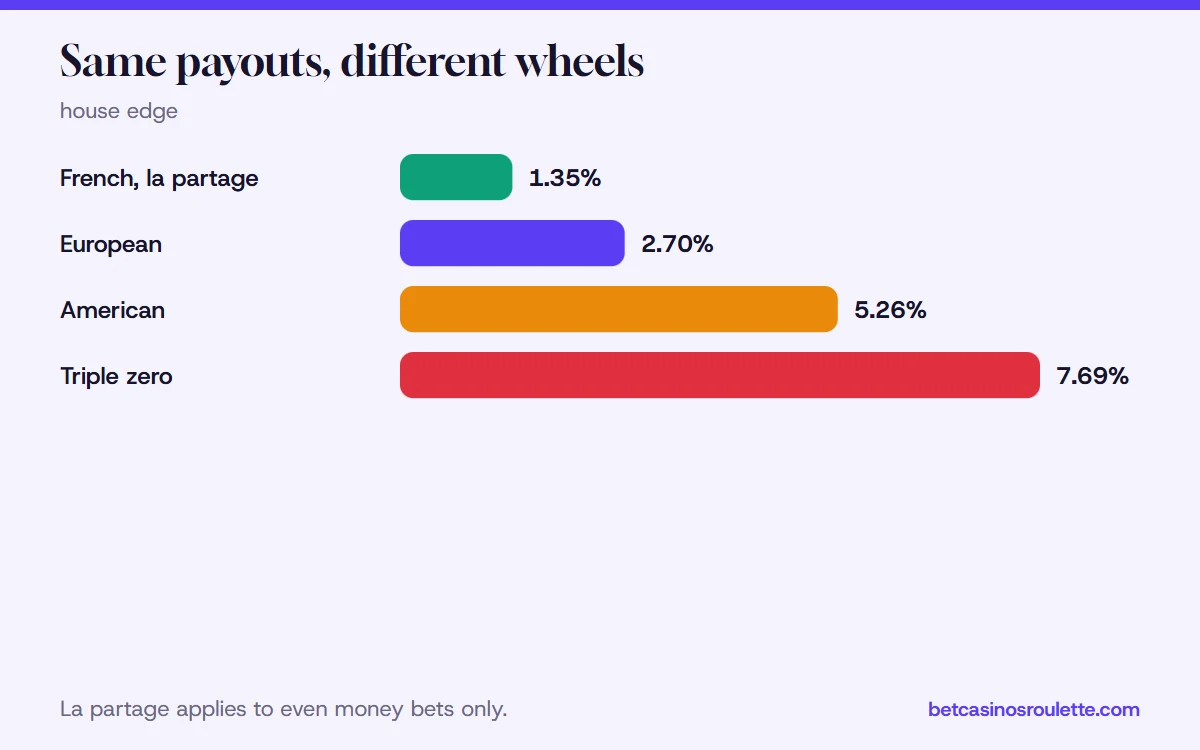
Roulette odds by wheel: single zero, French, double zero, triple zero
Since the payouts never move, the wheel decides your cost. The chart shows what each version keeps over time from every unit you bet, and the table turns that into units lost on 100 bets of 1 unit.
| Wheel | Green pockets | Edge | Average loss |
|---|---|---|---|
| French table, even money boxes under la partage | 1 | 1.35% | 1.35 units |
| European or French, other bets | 1 | 2.70% | 2.70 units |
| American | 2 | 5.26% | 5.26 units |
| Triple zero | 3 | 7.69% | 7.69 units |
La partage refunds 50% of each even money stake when zero lands, which halves the edge on those bets. The French roulette guide explains it with examples, and the triple zero roulette page shows why the third green pocket is so costly.
How roulette pays out at the table
Once the ball settles, the dealer sets a marker on top of the winning number. Most of us called it the dolly. Losing chips are swept first. Then winners are paid, usually from the outside bets inward, with the straight ups last.
Here is what that looks like. You have 3 units on the split 8 and 11, and 8 hits. The dealer leaves your 3 units where they are and sets 51 units beside them, because 3 times 17 is 51. You now have 54 units on that spot. The stake is still yours to pull back or leave riding, but move it only after the dolly is lifted.
Payouts come in your own color of wheel chips, which you trade for regular chips at that same table before you leave. The roulette chips page covers how that works.
Odds guides in this section
Each page below takes one question from this chart and answers it in full, with worked numbers.
| Topic | Page | What it answers |
|---|---|---|
| Chance | Roulette probability | Odds of red, green, a number, and streaks over many spins |
| Chance | Payout calculator | Payout and expected loss for any mix of bets |
| House edge | Casino house edge | What the edge is and how it works in every game |
| House edge | Games ranked by odds | Where roulette ranks against cards, dice and machines |
| Fairness and myths | Is roulette rigged | Testing, electronic tables and why streaks look suspicious |
| Fairness and myths | Best numbers | Whether any number hits more than another |
| Fairness and myths | Roulette prediction | What predictor apps and charts can and cannot do |
Which roulette bet has the best odds
Odds of winning and value are two separate questions. Red wins far more often than a single number, 48.65% against 2.70% with one zero, but both lose the same 2.70% of what you stake over time. So the best roulette odds come from the wheel you pick, not the box you bet on.
- Best: the even money boxes at a French game that runs either la partage or en prison, about 1.35%.
- Next: anything on a 37 pocket wheel, 2.70%.
- Worse: any bet on a double zero wheel, 5.26%.
- Worst: the American top line at 7.89%, and triple zero wheels at 7.69%.
Want to feel the difference without risk? Run both wheels side by side on the free roulette simulator, using play credits, and watch the balance over a few hundred spins.
Questions players ask
What is the payout on roulette for one number?
A single number pays 35 to 1 on every standard wheel. Bet 2 units and win, and you get 70 units plus your 2 back. The true odds are 36 to 1 with one zero and 37 to 1 with two, so the pay is always a bit short.
How much does roulette pay on red or black?
Red and black pay 1 to 1, so a 5 unit bet returns 10 units when it wins. They hit in 48.65% of European spins versus 47.37% on an American one, because the zeros are neither red nor black.
What does 0 pay on a roulette wheel?
A chip placed straight on 0 pays 35 to 1, the same as any number. The 00 on an American wheel pays the same. Zero does not pay anything to outside bets; they lose when it lands unless the table follows la partage or en prison rules.
What are the odds on a 00 roulette table?
On a double zero table every number has a 1 in 38 chance, or 2.63%. Payouts match the single zero table, so the edge climbs to 5.26% across the board, or 7.89% for the five number top line.
Does a bigger payout mean better odds?
No. A bigger payout only makes up for a smaller chance of winning. On one wheel every bet loses about the same share of the stake over time; the high payers just give bigger ups and downs along the way.
Do I get my stake back when I win?
Yes. "To 1" payouts are paid on top of your stake, which stays on the table. A 1 unit dozen bet that wins leaves you with 3 units: the 2 unit win and the original chip.