
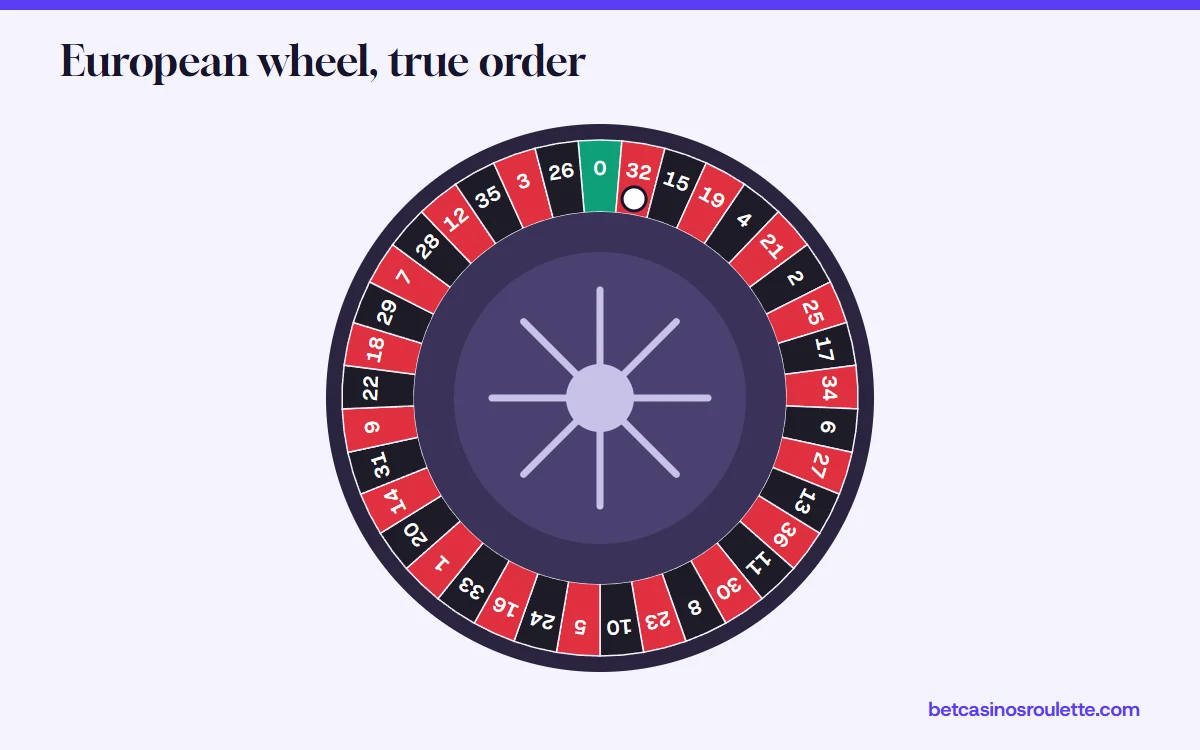
A roulette wheel is a balanced, spinning disc with 37 numbered pockets on the European version or 38 on the American, set inside a sloped bowl where a ball circles until it drops into one of them. The free spinner below follows the exact pocket order of each wheel, tells you everything about the number that comes up, and can fire off batches of 100 or 1,000 spins so you can see what randomness really looks like.
At the table
Pockets
37 European, 38 American, 39 triple zeroColors
18 red, 18 black, plus 1, 2 or 3 greenSpin rule
Ball travels opposite to the rotorOrder
Fixed and mixed, red and black alternateSpinner shows
Number, color, odd or even, half, dozen, columnBatch spins
100 or 1,000 at once with hot and cold counts
How the roulette wheel works
A casino wheel has two main pieces. The outer bowl is fixed and has a slanted track near its top edge where the ball runs. The inner rotor, which holds the numbered pockets, turns on a precise bearing around a central spindle, usually topped by a decorative handle called the turret.
The dealer sets the rotor turning one way and launches the ball the other way along the track. Friction slows the ball until gravity pulls it down the slope. On the way it strikes metal deflectors fixed to the bowl, then hops across the dividers between pockets, called frets, before it stops. All those bounces turn tiny differences in speed into completely different numbers, which is why the result cannot be called in advance.
How to use the roulette wheel spinner
- Choose European or American with the switch.
- Press Spin and watch a pocket get picked.
- Read the result panel, which lists the number, then its color and parity, which half and which dozen and column hold it.
- Press Spin 100 or Spin 1,000 to run a batch. The hot and cold count fills in.
- Switch wheels and run a batch again to compare.
Worked example: on the American setting a spin lands on 27. The panel reads red, odd, high (19 to 36), third dozen, third column. Now press Spin 1,000. Each of the 38 pockets should come up about 26 times on average (1,000 divided by 38), but you will see some numbers near 16 and others near 37. That spread is normal. With 1,000 spins the typical gap from the average is about 5 hits either way, so a number that looks hot or cold is almost always just chance.
European vs American roulette wheel
| Feature | European | American |
|---|---|---|
| Green pockets | 0 | Two, 0 and 00, at opposite sides of the rim |
| Total pockets | 37 | 38 |
| Clockwise after 0 | 32, 15, 19, 4, 21 | 28, 9, 26, 30, 11 |
| How the order is built | Spread so highs, lows, odds and evens mix | Consecutive pairs sit opposite, such as 1 across from 2 |
| Chance of a given number | 2.70% | 2.63% |
| Average cost per bet | 2.70% | 5.26% |
French roulette uses the European wheel. A triple zero wheel adds 000 for 39 pockets and a 7.69% edge. Close looks at each are on the European wheel and American wheel pages.
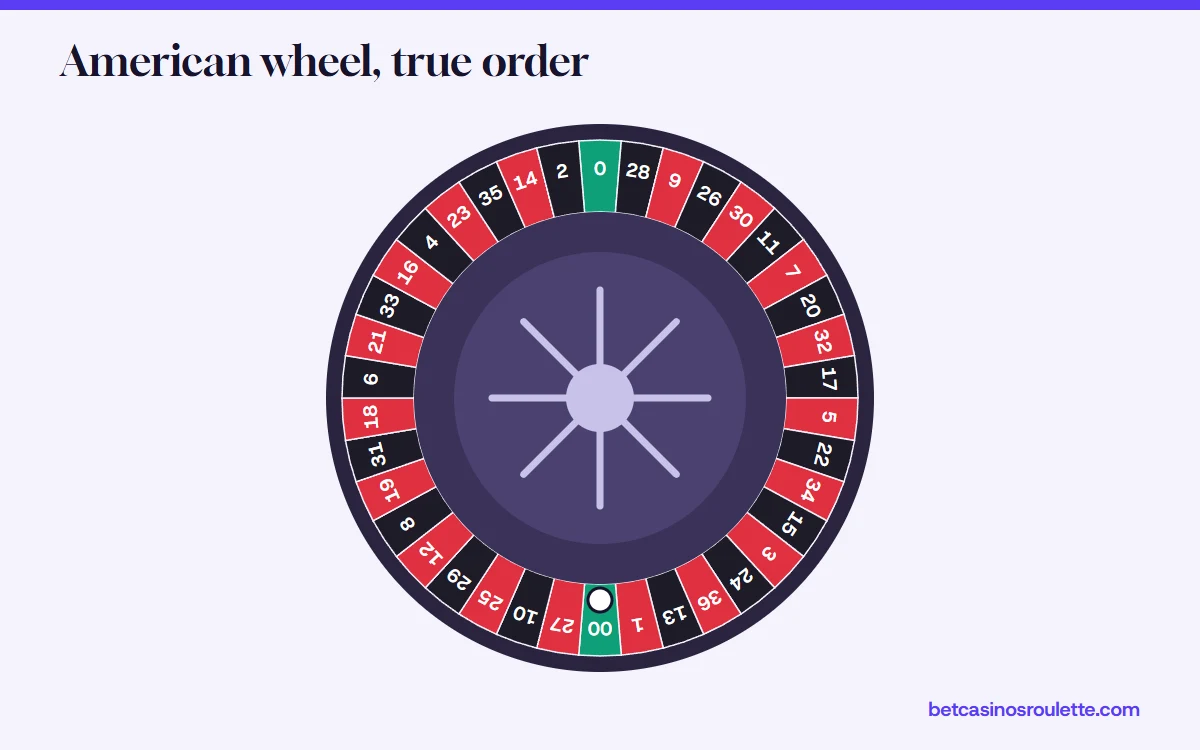
How many spots on a roulette wheel?
| Wheel | Red | Black | Green | All pockets |
|---|---|---|---|---|
| Single zero (European, French) | 18 | 18 | 1 | 37 |
| Double zero (American) | 18 | 18 | 2 | 38 |
| Triple zero | 18 | 18 | 3 | 39 |
The highest number is 36 on every standard wheel. Colors alternate red and black all the way round, and the green pockets break the pattern. For which numbers are red, see roulette numbers.
Are all roulette wheels the same?
No, in three ways. First, the pocket count: one, two or three green pockets. Second, the order of numbers, which differs between European and American wheels. Third, the build. Casino wheels are large, heavy and machined to tight tolerances; they are leveled and checked, and casinos inspect and rotate them because a worn or tilted wheel could develop a bias. Home and toy wheels are smaller and lighter and are not built to that standard.
On a screen, the result comes from either a filmed physical wheel or software. Where it is licensed, that software has to pass independent checks set by the gaming regulator, for example in Nevada or the UK. More on fairness is on is roulette rigged.
Wheel myths and what really happens
| Myth | Reality |
|---|---|
| A cold number is due | Every spin is independent; a number that missed 100 times has the same chance next spin |
| Hot numbers stay hot | Short runs of repeats are normal in random data and fade with more spins |
| Sections of the wheel take turns | Neighbor pockets are no more likely after a nearby hit |
| The dealer can aim | Bounces off deflectors and frets scatter the ball too much to aim |
| Watching enough spins reveals a pattern | Results on a fair wheel have no pattern to find |
Questions players ask
How many spots are on a roulette wheel?
A European wheel has 37 spots, 0 plus 1 to 36. An American wheel has 38 because it adds 00. A triple zero wheel has 39.
How does a roulette wheel work?
The rotor with the numbered pockets spins one way while the ball circles the track the other way. Losing speed, the ball falls inward, clatters off the metal bumps and the frets, and comes to rest; that pocket wins.
Is this roulette wheel spinner random?
Yes. Each spin picks a pocket at random with equal chance for every pocket. Run 1,000 spins and the counts will spread around the average just as a real wheel would.
Are all roulette wheels the same?
No. They differ in the number of green pockets, the order of the numbers, and build quality. European and French wheels match each other; American wheels use a different order with 00.
What is the highest number on a roulette wheel?
Thirty six. The numbers run from 1 to 36 plus one, two or three green zeros depending on the wheel.