
Roulette neighbor bets cover a number plus the pockets beside it on the wheel, usually two on each side, five chips in all, and they belong to a family of call bets that back whole slices of the wheel instead of rows on the felt. The four classic slices are voisins du zero, tiers du cylindre, orphelins and jeu zero. Each one is just a bundle of ordinary splits, corners and straight ups placed for you by the dealer, so the payouts and the house edge are the same as the bets they are built from. This page gives the exact chip placement for each, what each number nets you when it lands, and a full neighbor list for the single zero wheel.
At the table
Neighbors
A number and two pockets each side on the wheel: 5 chips, 5 numbersVoisins du zero
17 numbers around zero, 9 chipsTiers du cylindre
12 numbers opposite zero, 6 chipsOrphelins
The 8 numbers left over, 5 chipsJeu zero
7 numbers closest to zero, 4 chipsHouse edge
2.70% on a single zero wheel, the same as the bets inside them
Roulette neighbor bets and the racetrack
On the felt, numbers climb neatly from 1 up to 36. The numbers on the wheel do not. That is why many single zero tables have a racetrack. The roulette racetrack layout is an oval drawn beside the betting grid that shows the pockets in true wheel order. You point at a spot on the racetrack, or say the bet out loud, and the dealer turns it into chips on the layout or keeps the chips on the racetrack and pays from there.
Bets made this way are called call bets. Strictly speaking, they are announced bets: you say the bet and put down the chips to cover it at the same moment. A true call bet, made on credit with no chips down, is not allowed in many places, including the UK, so expect to hand over the full stake as you announce it.
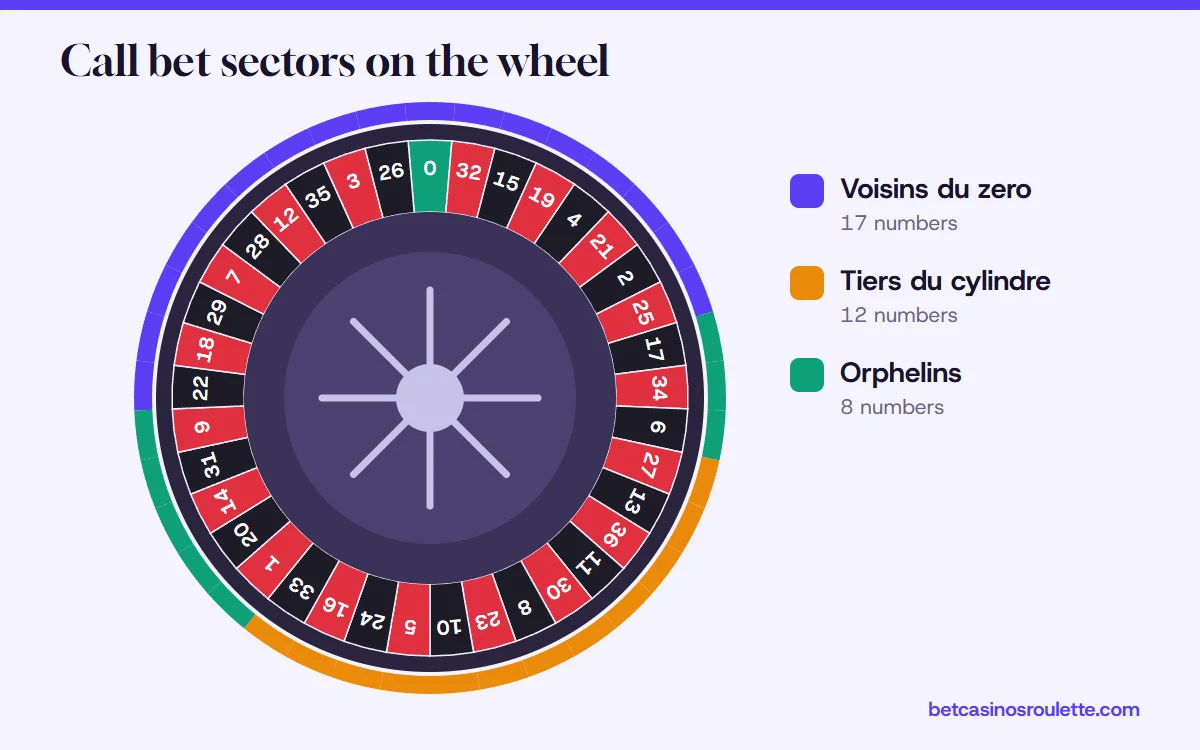
The wheel below shows the three big sectors. Together, voisins, tiers and orphelins cover all 37 pockets exactly once.
Neighbors: a number and two each side
Ask for "17 and the neighbors" and you get five straight up chips: 17 plus the two pockets on each side of it on the wheel. On a single zero wheel those are 2 and 25 on one side, 34 and 6 on the other. Each chip is a normal straight up at 35 to 1.
- Cost: 5 units at 1 unit a chip.
- If any of the five lands: that chip returns 36, the other four lose, so you net plus 31.
- Chance per spin: five pockets of 37, which is 13.51%.
- Edge: 2.70%, the same as one straight up.
On an American wheel the neighbors are different, because the pocket order is different. There, 00 has 13 and 1 on one side and 27 and 10 on the other. Some double zero tables and many game screens show a racetrack for neighbor bets, but the classic French slices below are drawn for the single zero wheel.
Voisins du zero: 17 numbers, 9 chips
Voisins du zero means "neighbors of zero". It covers the 17 pockets from 22 round to 25, with zero in the middle: 0, 2, 3, 4, 7, 12, 15, 18, 19, 21, 22, 25, 26, 28, 29, 32 and 35. The dealer places 9 chips like this:
| Chip spot | Chips | Numbers it covers | Net when one of them lands |
|---|---|---|---|
| Trio 0, 2, 3 | 2 | 0, 2, 3 | plus 15 |
| Split 4 and 7 | 1 | 4, 7 | plus 9 |
| Split 12 and 15 | 1 | 12, 15 | plus 9 |
| Split 18 and 21 | 1 | 18, 21 | plus 9 |
| Split 19 and 22 | 1 | 19, 22 | plus 9 |
| Split 32 and 35 | 1 | 32, 35 | plus 9 |
| Corner 25, 26, 28, 29 | 2 | 25, 26, 28, 29 | plus 9 |
How the net works: the trio pays 11 to 1 on 2 chips, so 24 come back against 9 staked. A split returns 18 on 1 chip. The corner pays 8 to 1 on 2 chips, also 18 back. Your chance of a hit is 17 in 37, about 45.95%.
Jeu zero: the zero game with 4 chips
Jeu zero, also called zero spiel, is a smaller version of voisins. It covers the 7 pockets closest to zero: 0, 3, 12, 15, 26, 32 and 35.
- 1 chip on the split 0 and 3
- 1 chip on the split 12 and 15
- 1 chip on the split 32 and 35
- 1 chip straight up on 26
With 4 units down, a hit on any split number returns 18, a net of plus 14. A hit on 26 returns 36, a net of plus 32. You win on 7 numbers out of 37, about 18.92% of spins.
Tiers du cylindre: 6 splits opposite zero
Tiers du cylindre means "third of the wheel". It covers the 12 pockets on the far side from zero, from 27 round to 33: 5, 8, 10, 11, 13, 16, 23, 24, 27, 30, 33 and 36. All six chips are splits:
| Split | Pays |
|---|---|
| 5 and 8 | 17 to 1 |
| 10 and 11 | 17 to 1 |
| 13 and 16 | 17 to 1 |
| 23 and 24 | 17 to 1 |
| 27 and 30 | 17 to 1 |
| 33 and 36 | 17 to 1 |
With 6 units staked, whichever number lands returns 18, so the net is always plus 12. Chance per spin: 12 in 37, about 32.43%. Some tables also offer a variant of tiers with different placements, so if the dealer offers one, ask how it is built.
Orphelins: the 8 orphan numbers
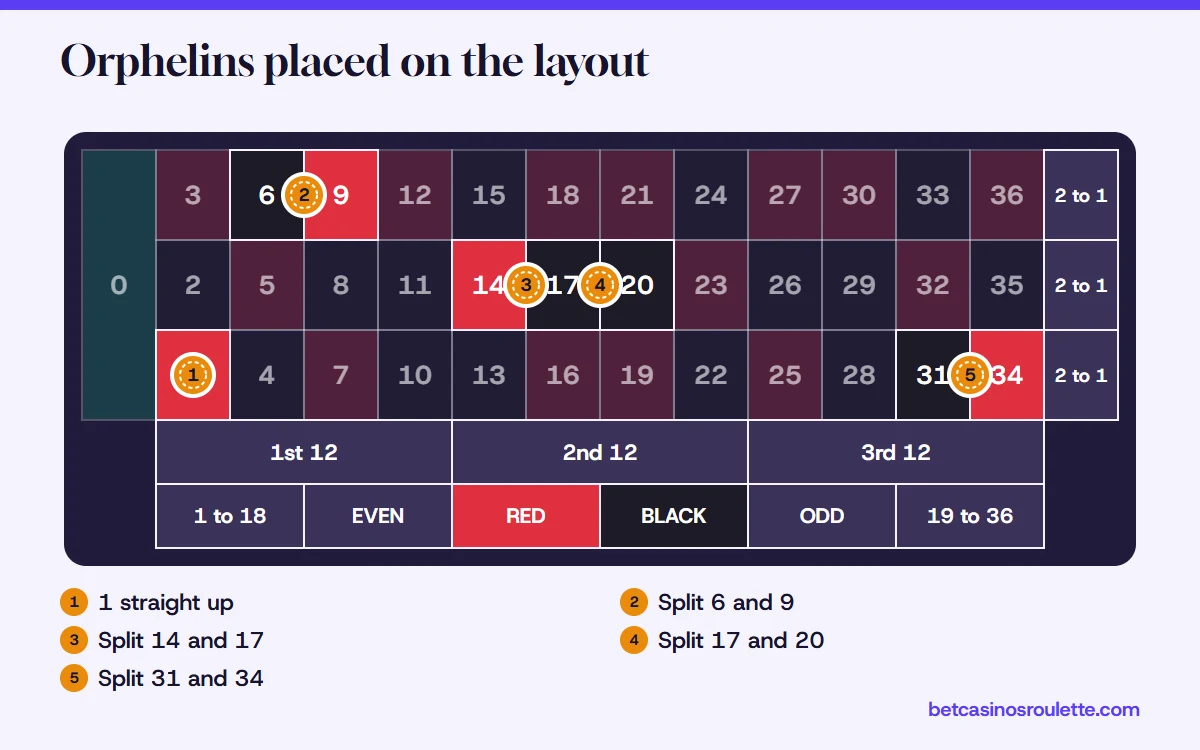
Roulette orphelins means "orphans": the numbers not in voisins or tiers. They sit in two pieces on the wheel, 17, 34 and 6 on one side and 1, 20, 14, 31 and 9 on the other. The bet uses 5 chips:
- 1 chip straight up on 1
- 1 chip on the split 6 and 9
- 1 chip on the split 14 and 17
- 1 chip on the split 17 and 20
- 1 chip on the split 31 and 34
Notice 17 is in two splits. If 17 lands, both pay: 36 back against 5 staked, plus 31. If 1 lands, the straight up returns 36, also plus 31. Any of the other six numbers returns 18, a net of plus 13. The bet connects on eight pockets of 37, or 21.62% of spins.
Every call bet side by side
| Bet | Numbers | Units down | Hit chance | Best net | Smallest net |
|---|---|---|---|---|---|
| Neighbors | 5 | 5 | 13.51% | plus 31 | plus 31 |
| Jeu zero | 7 | 4 | 18.92% | plus 32 | plus 14 |
| Orphelins | 8 | 5 | 21.62% | plus 31 | plus 13 |
| Tiers | 12 | 6 | 32.43% | plus 12 | plus 12 |
| Voisins | 17 | 9 | 45.95% | plus 15 | plus 9 |
None of these beats the wheel. Each chip inside them is an ordinary bet, so the whole bundle keeps the 2.70% edge: a 9 unit voisins costs about 0.24 units per spin over time. Slices of the wheel feel smart because the ball has to land somewhere physical, but every pocket still has the same 1 in 37 chance. The roulette prediction page explains why guessing a sector does not work, and you can rehearse these bundles chip by chip on the roulette simulator.
Roulette neighbours list for the single zero wheel
Use these roulette wheel neighbours to call a neighbor bet on any number. It lists the two pockets on each side on a European or French wheel. Left and right depend on which way you face the wheel, so dealers just say "and the neighbors".
| Number | Two on one side | Two on the other side |
|---|---|---|
| 0 | 3 and 26 | 32 and 15 |
| 1 | 16 and 33 | 20 and 14 |
| 2 | 4 and 21 | 25 and 17 |
| 3 | 12 and 35 | 26 and 0 |
| 4 | 15 and 19 | 21 and 2 |
| 5 | 23 and 10 | 24 and 16 |
| 6 | 17 and 34 | 27 and 13 |
| 7 | 18 and 29 | 28 and 12 |
| 8 | 11 and 30 | 23 and 10 |
| 9 | 14 and 31 | 22 and 18 |
| 10 | 8 and 23 | 5 and 24 |
| 11 | 13 and 36 | 30 and 8 |
| 12 | 7 and 28 | 35 and 3 |
| 13 | 6 and 27 | 36 and 11 |
| 14 | 1 and 20 | 31 and 9 |
| 15 | 0 and 32 | 19 and 4 |
| 16 | 5 and 24 | 33 and 1 |
| 17 | 2 and 25 | 34 and 6 |
| 18 | 9 and 22 | 29 and 7 |
| 19 | 32 and 15 | 4 and 21 |
| 20 | 33 and 1 | 14 and 31 |
| 21 | 19 and 4 | 2 and 25 |
| 22 | 31 and 9 | 18 and 29 |
| 23 | 30 and 8 | 10 and 5 |
| 24 | 10 and 5 | 16 and 33 |
| 25 | 21 and 2 | 17 and 34 |
| 26 | 35 and 3 | 0 and 32 |
| 27 | 34 and 6 | 13 and 36 |
| 28 | 29 and 7 | 12 and 35 |
| 29 | 22 and 18 | 7 and 28 |
| 30 | 36 and 11 | 8 and 23 |
| 31 | 20 and 14 | 9 and 22 |
| 32 | 26 and 0 | 15 and 19 |
| 33 | 24 and 16 | 1 and 20 |
| 34 | 25 and 17 | 6 and 27 |
| 35 | 28 and 12 | 3 and 26 |
| 36 | 27 and 13 | 11 and 30 |
For the full pocket order of both wheels, see our roulette wheel numbers guide, and for how French tables handle these bets, the French roulette page.
Questions players ask
What is a neighbour bet in roulette?
You back one number together with the pockets next to it on the wheel, usually two on each side. That makes five straight up chips. Any of the five landing pays 35 to 1 on that chip, a net of plus 31 on a 5 unit bet.
What are orphelins in roulette?
Orphelins are the 8 numbers left over once voisins and tiers are taken: 1, 6, 9, 14, 17, 20, 31 and 34. The bet uses 5 chips, a straight up on 1 and splits on 6 and 9, 14 and 17, 17 and 20, and 31 and 34.
How many chips do you need for voisins du zero?
Nine. Two go on the 0, 2, 3 trio, two on the 25, 26, 28, 29 corner, and one each on the splits 4 and 7, 12 and 15, 18 and 21, 19 and 22, and 32 and 35.
Is there a racetrack on American roulette tables?
Some double zero tables and screens have one, mainly for neighbor bets in the American pocket order. The voisins, tiers and orphelins slices are built for the single zero wheel, so they are rarely offered on double zero games.
Do call bets have better odds?
No. Each call bet is made of normal splits, corners, trios and straight ups, so it carries the same 2.70% edge on a single zero wheel. They only change which numbers you cover, not what you pay for them.
What is the difference between a call bet and an announced bet?
An announced bet is said out loud with the chips put down at the same time. A true call bet is made without chips, on credit, which many places do not allow. Most tables use call bet loosely to mean an announced bet.