
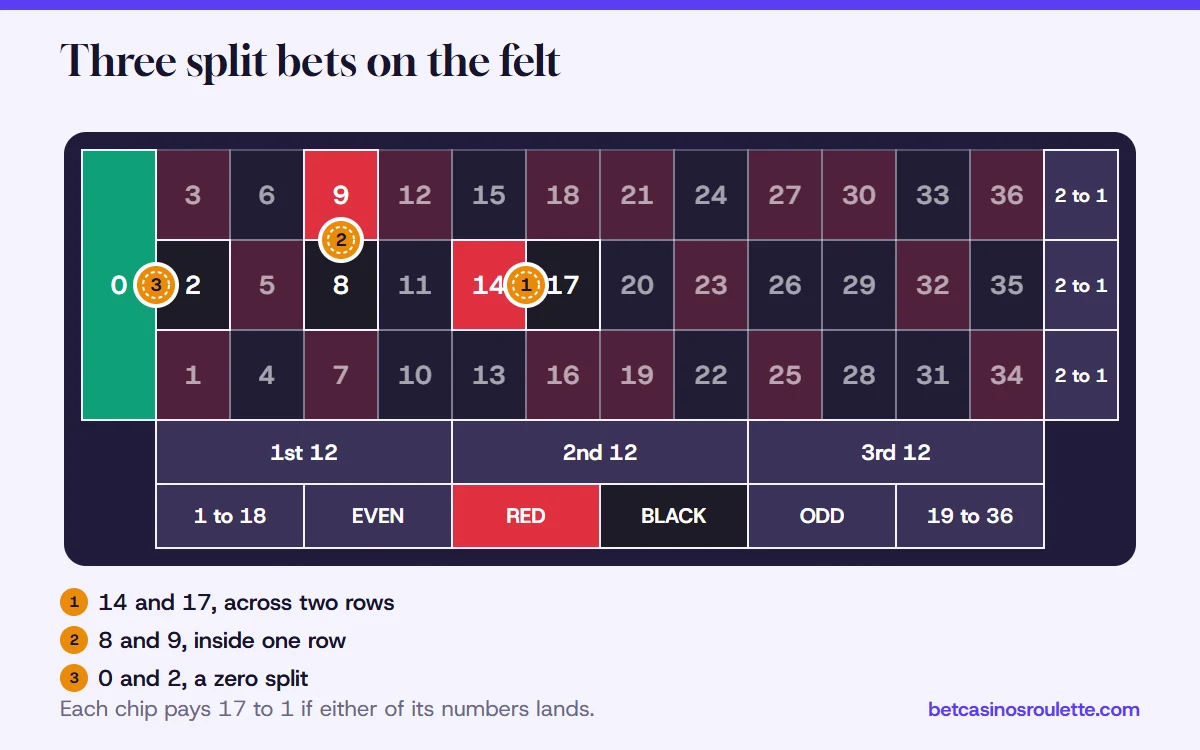
A split bet roulette players make is one chip placed on the line between two numbers sharing a border on the felt, such as 14 and 17 or 8 and 9, and it collects 17 to 1 when either of the pair comes up. One unit on a winning split brings back 18 units: 17 in winnings plus your chip. The math behind it is neat, the counting is a good party trick for dealers, and most errors with this bet come from a chip that drifts a few millimeters. Here is all of it, from the count of splits on each table to the way French dealers name the bet.
At the table
Numbers covered
Two that share a border on the felt, side by side or one above the otherPayout
17 to 1, so 1 unit returns 18 units when it winsWin chance, European wheel
2 in 37, or 5.41%Win chance, American wheel
2 in 38, or 5.26%House edge
2.70% on one zero, 5.26% on 0 and 00Chip spot
Right on the line the two boxes share
Split bet roulette: where the chip sits
Find the line that two numbers share and set the chip squarely across it, so half the chip rests on each box. The two numbers must touch along an edge. On the felt, numbers run in short rows of three (1, 2, 3, then 4, 5, 6 and so on) and long columns of twelve. That gives two kinds of split:
- Along a row: two numbers in the same row of three, like 8 and 9, or 34 and 35.
- Across rows: a number and the one directly next to it in the same column, which is always three higher, like 14 and 17, or 30 and 33.
Numbers that only meet at a corner point, like 14 and 18, cannot be split. Neither can numbers far apart, like 7 and 29. For those, use two separate straight up chips.
How many split bets are on the layout
Counting splits is a good way to learn the table by heart. Do it in three steps.
- Inside each row. Every row of three has two lines inside it (1 and 2, 2 and 3). Twelve rows times two lines is 24.
- Between rows. Eleven gaps separate the twelve rows, and each gap is crossed by three columns. Eleven times three is 33.
- Add them. 24 plus 33 is 57 splits using only the numbers 1 to 36.
Green boxes add a few more. On a European or French table the 0 box touches 1, 2 and 3, so you also get 0 and 1, 0 and 2, and 0 and 3, which makes 60 in total.
| Where the line is | One zero table | 0 and 00 table |
|---|---|---|
| Inside the rows of three | 24 | 24 |
| Between neighboring rows | 33 | 33 |
| Lines touching a zero | 3 (0 with 1, 2 or 3) | 0 and 00 plus the edge splits that table accepts |
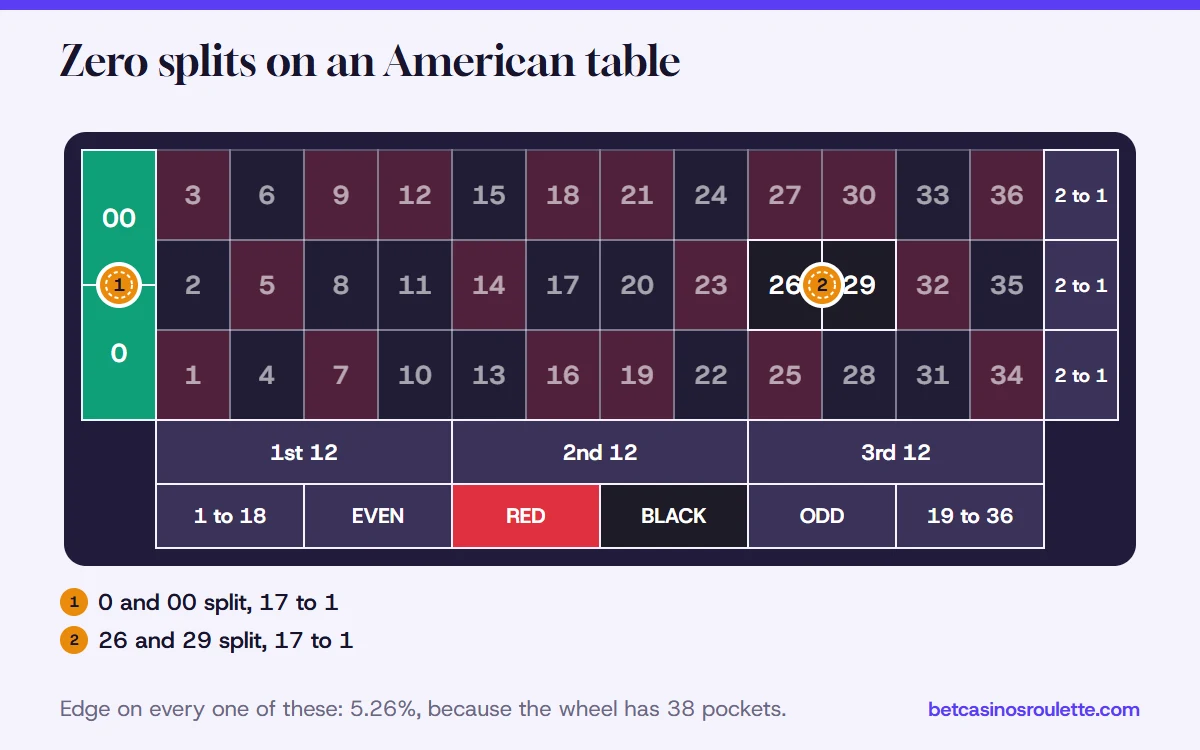
On a double zero table the 0 and 00 boxes share a line, so 0 and 00 is always a split. Many tables also take 0 and 1 and 00 and 3, and some accept 0 and 2 or 00 and 2 as well, which puts the total somewhere from 60 to 62. Ask the dealer which zero splits that table takes.
Roulette split bet payout and the true odds
Two winning pockets out of 37 means 35 ways to lose, so the odds against a split are 35 to 2, or 17.5 to 1. The table pays 17 to 1. On a wheel with 0 and 00 you face 36 losing pockets against 2, which is exactly 18 to 1, and the payout is still 17 to 1.
| Wheel | Edge kept by the house | Pockets that beat your split | Price that would be fair |
|---|---|---|---|
| European, 37 pockets | 2.70% | 35 | 17.5 to 1 |
| American, 38 pockets | 5.26% | 36 | 18 to 1 |
| Triple zero, 39 pockets | 7.69% | 37 | 18.5 to 1 |
Winning stakes, worked out: 1 unit wins 17 and returns 18. 4 units win 68 and return 72. 10 units win 170 and return 180.
A split is two straight up bets sharing a chip
Here is the quick way to see that a split is neither better nor worse than betting single numbers. Compare 2 units on the 17 and 20 split with 1 unit straight up on 17 plus 1 unit straight up on 20.
- Split, 2 units: if 17 lands you win 2 times 17, which is 34 units.
- Two straight ups, 1 unit each: the chip on 17 wins 35, the chip on 20 loses 1, so you are up 34 units.
Same numbers covered, same cost, same result. The payouts on the layout are built this way on purpose, which is why every inside bet on one wheel carries the same edge. The split just saves a chip and some reaching. You can check this yourself on the payout calculator, which prices both setups side by side.
Worked examples in units
One split, one spin. You put 3 units on the 23 and 26 split at a European table. The ball lands on 26. You are paid 51 units and keep your 3, so 54 units come back.
Four splits around one number. Some players back a number and every split that touches it. Around 17 that means 14 and 17, 16 and 17, 17 and 18, and 17 and 20: four chips. If 17 lands, all four splits win, 4 times 17 is 68 units. If 14 lands, only one split wins, 17 units, and the other three chips are lost, so you are up 14. Middle column numbers from 5 to 32 touch four splits each, most outer column numbers touch three, and the end boxes 34 and 36 touch only two.
A long run. A hundred 1 unit splits cost about 2.7 units on average on a European wheel and about 5.3 on an American one. That is the edge at work, and no choice of numbers changes it. Try a few hundred spins of splits on the free simulator and watch the balance wander around that line.
Cheval, split and other names for the bet
English speaking dealers say "split" and name both numbers: "a split, 17 and 20". On French tables the bet is a cheval, which means "on horseback", a picture of the chip straddling the line. You will also hear players ask for "the split" on a number, meaning a particular one of its splits, so name both numbers to avoid mix ups. When you hand chips to the dealer to place for you, say the pair early, while the ball is still spinning fast.
Splits sit in the inside bet family with streets, corners and six lines. Our guide to inside bets compares all of them, and the straight up bet page covers the single number they are built from.
Common split bet mistakes
- Chip on the corner point. Slide a split chip toward the end of the line and it may sit where four numbers meet. That is a corner at 8 to 1, not your split.
- Expecting a split across the layout. 7 and 29 cannot be split. If you want them both, bet each straight up.
- Thinking a split doubles your value. It doubles your chance and halves your payout, which leaves the edge exactly where it was.
- Playing splits at a double zero table when a single zero table is open. Same 17 to 1 price, nearly twice the cost over time.
Questions players ask
What does a split bet pay in roulette?
A split pays 17 to 1. A 1 unit chip on a winning split earns 17 units and you keep the chip, so 18 units come back. The payout is the same on European, French, American and triple zero tables.
How many split bets are there in roulette?
The numbers 1 to 36 form 57 splits: 24 inside the rows of three and 33 between rows. A table with one zero adds 0 with 1, 2 and 3 for 60 in all. A double zero table adds 0 and 00 plus whichever zero edge splits that house accepts.
Can you split 0 and 00?
Yes, on an American table the 0 and 00 boxes share a line, and a chip on it is a normal split at 17 to 1. It wins on either zero. The edge is the usual 5.26% for that wheel.
Can I split two numbers that are not next to each other?
No. A split must cover two boxes that share an edge on the felt. For two numbers that do not touch, place a straight up chip on each, which gives the same total result for the same cost.
Is a split better than a straight up bet?
Neither is better on average. A split wins twice as often and pays half as much, so the house edge is identical. Pick the one that fits how often you want small wins versus rare bigger ones.
How often does a split win?
With 37 pockets it lands about 2 spins in every 37, a 5.41% chance per spin. With 0 and 00 the share falls to 5.26%. Across 37 European spins, your pair shows at least once about 87.20% of the time.