
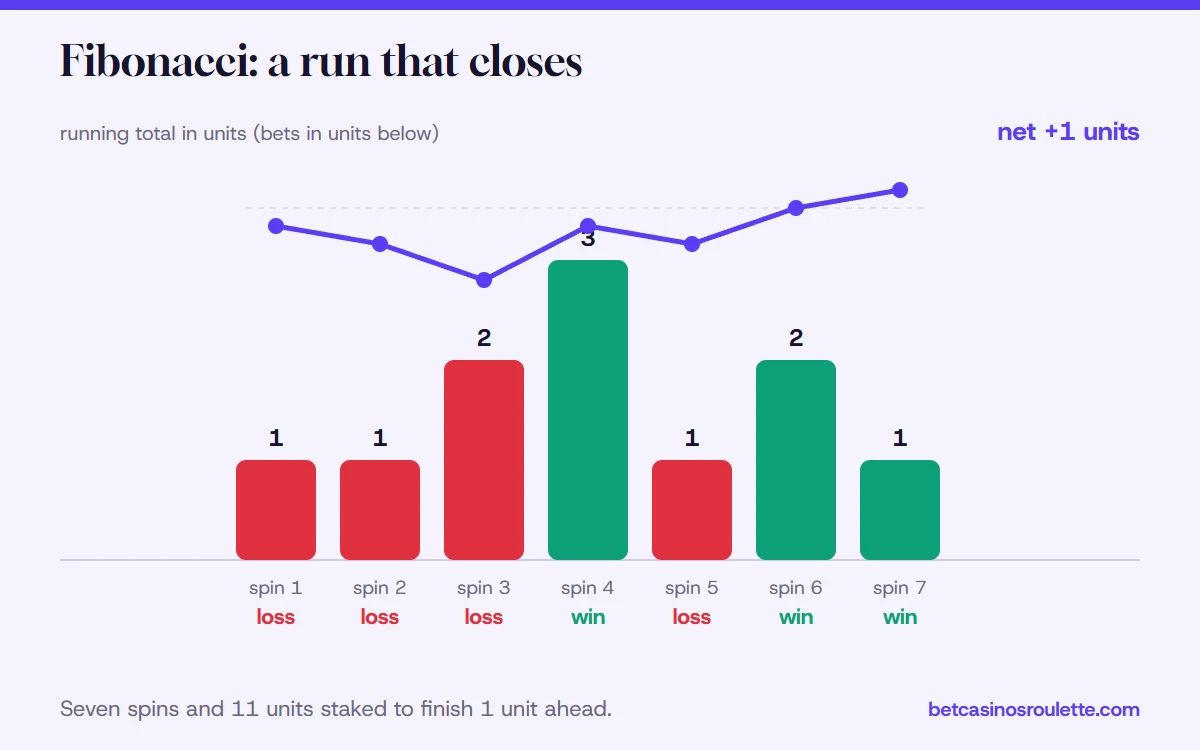
The Fibonacci roulette strategy moves your stake one step along the sequence 1, 1, 2, 3, 5, 8, 13, 21, 34, 55 after each loss and two steps back after each win, which climbs more slowly than doubling but still bleeds the same percentage to the casino. Each number is the sum of the two before it. That gentle growth is the whole appeal.
This page walks through the rules, a full run with real spins, the chart of what each step has cost you, the losing streak that ends a session, and what 100,000 simulated sessions show.
At the table
Sequence
1, 1, 2, 3, 5, 8, 13, 21, 34, 55After a loss
Move one step forwardAfter a win
Move two steps backRun ends
Back at the first step, usually slightly aheadNine losses in a row cost
88 units, with 55 needed nextTypical bet
Red or black, odd or even, low or high
How the Fibonacci roulette strategy works
You need one even money box and a written copy of the sequence. Keep a finger or a chip on the step you are on.
- Start at the first step: bet 1 unit on, say, black.
- After a loss, move one step to the right and bet that amount: 1, then 2, then 3, then 5.
- After a win, move two steps to the left. From 5 you drop to 2; from 3 you drop to 1.
- If a win would take you past the first step, the run is over. Start fresh at 1 unit.
- Stop the session when you hit your time limit, your loss limit, or a bet you cannot cover.
Why two steps back? Because a win at one step roughly pays for the two losses before it. That is a neat property of the numbers, but it does not mean every run ends in profit. Some finish level, most finish 1 unit up.
Fibonacci roulette chart: what each step has cost
This chart is the one to print. The third column shows what you have lost if every bet so far in the run has lost.
| Step | Bet | Total down if all lost | Chance of reaching this step by losses alone |
|---|---|---|---|
| 1 | 1 | 1 | first bet |
| 2 | 1 | 2 | 51.35% |
| 3 | 2 | 4 | 26.37% |
| 4 | 3 | 7 | 13.54% |
| 5 | 5 | 12 | 6.95% |
| 6 | 8 | 20 | 3.57% |
| 7 | 13 | 33 | 1.83% |
| 8 | 21 | 54 | 0.94% |
| 9 | 34 | 88 | 0.48% |
| 10 | 55 | 143 | 0.25% |
The chances assume a European wheel, where zero counts as a loss. A run with a few wins mixed in can also reach the high steps, which is why the real failure rate is a bit higher than the last column.
A worked Fibonacci run with real spins
A slightly longer run, betting black from a 100 unit bankroll:
| Spin | Step | Stake | Ball | Net |
|---|---|---|---|---|
| 1 | 1 | 1 | red 5 | -1 |
| 2 | 2 | 1 | red 30 | -2 |
| 3 | 3 | 2 | green 0 | -4 |
| 4 | 4 | 3 | red 19 | -7 |
| 5 | 5 | 5 | black 13 | -2 |
| 6 | 3 | 2 | black 24 | 0 |
| 7 | 1 | 1 | red 36 | -1 |
| 8 | 2 | 1 | black 6 | 0 |
| 9 | 1 | 1 | black 35 | +1 |
Nine spins, 17 units staked, 1 unit earned. I had a script play 200,000 separate runs, each with 100 units behind it; roughly 99.1% closed like this one. The other 0.9% hit a streak the bankroll could not cover and lost about 88 units each.
The losing run: bankroll and table maximum
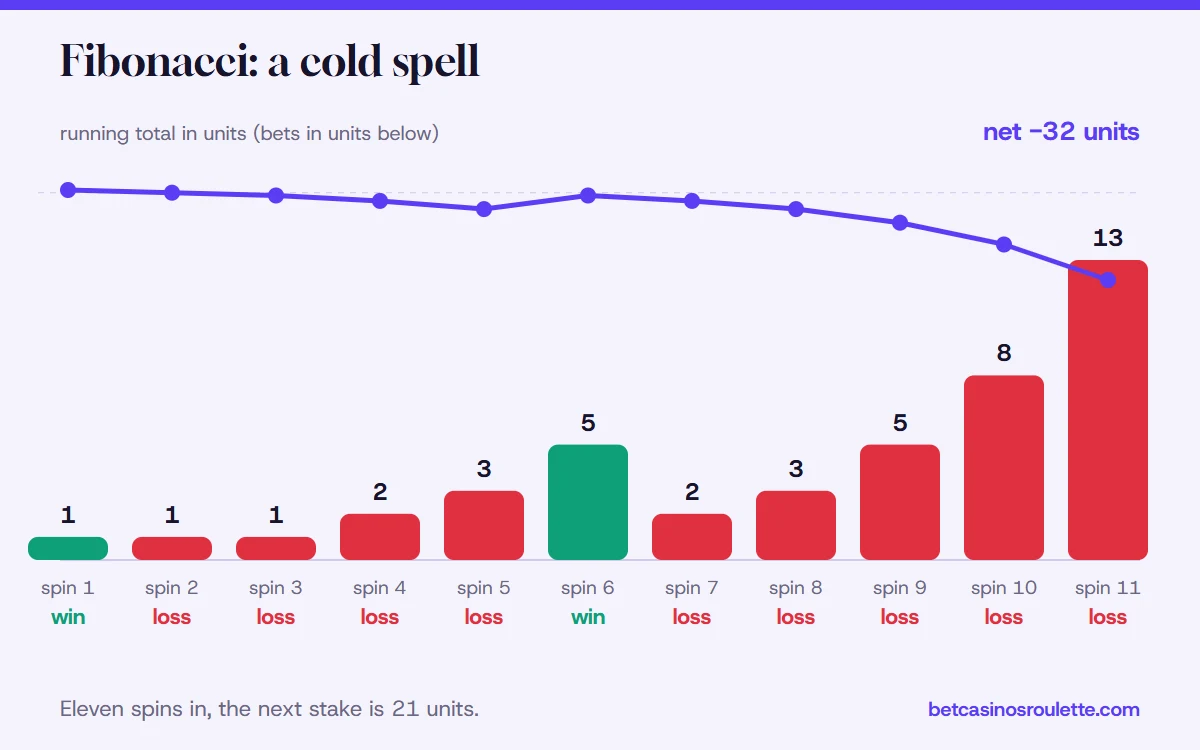
Here is what the bad 0.9% looks like. One early win, then a long cold spell.
| Spin | Stake on black | Ball | Net |
|---|---|---|---|
| 1 | 1 | black 2 | +1 |
| 2 | 1 | red 23 | 0 |
| 3 | 1 | red 7 | -1 |
| 4 | 2 | red 34 | -3 |
| 5 | 3 | green 0 | -6 |
| 6 | 5 | black 15 | -1 |
| 7 | 2 | red 1 | -3 |
| 8 | 3 | red 27 | -6 |
| 9 | 5 | red 12 | -11 |
| 10 | 8 | red 25 | -19 |
| 11 | 13 | red 16 | -32 |
The next bet is 21 units and the hole is 32. Three more losses and you are 88 down with 55 required, which a 100 unit bankroll cannot pay. To ride out ten straight losses you would need 143 units on hand.
A table maximum cuts the sequence short. With a limit of 50 units and a 1 unit base, the 55 step can never be placed, so after nine losses you must take the 88 unit loss and restart. In the simulation, a 500 unit bankroll with that limit never ran dry, yet still averaged about 6.6 units lost per 100 spins.
Does the Fibonacci system win in the long run?
No betting order changes what the wheel pays. My simulation ran 100,000 sessions per row, each capped at 100 spins, always on red from a 1 unit opening stake. Read the figures as approximate.
| Wheel and bankroll | Sessions ahead | Hit a bet too big to cover | Average per session |
|---|---|---|---|
| European, 100 units | 74% | 23% | -5.9 units |
| American, 100 units | 68% | 28% | -11.8 units |
| European, 1,000 units | 91% | 2% | -11.4 units |
Three out of four sessions finish up, which is why people swear by it. The ones that fail lose about 80 units each, and the average lands below zero. Divide the average loss by the total staked and you get roughly the 2.7% single zero edge, or about 5.3% on the American wheel. The house edge simply rides along with every unit you put down.
When the Fibonacci makes sense, and how to test it
It suits a player who wants a long, calm session with small stakes and accepts that a rare streak will cost a chunk of the bankroll. It grows slower than the Martingale, so it reaches the table limit later, but it also recovers less after a long streak.
The tester above opens on Fibonacci. Load a 150 unit stack, a one unit opener and a limit of 50 per bet on the European wheel, then ask for 80 spins over 1,000 sessions. When it finishes, look at how many sessions busted and how high the stakes climbed. Then flip the wheel switch to American and rerun to see how much the second zero hurts. Compare the line with the one from the Labouchere preset.
More systems, side by side, are on roulette betting systems.
Questions players ask
Does the Fibonacci roulette system work?
It wins small amounts often and loses a large amount now and then. In my simulation nearly three sessions in four finished up from a 100 unit stack, yet the average session still lost. It cannot change the 2.70% European edge.
What is the Fibonacci sequence in roulette?
It is the list 1, 1, 2, 3, 5, 8, 13, 21, 34, 55, where each number adds the two before it. Players use it as a list of stake sizes. You step forward after a loss and back two after a win.
How much bankroll does the Fibonacci roulette strategy need?
Nine losses in a row cost 88 units, and the tenth bet is 55, so about 143 units covers ten. A longer streak needs more. Most players also face a table maximum that stops the climb earlier.
Is Fibonacci safer than the Martingale?
The stakes grow more slowly, so a run of six or seven misses costs less. But a win after a long streak does not recover everything, so you may need several wins to get back. Over time both lose at the same rate per unit staked.
Can I use the Fibonacci strategy on dozens?
Yes, some players apply it to a dozen or column, which pays 2 to 1. You win about 32% of spins instead of about 49%, so streaks of losses are longer. The edge is unchanged.