
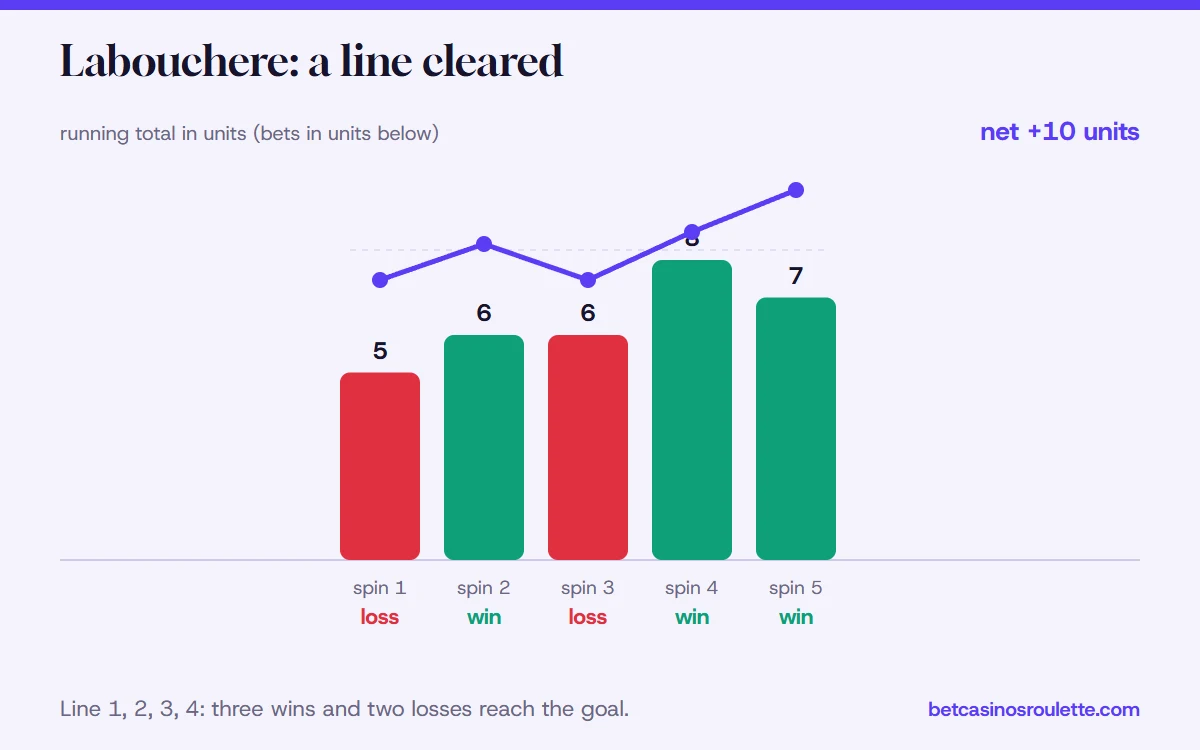
The Labouchere roulette system has you write a short line of numbers, such as 1, 2, 3, 4, and bet the first plus the last on an even money box: a win crosses both off, a loss adds the stake to the end, and clearing the line wins its total, here 10 units. It is also called the cancellation system. It feels organized and in control, which is exactly why a long line can sneak up on you.
Below: the rules, a full line cleared in five spins, a line that runs away, the bankroll that needs, and the long run numbers.
At the table
Starting line
1, 2, 3, 4 (target 10 units)Each bet
First number plus last numberWin
Cross off both numbersLoss
Write the amount lost at the endLine cleared in our test
About 87% of lines with a 100 unit bankrollFailed lines cost
About 84 units each, on average
How the Labouchere roulette system works
Grab a pen. The line is your plan, and the sum of the line is your goal for the run.
- Write a line of small numbers. 1, 2, 3, 4 adds up to 10, so the goal is 10 units.
- Bet the first number plus the last number on an even money chance such as red or high. Here that is 1 + 4 = 5 units.
- If you win, cross off both numbers. The next bet uses the new first and last.
- If you lose, write the amount you just lost at the right end of the line.
- When one number is left, bet just that number. When every number is crossed off, you have won the goal. Write a fresh line or stop.
Each win removes two numbers and each loss adds only one, so you can lose more often than you win and still clear the line. That is the clever part. The trap is that each loss also makes the next bet bigger.
A worked Labouchere example
| Spin | Bet (first + last) | Black? | Line after the spin | Running net |
|---|---|---|---|---|
| 1 | 1 + 4 = 5 | No | 1 2 3 4 5 | -5 |
| 2 | 1 + 5 = 6 | Yes | 2 3 4 | +1 |
| 3 | 2 + 4 = 6 | No | 2 3 4 6 | -5 |
| 4 | 2 + 6 = 8 | Yes | 3 4 | +3 |
| 5 | 3 + 4 = 7 | Yes | all crossed off | +10 |
Three wins, two losses, 32 units staked and 10 units earned. Out of 200,000 simulated lines, each backed by 100 units, about 87% ended like this. The rest did not.
When the line runs away
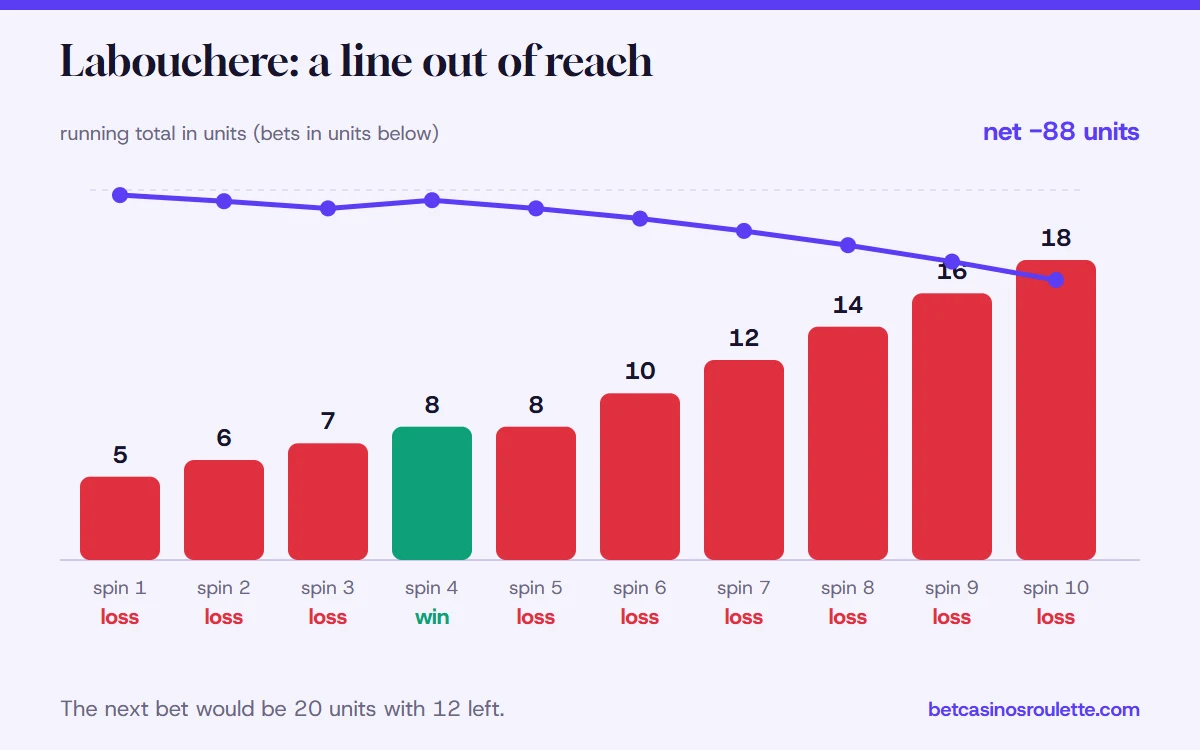
A line only shrinks on wins. A cold spell stretches it and pushes every bet higher.
| Spin | Bet | Result | Line now | Net |
|---|---|---|---|---|
| 1 | 5 | Loss | 1 2 3 4 5 | -5 |
| 2 | 6 | Loss | 1 2 3 4 5 6 | -11 |
| 3 | 7 | Loss | 1 2 3 4 5 6 7 | -18 |
| 4 | 8 | Win | 2 3 4 5 6 | -10 |
| 5 | 8 | Loss | 2 3 4 5 6 8 | -18 |
| 6 | 10 | Loss | 2 3 4 5 6 8 10 | -28 |
| 7 | 12 | Loss | ... 8 10 12 | -40 |
| 8 | 14 | Loss | ... 10 12 14 | -54 |
| 9 | 16 | Loss | ... 12 14 16 | -70 |
| 10 | 18 | Loss | ... 14 16 18 | -88 |
After ten spins the line holds eleven numbers and the next bet is 20 units, but only 12 remain. The run is over, 88 units down, chasing a 10 unit goal. Nine losses in ten spins happens only about 1.3% of the time, but in the simulation a failed line usually took ten to eighteen mixed spins and ended the same way.
Bankroll needs and the table maximum
Bets grow by adding, not doubling, so the climb is steadier than the Martingale. Steady still adds up. In the simulated lines, the typical biggest bet was 9 units, but one line in ten needed 25 units or more from a 100 unit stack, and 40 or more from a bigger one.
| Bankroll | Line cleared | Line abandoned | Average loss on a failed line |
|---|---|---|---|
| 100 units | 87.3% | 12.7% | 84 units |
| 500 units | 96.9% | 3.1% | 432 units |
| 1,000 units | 98.3% | 1.7% | 865 units |
A bigger bankroll makes failure rarer and much more expensive. The table maximum works the same way as running out of chips: when first plus last passes the limit, the line has to be dropped and the loss taken. A 500 unit bankroll with a 50 unit maximum rarely went broke in the simulation, but it ended 100 spins down in about 54% of sessions.
The long run result and the reverse Labouchere
Across 100,000 simulated sessions (100 spin cap, 100 unit stack, European wheel), Labouchere finished ahead about 31% of the time, went bust in about 68%, and averaged a loss of about 17 units. It also put far more units into action than flat betting, around 630 per session, and lost roughly 2.7% of that. The method moves money faster; it does not change the house edge.
The reverse Labouchere flips the rules: add the stake to the line after a win, cross off two numbers after a loss. It aims for rare long winning streaks and accepts many small lost lines. Over time it loses at the same rate.
Testing the Labouchere before you try it
The tester above starts on Labouchere with a 1, 2, 3, 4 line. Give it 300 units, a base of one and a per bet limit of 50, on the European wheel, for 120 spins and 500 sessions, then run. Look at the biggest bet needed and the sample line; it often climbs in steps, then falls sharply. Try a short session of 30 spins to see why people enjoy it for a single evening.
If you play it anywhere, choose a small goal, a hard loss limit and a finish time first, and quit when either limit arrives. Compare it with the Fibonacci and Paroli, or see every method together on roulette betting systems.
Questions players ask
Does the roulette Labouchere system work?
Most lines finish with a small profit, and a few fail with a large loss. In simulation about 87% of 1, 2, 3, 4 lines cleared from a 100 unit stack, but failed lines cost about 84 units each. Overall it hands the casino roughly 2.7% of all action when there is one zero.
What line should I start the Labouchere with?
Short lines of small numbers keep the bets lower. A line of 1, 2, 3, 4 targets 10 units; 1, 1, 1, 1 targets 4 and grows more slowly. Longer lines take more wins to clear and push bets up faster after losses.
Why is Labouchere called the cancellation system?
Because you cancel, or cross off, numbers from your line as you win. Each win cancels two numbers and each loss adds one. The run ends when every number is cancelled.
Is Labouchere safer than the Martingale?
Its bets rise by adding, not doubling, so one streak hurts less quickly. But a long line can still demand bets of 20 units or more and wipe out a small bankroll. Both give up the same share of stakes in the long run.
Can I use the Labouchere on dozens?
Yes. With dozens you win roughly one spin in three, so lines stretch further during cold spells, and players usually size bets differently because of the bigger payout. The edge stays at 2.70% with one zero.