
The honest answer to how to beat roulette is that nobody can beat a fair wheel over time, since each payout is trimmed a hair short of what the odds deserve. You can win a night, a hot hour or a single lucky spin. You cannot win every spin, every time or over the long run, and anyone selling a method that does is selling a story.
I spent years watching players try. The ones who left happiest were not the ones with clever systems. They were the ones who picked a single zero wheel, sized their bets for the time they wanted to play, and walked away at a number they had chosen before they sat down. This page shows the math behind that, then the short list of things you really control.
At the table
Can you beat it long term?
No. The edge is 2.70% on a single zero wheel and 5.26% on a double zero wheel, on every bet.Win every spin?
Impossible. Even 1 chip on all 37 numbers returns only 36.Ahead after 1,000 red bets
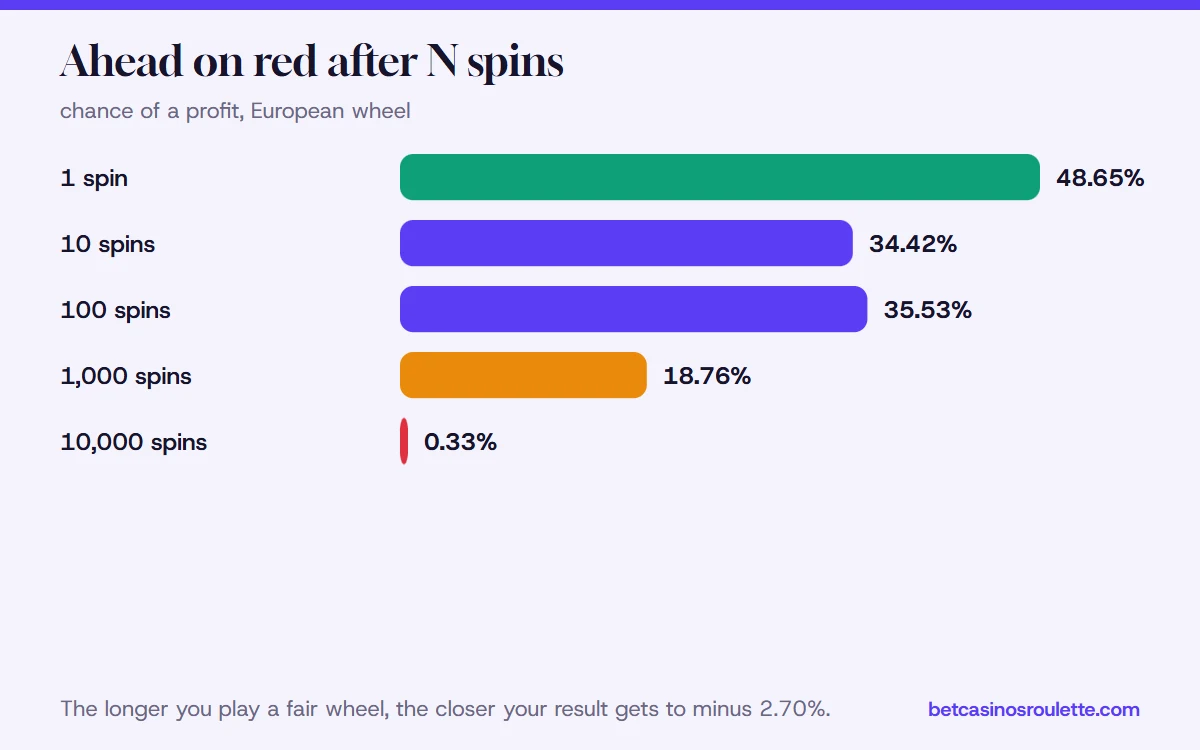
About 18.76% on a European wheel, 4.48% on an American one.Best edge available
Near 1.35%, when a French table refunds half on zero or jails the stake.What you control
Wheel type, bet size, how long you play and when you stop.
How to beat roulette: the short answer in numbers
Take a European wheel with 37 pockets. A straight up bet pays 35 to 1, so a 1 unit win hands back 36 units. If the payout were fair it would hand back 37. That shortfall of one chip per 37 spins is where the 2.70% casino advantage comes from. On an American wheel the gap is two pockets out of 38, so 5.26%.
Every other bet on the layout is priced the same way. Red pays 1 to 1 but wins only 18 times in 37. Any dozen returns double the stake as profit yet comes in only 12 times in 37. Switch bets and the hit rate and the size of each win move in opposite directions, but the slice the casino keeps stays put.
Short runs are noisy, so plenty of people walk out ahead. The chart below shows what happens as the spins pile up for someone betting 1 unit on red each time. The chance of being in profit sinks toward zero.
How to win roulette every spin or every time: can it be done?
Here is the cleanest proof I know. Drop 1 chip on each of the 37 pockets, zero included. You are now certain to win a bet on every spin. The winning chip pays 35 and comes back, so you collect 36 chips. You spent 37. You lose 1 chip per spin, every spin, guaranteed.
Covering fewer numbers does not fix that. It only swaps a small sure loss for a bigger chance of a miss. Here is how wide coverage trades against what a hit returns, for a 37 chip spread on a single zero wheel.
| Numbers covered with 1 chip each | Chips back on a hit | Net on a hit | Chance of a hit |
|---|---|---|---|
| 37 (every pocket) | 36 | minus 1 | 100% |
| 36 (all but zero) | 36 | 0 | 97.30% |
| 30 | 36 | plus 6 | 81.08% |
| 18 | 36 | plus 18 | 48.65% |
| 1 | 36 | plus 35 | 2.70% |
Notice the 36 number row. You break even on a hit and lose all 36 chips on zero. So a method that claims to win every time is either covering everything and losing a little, or hiding the rare spin that wipes out the run. Systems like Martingale do the second thing with bet sizes instead of chip spreads.
Why no strategy always wins, and what systems really do
A betting system is a rule for how big your next bet should be. It cannot change the pocket the ball lands in, and every bet it places carries the same edge. So your long run bill is still the edge multiplied by the full amount put in play. Systems shuffle the shape of results: many small wins and a rare big loss, or many small losses and a rare big win.
- Raise after a loss (Martingale, Fibonacci, D'Alembert, Labouchere): frequent small wins, then a losing streak that hits the table maximum or your bankroll.
- Raise after a win (Paroli, reverse Martingale): frequent small losses, with the odd streak that pays well.
- Wide coverage (Romanosky and similar spreads): a high hit rate, small profit per hit, large loss on a miss.
In my own test of nine systems over 100,000 sessions each, every one lost between 2.61% and 2.76% of all chips wagered, right around 2.70% once you allow for luck. The roulette strategy chart lays those results side by side, and the betting systems guide walks through each one in detail.
Is there a roulette strategy to win big? What a big win costs
A big win at roulette nearly always means a straight up hit at 35 to 1, or a short streak with bets left to ride. Both happen. Neither is a plan.
Bet 1 unit on one number for 37 spins and you have about a 63.71% chance of at least one hit, which sounds great until you count: one hit returns 36 units after you spent 37. You need two hits in that stretch to finish ahead.
If you want the best single shot at doubling a stake, one big bet on red beats lots of little ones. With 100 units on a European wheel, a single 100 unit bet doubles the stake 48.65% of the time. Grinding at 1 unit a spin toward the same goal succeeds only about 0.45% of the time, because the edge nibbles at every one of thousands of spins. The small bankroll guide has the full table. Big bets mean a short visit, though, and most people come for the evening, not for one spin.
Trying to beat online roulette, phone tricks and worn wheels
Licensed online and electronic roulette runs on tested random number generators or on real wheels filmed live. Gaming regulators insist on that lab testing (in Nevada it is the Gaming Control Board, in Britain the Gambling Commission), so a screen full of past numbers predicts nothing. Videos promising a pattern for online wheels are reading shapes into noise.
People also ask how to beat roulette using a mobile phone. Apps that claim to predict the next number cannot see inside a random number generator. At a real table, using any device to project the outcome is against casino rules, and Nevada law makes it a crime at licensed casinos.
The famous stories of a gambler who beat roulette usually involve a worn or tilted wheel. Casinos know this, which is why they level, inspect and rotate their wheels. Treat those tales as history, not a to do list. Curious what true randomness looks like? The wheel spinner lets you spin 1,000 times in a few seconds and watch the hot and cold numbers swap places.
The parts of the game you do control
You cannot beat roulette, but you are not powerless. Five decisions shape how your session goes.
- Pick the wheel. One green pocket instead of two halves the casino's cut compared with double zero. French rules halve it again on even money bets.
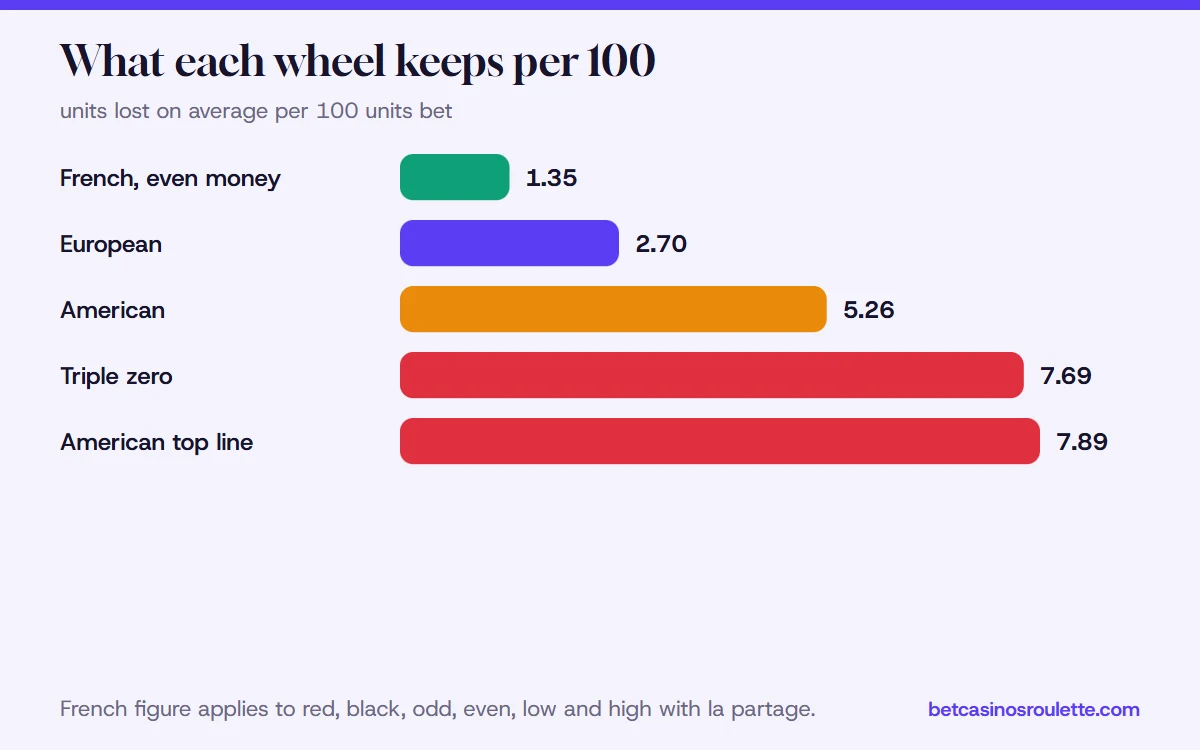
- Avoid the worst bet. On an American table, skip the five number spot that straddles 0, 00 and the first row. At 7.89% it is the priciest spot on that felt.
- Size bets for time, not hope. Smaller bets stretch play; the expected cost per spin is the bet times the edge.
- Fix your stop loss and your clock in advance. Decide both while you are calm, before the first chip.
- Choose a stopping point when ahead. It does not change the edge, but it turns a lucky run into a result instead of a story about the one that got away.
| Choice | Effect on the edge | Effect on your night |
|---|---|---|
| Single zero over double zero | 5.26% down to 2.70% | Roughly halves the average loss |
| French rules on red or black | 2.70% down to about 1.35% | Zero only takes half your stake |
| Smaller bet size | None | More spins for the same bankroll |
| Loss and time limits | None | Caps the worst case |
| Any betting system | None | Changes how wins and losses cluster |
Can you beat roulette long term? What the average loss looks like
Working out the expected loss takes one multiplication: edge by everything wagered. A hundred spins at 5 units apiece puts 500 units through the wheel. On a European wheel the average cost is about 13.5 units. Double zero raises that to roughly 26.3 units. Those are averages; a real night will land above or below, but the center of the spread sits there and drifts further down the more you play.
The chart compares what each version of the game keeps from every 100 units you bet. Same table, same chips, very different bills.
Questions players ask
Is there a guaranteed way to win on roulette?
No. Every bet pays a little less than its true odds, so the casino keeps 2.70% or 5.26% of all bets over time, depending on the wheel. A guarantee would need a payout above the true odds, and no fair table offers one.
How to win at roulette every time?
You cannot. Covering every number wins a bet each spin but returns 36 chips for every 37 you put down. Any approach that seems to win every time is hiding a rare, large loss somewhere in the sequence.
Does any roulette strategy beat the house edge?
None does. Betting systems only change bet sizes, and every bet they place carries the same edge. In 100,000 simulated sessions per system, all of them lost close to 2.70% of the total wagered on a single zero wheel.
How do people win big on roulette?
Mostly through straight up hits at 35 to 1 or a short lucky streak. Those are real outcomes of chance, not repeatable methods. The same bet that wins big one night loses on most others.
How to win roulette in Vegas?
The game in Las Vegas follows the same math as anywhere else. Your best move is to find a single zero table, accept that minimums there are often higher, keep bets small enough to last, and leave at a limit you set in advance. Double zero tables, with their 5.26% edge, are the most common kind in town.
Can you beat roulette long term?
Not on a fair wheel. The more spins you play, the closer your result moves to the house edge. After 10,000 red bets on a European wheel, the chance of being ahead is about 0.33%.