
Roulette is a table game where a dealer sends a small ball around a spinning numbered wheel and players bet on the pocket where it will stop, from one single number to half the board at once. This site walks through the whole game the way a dealer would teach it on a quiet shift: the rules, each place you can put a chip, the real chance of every bet, and what systems do to a bankroll. Every tool here runs on play credits, so you can try anything before you ever sit at a real table.
At the table
Pockets
37 on a European wheel, 38 on an American wheel, 39 on a triple zero wheelBiggest payout
35 to 1 for one number, so 1 unit comes back as 36House edge
2.70% with one zero, 5.26% with two, 7.69% with threeCheapest bet
Even money bets under la partage, about 1.35%Can a system win?
No. It changes how results are spread, never the edgeFree tools
Simulator, wheel spinner, betting layout, odds and system calculators
What roulette is, in one minute
The name is French for little wheel, and it is said roo-LET. A wooden wheel holds numbered pockets colored red, black and green. Picture two motions fighting each other: the rotor drifts clockwise or counterclockwise, and the ball races the opposite way along a groove just under the rim. When the ball slows, it drops, bounces off small metal bumps, and settles in one pocket. That pocket is the winning number for the round.
Around the wheel sits a felt layout carrying 1 through 36 as a grid of three columns, the zero or zeros at the top, and larger boxes for colors, odd and even, high and low, dozens and columns. You bet by setting chips on that cloth. A chip on one number is the purest bet in the game, which is why a call like "17 black" is so famous: its square lies close to the center of the felt and is easy to reach. It has no better odds than any other number.
For a slower tour of the parts, the words and the history, read what is roulette. To start playing right away, go to how to play roulette.
The three wheels you can meet
Every roulette game uses the same 36 numbers. What changes is the number of green pockets, and that one detail sets the price of every bet you make.
| Wheel | Green pockets | Total pockets | Edge on most bets | Where you see it |
|---|---|---|---|---|
| European | 0 | 37 | 2.70% | Across Europe and on many screens |
| French | 0 | 37 | 2.70%, even money near 1.35% | Tables using la partage or en prison |
| American | 0 and 00 | 38 | 5.26% (top line 7.89%) | Standard across US casino floors |
| Triple zero | 0, 00 and 000 | 39 | 7.69% | Some US casinos |
The order of the pockets differs between wheels too. See the European wheel and the American wheel for the full sequences.
How a round of roulette works
A round takes about a minute at a live table and a few seconds on a screen. The rhythm never changes:
- Buy in. Hand cash to the dealer and receive a stack of wheel chips in a color no one else at that table has.
- Bet. Place chips on numbers, lines between numbers, or the outside boxes. You can make many bets in one round.
- Spin. The wheel turns and the ball is launched against its direction. Chips can still go down for a few seconds.
- No more bets. The dealer waves a hand over the layout and calls it. Chips placed after this do not play.
- The ball lands. Out comes the dolly, a heavy little marker, set right on that number's square.
- Settle. Every losing chip is cleared away, then each winner is paid beside the bet. A winning chip stays yours along with its payout.
- Repeat. The dolly comes off and the next round opens.
Rehearse those steps on the free roulette simulator; it opens with 1,000 credits.
Inside and outside bets at a glance
Bets fall into two families. Inside bets sit on the numbered grid and hold between one and six numbers. Outside bets sit in the boxes around the grid and cover twelve or eighteen numbers. Fewer numbers means a rarer win and a larger payout.
- Inside: straight up, split, street, corner, six line and the zero bets such as the basket.
- Outside: the color bets, odd against even, low half against high half, and the dozens and columns.
- Call bets: groups of pockets named by their place on the wheel, explained on call bets.
The one trap for new players is the green pocket. Green belongs to none of the outside groups, so when the ball finds a zero, color, parity, half, dozen and column bets all go down together. Read more on the green 0 and 00.
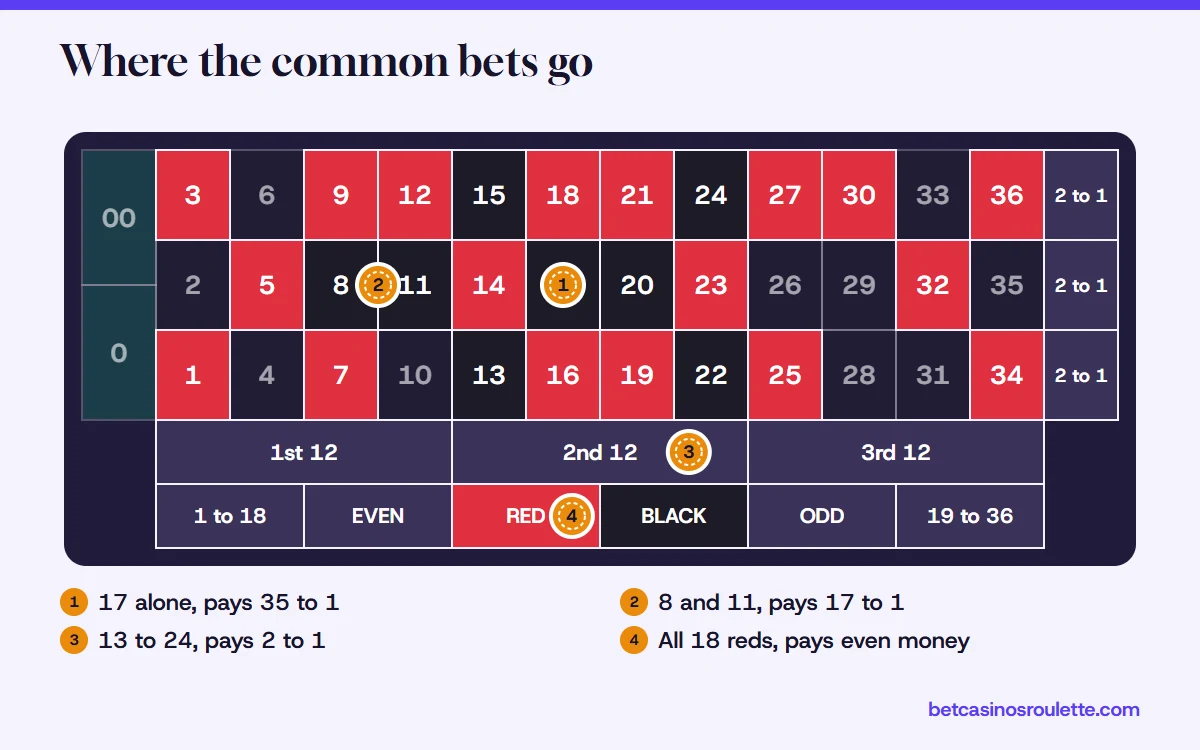
Roulette odds in one table
Each payout falls short of the fair price by a sliver, and that sliver is the house edge. Here is every standard bet, widest first, with its chance on both main wheels:
| Bet | Paid at | 1 unit comes back as | Single zero chance | Double zero chance |
|---|---|---|---|---|
| Any color, parity or half | 1 to 1 | 2 units | 48.65% | 47.37% |
| Any dozen, any column | 2 to 1 | 3 units | 32.43% | 31.58% |
| Double street of six | 5 to 1 | 6 units | 16.22% | 15.79% |
| Top line (American only) | 6 to 1 | 7 units | none | 13.16% |
| Corner, or first four | 8 to 1 | 9 units | 10.81% | 10.53% |
| Street or trio of three | 11 to 1 | 12 units | 8.11% | 7.89% |
| Pair split | 17 to 1 | 18 units | 5.41% | 5.26% |
| Lone number | 35 to 1 | 36 units | 2.70% | 2.63% |
Want the math behind each line? See payouts and odds for the working, and the probability page covers streaks and long runs.
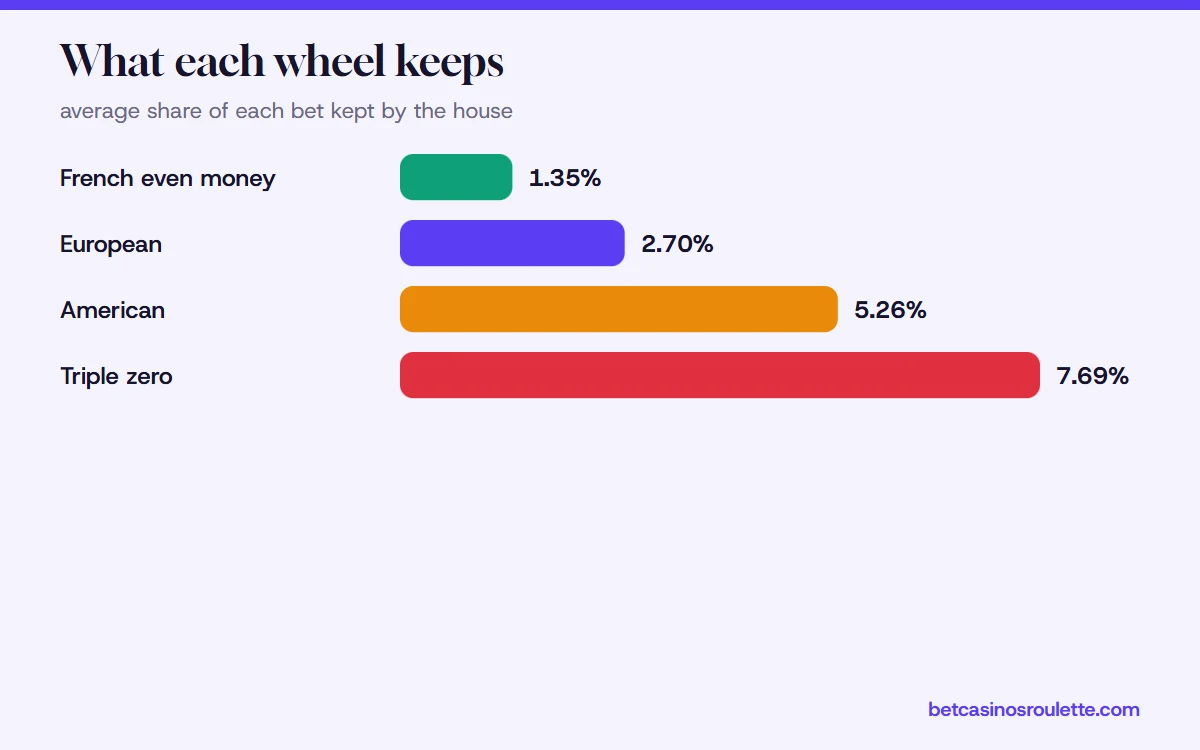
Why roulette always keeps a slice
Take a single zero wheel. A straight up bet has 1 winning pocket and 36 losing ones, so an even trade would return 36 for every 1 risked, yet the dealer hands over only 35. Over 37 bets of 1 unit you would, on average, win once and collect 36 units back, having spent 37. That missing unit, spread over 37 bets, is the 2.70% edge.
The same gap appears on every bet, because all payouts are worked out as if the zeros did not exist. That is why expected loss is simple to estimate: multiply the edge by everything you bet. Bet 1 unit per spin for 200 spins at a European table and the long run average loss is about 5.4 units. Swap to a 00 wheel and the figure roughly doubles to 10.5 units.
Free tools on this site
Every tool works in the browser, uses play credits or units, stores nothing and needs no account.
| Tool | Use it to | Find it on |
|---|---|---|
| Roulette table | Bet with play credits on a single zero table; the other game pages carry their own versions | Free roulette simulator |
| Wheel spinner | See pocket order and run 100 or 1,000 spins to watch hot and cold counts form | Spin the wheel |
| Interactive layout | Tap a bet type and see the payout, chance and edge for both wheels | Table layout |
| Payout calculator | Combine bets in units and see the return and expected loss per 100 spins | Payout calculator |
| System tester | Replay Martingale, Paroli and other systems across as many as 1,000 sessions and count how many end broke | Martingale |
Play: the game, the wheel and the table
Start here if you have never played, or if you want to know exactly what you will see at a table.
| Guide | What it covers |
|---|---|
| How to play | The full beginner route, from buying in to collecting a win |
| What is roulette | Meaning of the word, the parts of the game and where it came from |
| Free roulette simulator | A complete table with 1,000 play credits, no download |
| Spin the wheel | A spinner in true pocket order with 100 and 1,000 spin buttons |
| Table layout | Tap any bet and watch the covered numbers light up |
| Wheel numbers | How many numbers, which ones are red, and why the order looks scrambled |
| American roulette | The double zero game found at most US tables |
| European roulette | The single zero game and its lower edge |
| French roulette | French names on the cloth plus the half back rules on zero |
| Triple zero roulette | The 39 pocket wheel and why it costs the most |
| American wheel | The 38 pocket order, with 0 and 00 facing each other |
| European wheel | The 37 pocket order and how its colors alternate |
| Roulette chips | Colored wheel chips, how their value is set and cashing out |
| Table limits | Minimums, maximums and how the inside rule differs from the outside one |
| Roulette in Las Vegas | What to expect at a Nevada table before your first spin |
| California roulette | Why some California tables use cards to pick the number |
Bets: every place a chip can go
One page per bet, each with a layout picture, the payout, the chance on each wheel and common mistakes.
| Bet | In short |
|---|---|
| All roulette bets | Every chip position on one page, with payouts |
| Inside bets | Bets on the numbered grid, from one number to six |
| Outside bets | Colors, dozens, columns and the other wide bets |
| Straight up bet | One number, the 35 to 1 bet |
| Split bet | Two touching numbers on one chip |
| Street bet | A row of three across the grid |
| Corner bet | Four numbers that meet at one point |
| Six line bet | Two rows side by side, six numbers |
| Basket bet | The zero bets whose name changes from place to place |
| Dozens and columns | Twelve numbers at a time, at a 2 to 1 price |
| Red or black | The most played bet and what zero does to it |
| Call bets | Voisins, tiers and orphelins, the sections of the wheel |
| Green 0 and 00 | What the green pockets are and how to bet on them |
| Best bets | Which bets cost the least, ranked by edge |
Odds: payouts, probability and the edge
The numbers behind the game, worked out step by step.
| Page | The question it answers |
|---|---|
| Payouts and odds | What each bet returns and how often it should hit |
| Payout calculator | Add your bets in units and see the return and expected loss |
| Roulette probability | Streaks, misses and the chance of any outcome |
| Casino house edge | Where the edge comes from and what it costs per hour |
| Casino games with best odds | How roulette ranks against other table games |
| Is roulette rigged | How wheels and number generators are tested |
| Best numbers | Why no number is luckier than another |
| Roulette prediction | What past results can and cannot tell you |
Strategy: systems tested honestly
Each system page explains the rules, shows a winning run and a losing run in units, and opens the tester with that system loaded.
| System or guide | What you will find |
|---|---|
| Roulette strategy | What a plan can control and what it never will |
| Betting systems | Every popular progression, side by side |
| How to beat roulette | The honest answer, with numbers |
| Roulette tips | Practical habits that cut the cost of playing |
| Strategy chart | One chart comparing systems by risk and reward |
| Small bankroll | Making 100 units last longer |
| Martingale | Double after a loss, and where it breaks |
| Fibonacci | A slower climb through 1, 1, 2, 3, 5 |
| Paroli | Press wins, not losses |
| Labouchere | The crossing off line system |
| James Bond strategy | The 20 unit pattern that covers 25 numbers |
| Romanosky | Two dozens and two corners, 32 numbers |
Questions players ask
How do you pronounce roulette?
Say roo-LET, with the stress on the second part. The word comes from French and means little wheel.
What are the best roulette tactics?
The tactics that help are about cost, not winning more often. Choose a single zero wheel, use even chance bets at a French table with the half back rule when you find one, and set a stopping point in advance. No tactic turns the house edge in your favor.
Can you win at roulette?
You can win in a single session, since short runs swing both ways. Over many spins the average result moves toward a loss equal to the house edge times the total amount bet. That is true for every bet and every system.
What does 17 black mean in roulette?
It is a straight up bet on the number 17, which is black on the layout. It pays exactly what every other single number pays. It is popular because it sits in the middle of the grid, not because it wins more often.
What is the roulette marker?
It is a small weighted piece, often called the dolly, that the dealer places on the winning number after the ball lands. While it is on the layout, nobody may touch chips. Once winners are paid, it comes off and betting opens again.
Is online roulette real or fake?
Licensed electronic roulette uses either a real wheel on camera or number generating software that outside labs have checked. Gaming regulators, for instance those overseeing Nevada and Britain, insist on that testing. The house edge still applies in exactly the same way.