
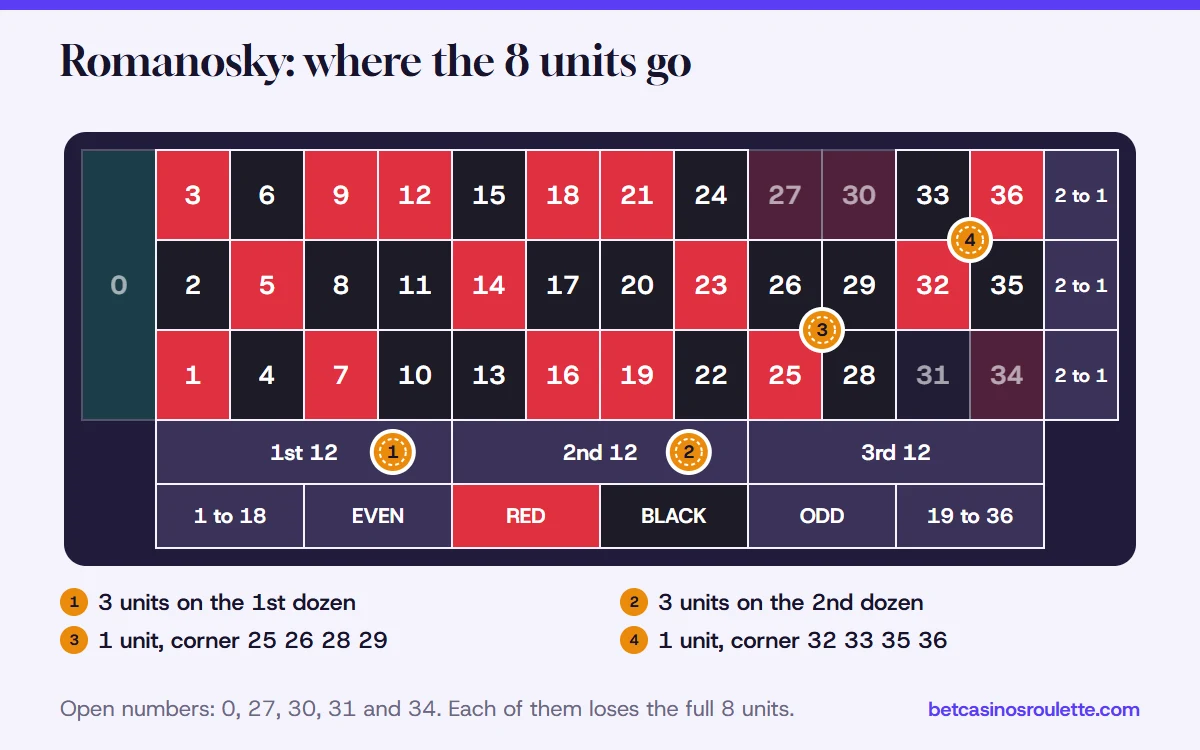
Romanovsky roulette is a flat betting spread that puts 3 units on each of two dozens and 1 unit on each of two corners in the third dozen, so 8 units blanket 32 out of 37 European pockets. It wins small on most spins and loses all 8 units on the other five numbers. You will also see it spelled Romanosky; it is the same bet.
The appeal is obvious: about 86 spins in 100 are winners. The catch is that each win nets 1 unit and each loss costs 8. Below is the exact chip map, the result for every number, and how a hundred thousand computer sessions turned out.
At the table
Stake per spin
8 units: 3 + 3 on two dozens, 1 + 1 on two corners.Numbers covered
32 of 37 on a European wheel (86.49%), 32 of 38 on an American wheel (84.21%).Win
Plus 1 unit on any covered number.Loss
Minus 8 units on the 4 open numbers and zero (and 00).House edge
2.70% single zero, 5.26% double zero. Unchanged by the spread.Loss per spin on average
About 0.22 units single zero, 0.42 units double zero.
Romanovsky roulette chip placement, step by step
The classic layout leaves the third dozen mostly open and covers it with two corners. Here is the version I use for every number on this page.
- Put 3 units on the 1st dozen (1 to 12).
- Put 3 units on the 2nd dozen (13 to 24).
- Put 1 unit on the corner 25, 26, 28, 29, on the cross where those four squares meet.
- Put 1 unit on the corner 32, 33, 35, 36.
That is 8 units in total. The numbers left bare are 27, 30, 31, 34 and the zero. Any two dozens work the same way, as long as the two corners sit inside the dozen you skipped and do not overlap.
Every possible result of one spin
Here is the full settlement table. Winning dozens return twice their stake as profit, winning corners eight times theirs, and that pairing is why every hit lands on exactly plus 1.
| Ball lands on | Count | Winning chip | Paid | Chips lost elsewhere | Net |
|---|---|---|---|---|---|
| 1 to 12 | 12 | 1st dozen (3) | 6 | 3 + 1 + 1 | plus 1 |
| 13 to 24 | 12 | 2nd dozen (3) | 6 | 3 + 1 + 1 | plus 1 |
| 25, 26, 28, 29 | 4 | first corner (1) | 8 | 3 + 3 + 1 | plus 1 |
| 32, 33, 35, 36 | 4 | second corner (1) | 8 | 3 + 3 + 1 | plus 1 |
| 27, 30, 31, 34 | 4 | none | 0 | all 8 | minus 8 |
| 0 | 1 | none | 0 | all 8 | minus 8 |
| 00 (American only) | 1 | none | 0 | all 8 | minus 8 |
Coverage, then, is 32 numbers. On a European wheel that is 86.49% per spin, leaving five bare pockets, a 13.51% miss rate. On an American wheel the extra 00 pushes the miss chance to 6 in 38, or 15.79%.
Why an 86% hit rate still loses over time
Do the sum over a perfect cycle of 37 spins where every pocket shows once. The 32 covered numbers earn 32 units. The five bare ones cost 5 times 8, which is 40 units. Net: minus 8 units for 296 units wagered. That is 2.70%, exactly the edge of any single bet on the same wheel. Spreading chips does not dilute it.
The shape is the trap. One miss wipes out eight wins, and you need a ninth win to get back above where you were. The chance of reaching ten spins without a single miss is only 23.41%, so in roughly three runs of ten spins out of four, at least one 8 unit hit arrives.
- Single zero: average loss about 0.22 units per spin (8 times 2.70%).
- Double zero: about 0.42 units per spin (8 times 5.26%), almost double.
Romanosky roulette strategy sessions: what 100,000 runs showed
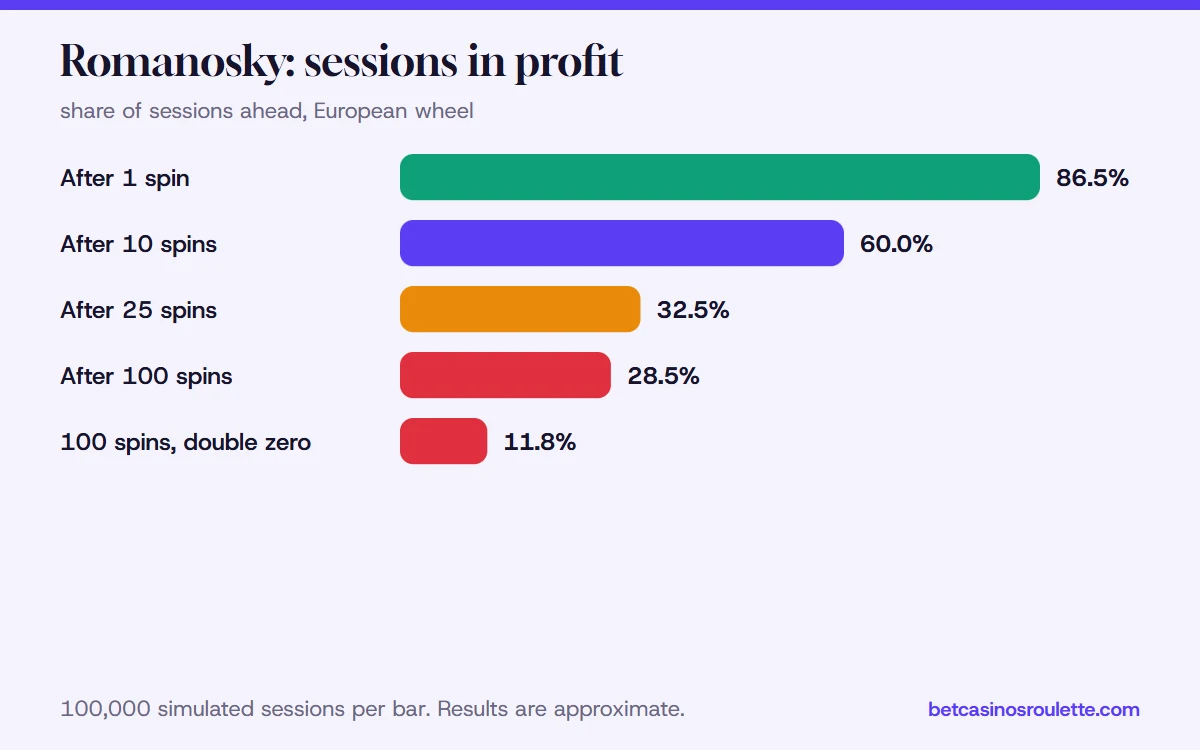
I simulated the spread with a 96 unit stake (twelve rounds of 8) on both wheels. The session stops at a fixed spin count or when fewer than 8 units remain. Treat the figures as approximate; a direct binomial count landed almost on top of them.
| Session length | Ahead, one zero | Ahead, two zeros |
|---|---|---|
| 1 spin | 86.49% | 84.21% |
| 10 spins | 60.00% | 51.56% |
| 25 spins | 32.5% | 22.1% |
| 50 spins | 31.5% | 17.8% |
| 100 spins | 28.5% | 11.8% |
Over 100 spins on the European wheel the average session ended about 21.6 units down, and 3.0% ran out of chips. On the American wheel the average was about 41.1 units down, and 11.3% busted. The spread feels safe spin to spin, yet after a full evening most sessions are behind.
Other ways to place the Romanovsky roulette system
Because only the pattern matters, you can rotate the spread around the layout. Three common placements:
| Dozens with 3 units | Corners with 1 unit | Numbers left open |
|---|---|---|
| 1st and 2nd | 25, 26, 28, 29 and 32, 33, 35, 36 | 0, 27, 30, 31, 34 |
| 1st and 3rd | 14, 15, 17, 18 and 19, 20, 22, 23 | 0, 13, 16, 21, 24 |
| 2nd and 3rd | 2, 3, 5, 6 and 7, 8, 10, 11 | 0, 1, 4, 9, 12 |
Choosing one over another changes nothing about the odds. Every version covers 32 numbers and pays plus 1 or minus 8. If you want to see how a single corner is placed and paid, the corner bet guide has it, and dozens and columns explains the 2 to 1 boxes.
Try the Romanosky spread on the system tester
This page's tester loads the Romanosky preset by default, and every chip in it is a play unit.
- Check the system reads Romanosky and choose the European wheel.
- Give it a bankroll of 96 and a base unit of 1, so each round stakes 8.
- Set the spin count to 100 and the number of sessions to 1,000.
- Press run. Expect something close to 28% of sessions ahead, a few percent busted, and an average near minus 22 units.
- Now flip the wheel setting to American and repeat. The share ahead should fall to roughly 12%.
Watch the single sample line it draws: a staircase up in steps of 1, then a cliff of 8. Run it a few times and the pattern becomes familiar.
Honest verdict on the Romanovsky roulette strategy
As a way to enjoy lots of small wins, it does what it says. As a way to profit, it fails like every other system, because it is simply four normal bets placed together. If you like it, three habits keep it sensible:
- Play it only on a single zero wheel. Double zero almost doubles the cost.
- Keep the stake at twelve rounds or more, so one bad patch does not end the visit.
- Name your stopping loss and your finishing hour before buying in, and honor whichever arrives first.
For context on how this spread compares with progressions and other patterns, see the roulette strategy chart and the wider roulette strategy guide.
Questions players ask
What is the Romanovsky roulette system?
It is a fixed spread of 8 units: 3 on each of two dozens and 1 on each of two corners in the third dozen. It covers 32 numbers, wins 1 unit when any of them hits, and loses 8 units on the rest.
Does the Romanosky roulette strategy work?
It wins often but does not make a profit over time. A lone zero still hands the casino 2.70%, which works out near 0.22 units lost per spin. In 100 spin simulated sessions, about 28.5% ended ahead.
Is it Romanosky or Romanovsky?
Both spellings are used for the same system. The bets and the math are identical.
What happens when zero lands?
Zero is not covered by any of the four chips, so all 8 units are lost. On an American wheel 00 is uncovered too, which is why the system costs more there.
Can I use the Romanovsky system on an American wheel?
You can place it the same way, but it covers 32 of 38 numbers instead of 32 of 37. The casino's slice climbs to 5.26%, and the share of 100 spin sessions ending ahead dropped to about 11.8% in the simulation.
How big a bankroll does Romanosky need?
Each round needs 8 units, and one miss costs all of them. A stake of 96 units, or twelve rounds, busted in about 3% of 100 spin sessions on a single zero wheel. Smaller stakes bust far more often.