
This roulette payout calculator tells you, before the ball drops, what each of your bets pays, how likely it is to win and what the whole spread costs you on average. It covers both the European and American wheels, any mix of inside and outside bets, and stakes in units. No sign in, nothing stored.
At the table
Inputs
Wheel type, bet type, numbers and stake in units. Add as many bets as you like.Outputs
Payout if each bet wins, chance of winning, expected loss per spin and per 100 spins.Payout math
Win = stake times the pay. You also keep the stake.Cost math
Expected loss = total staked times the edge: 2.70% or 5.26%.Limits
It prices bets. It cannot forecast the next number.
How the roulette payout calculator works
The tool sits just above this section. Think of it as a roulette odds calculator and a roulette bet calculator in one. It takes four quick steps.
- Choose the wheel. European means one zero, American means 0 and 00.
- Add a bet: pick the type, tap or type its numbers, and enter the stake in units.
- Repeat for every chip you plan to place on the same spin.
- Read each line's payout and chance, then the totals: average cost for a single spin and across a hundred.
If you are not sure where a bet sits on the felt, the table layout page shows every spot, and the roulette payouts chart lists the pay for each one.
Worked example: several bets on one spin
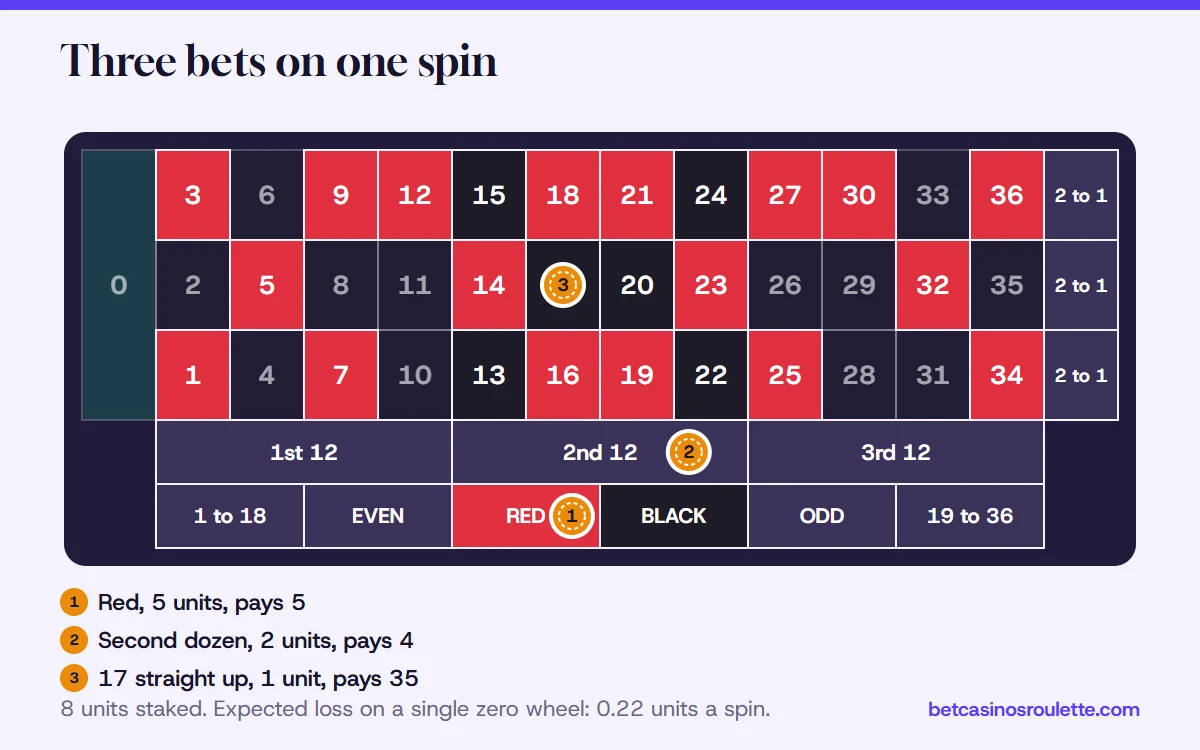
Say you place 5 units on red, 2 units on the second dozen (13 to 24) and 1 unit on 17, which is black, at a European table. That is 8 units on the table. The results split into five groups depending on where the ball lands.
| Ball lands on | Pockets | What wins | Net |
|---|---|---|---|
| 17 | 1 | Dozen and the straight up | +34 |
| Red, 13 to 24 | 6 | Red and dozen | +8 |
| Red, outside 13 to 24 | 12 | Red only | +2 |
| Black, 13 to 24, not 17 | 5 | Dozen only | -2 |
| Other black numbers and zero | 13 | Nothing | -8 |
You come out ahead on 19 of 37 pockets, which feels good. Yet the average over all 37 pockets is a loss of 0.22 units a spin, 21.62 units per 100 spins. That is exactly 2.70% of 8 units. On an American wheel the same spread loses 42.11 units per 100 spins. Mixing bets changes how often you win, never what you pay.
The formulas the calculator uses
You can check any result on paper with four lines.
- Win: stake times the pay. 3 units on a street at 11 to 1 wins 33.
- Total back: the win plus the stake. That street returns 36 units.
- Chance: how many numbers you cover, over the pocket count. A street is 3 in 37, or 8.11%.
- Expected loss: total staked times the edge. 3 units at 2.70% is about 0.08 units a spin.
Use 2.70% for a European wheel and 5.26% for an American one, with one exception: the American five number bet costs 7.89%.
35 to 1 payouts and the green pocket
A straight up chip pays 35 times its size. Green numbers count as straight ups too, so a chip on 0 or 00 is priced the same way.
| Chip size | Win | In front of you after |
|---|---|---|
| 1 unit | 35 | 36 |
| 5 units | 175 | 180 |
| 10 units | 350 | 360 |
| 25 units | 875 | 900 |
When zero lands, outside bets lose. French rules are the exception: under la partage a zero takes only half of an even money stake, so a 10 unit bet on black hands back 5 units. The calculator here uses standard rules.
Using it as a house edge calculator
The expected loss lines are a house edge calculator in disguise. They show what the game costs you per hour of play, in units. Suppose you stake 2 units per spin across 200 spins, so 400 units go into action. The European wheel's average bill is 10.81 units. The American wheel's is 21.05 units. Same stake, same time, double the price.
The bigger idea behind that number, and how it compares with other games, is on the casino house edge page.
What no roulette calculator can do
A calculator prices bets. It cannot tell you which number comes next, and neither can any "algorithm calculator" sold online. A fair wheel gives every pocket the same chance every spin. For more on that, see roulette prediction, and for chances over many spins, try the roulette probability streak tool. When you want to see the numbers play out, spin with play credits on the free simulator.
Questions players ask
How do I calculate a roulette payout?
Multiply your stake by the pay for that bet, then add your stake back. A 4 unit corner at 8 to 1 wins 32 units, so 36 units come back to you. The calculator does this for every bet at once.
Can the calculator handle multiple bets on one spin?
Yes. Add as many lines as you need and it shows each payout plus the combined expected loss. The total cost is always the sum staked times the house edge for that wheel.
What does a 35 to 1 payout give on 10 units?
It wins 350 units, and your 10 unit chip stays yours, so 360 units in all. The same math applies to a chip on 0 or 00.
Does the calculator work for American roulette?
Yes. Choose American and the tool counts 38 pockets. Payouts stay the same, chances drop slightly and the expected loss nearly doubles.
Can a roulette calculator predict the next number?
No. It works out payouts, chances and cost from fixed math. On a fair wheel no tool, chart or app can know the next pocket.