
The best roulette strategy is to play a single zero wheel, size your bets so the bankroll lasts, and set a firm stop, because no betting system or pattern can beat the house edge on any bet. That is not a gloomy answer. It tells you which decisions are worth your attention and which ones are noise.
When I dealt, players asked me for a system almost every shift. What actually separated a pleasant evening from a painful one was simpler: the wheel they sat at, how much they bet each spin, and whether they quit on time. This hub links every strategy guide on the site, with test results for each.
At the table
Can a strategy beat roulette?
No. Each spin pays less than fair oddsBiggest choice you control
The wheel: 2.70% single zero vs 5.26% double zeroLowest edge available
About 1.35% on even money bets with la partage or en prisonBet to avoid
The American five number bet, 7.89%Systems tested
Seven, 100,000 sessions each, all lost about 2.7% of stakesExpected loss
Edge times total staked: 100 single zero bets of 1 unit lose about 2.7
What a roulette strategy can and cannot do
Every bet on the table is priced slightly below fair. With one green pocket, any single number hits once per 37 spins over the long haul, so breaking even would need 36 to 1. The table pays 35 to 1. The missing unit is where the casino earns its keep: 2.70% of the stake, whether you bet red, a corner or a dozen. No sequence of bets can add up negative numbers into a positive one.
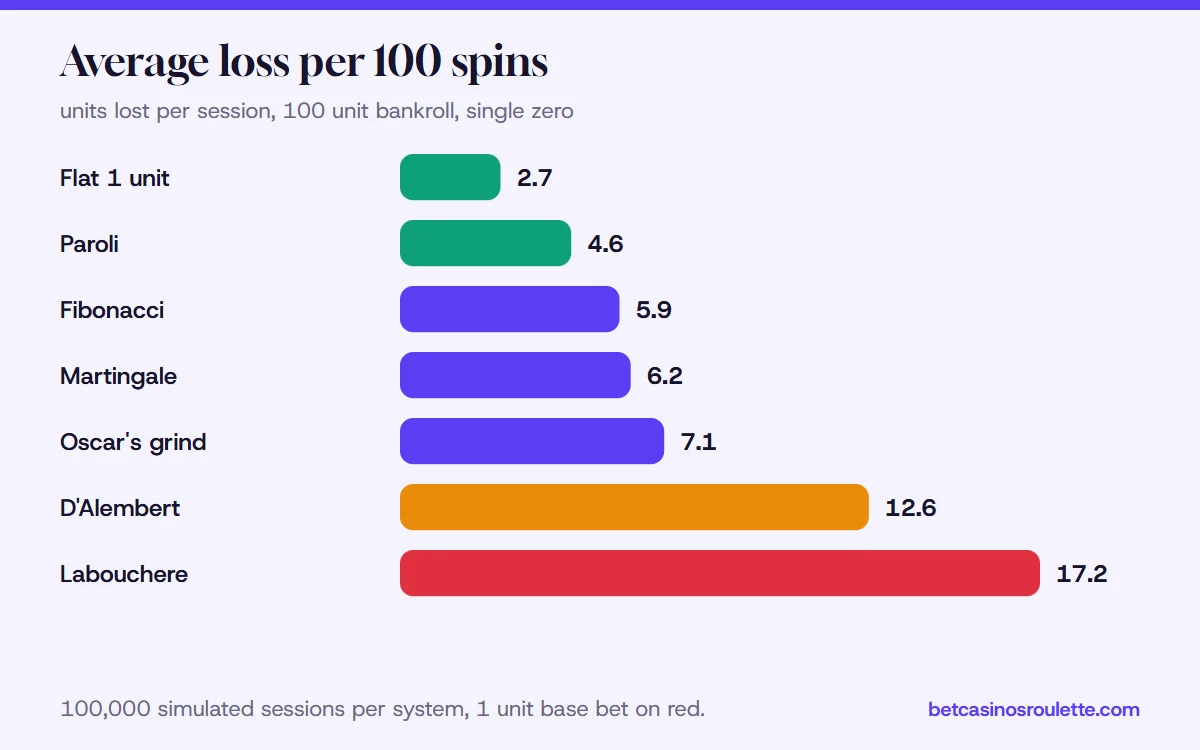
What a strategy can do is shape the ride. It can make winning sessions common and losing ones rare but deep, or the reverse. It can make your chips last longer or burn faster. It can stop you before tiredness makes the decisions for you. The chart shows what seven popular approaches cost on average over 100 spins of a single zero wheel.
Every roulette strategy guide on this site
| Topic | Guide | What you get |
|---|---|---|
| Overview | Roulette betting systems | All systems compared, plus D'Alembert and Oscar's grind |
| Raise after losses | Martingale | Doubling, the bankroll it needs, table limits |
| Raise after losses | Fibonacci | The 1, 1, 2, 3, 5 sequence and its chart |
| Raise after losses | Labouchere | The line method, cleared and failed lines |
| Raise after wins | Paroli | Three win streaks and why losses stay small |
| Coverage patterns | James Bond strategy | 20 units over 25 numbers |
| Coverage patterns | Romanosky | 8 units over 32 numbers |
| Practical play | Roulette tips | Habits that protect your bankroll at the table |
| Practical play | How to beat roulette | What is possible, what is a myth |
| Practical play | Small bankroll | Making a bankroll of 100 units last |
| Quick reference | Strategy chart | Every bet and system on one page |
The roulette strategy that matters most: pick the wheel
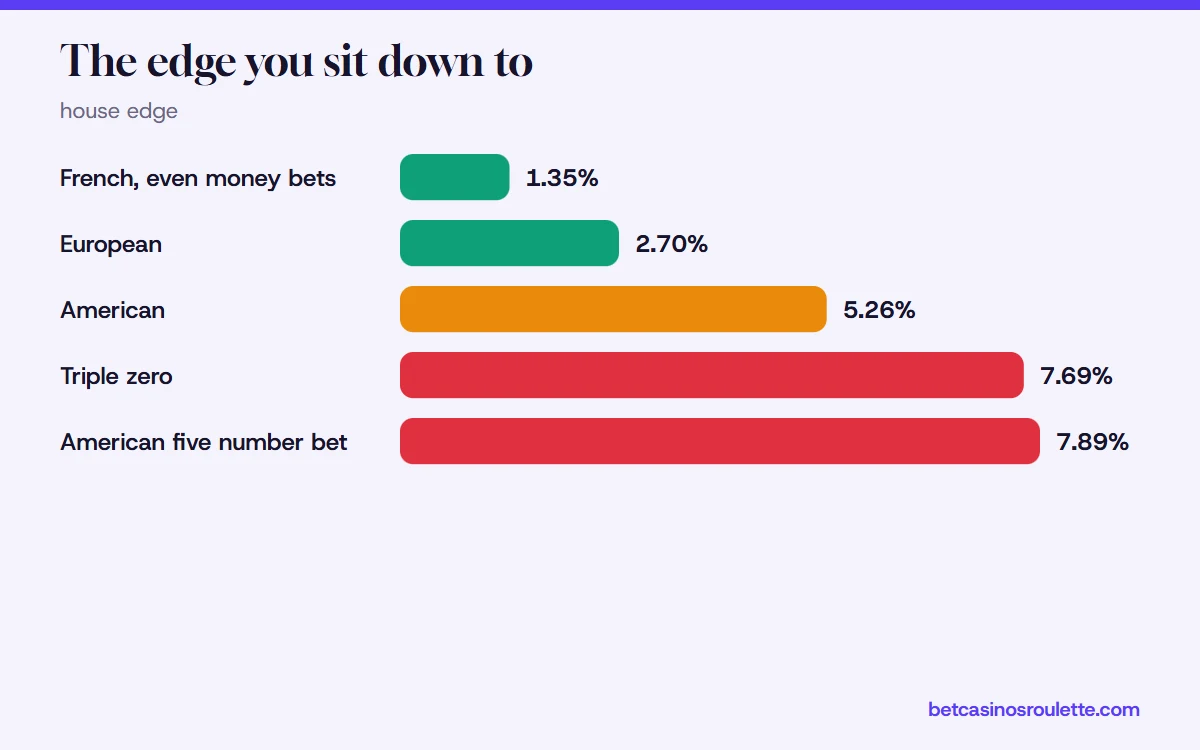
One decision changes your expected loss more than every system combined. A double zero wheel takes 5.26% of each bet, almost twice the single zero rate. Under French rules, la partage gives back half of a red, black or other even chance stake when the ball finds zero, and en prison holds that stake for one more spin instead. Either rule trims the cost of those bets to about 1.35%. A triple zero wheel takes 7.69%.
In plain units: 100 spins at 1 unit costs about 2.7 on a European wheel, 5.3 with the extra double zero and 7.7 on a triple zero table, on average. If a single zero table is available, it is the best roulette strategy there is. Read more on the European wheel and French roulette.
Bet choice: same edge, a different ride
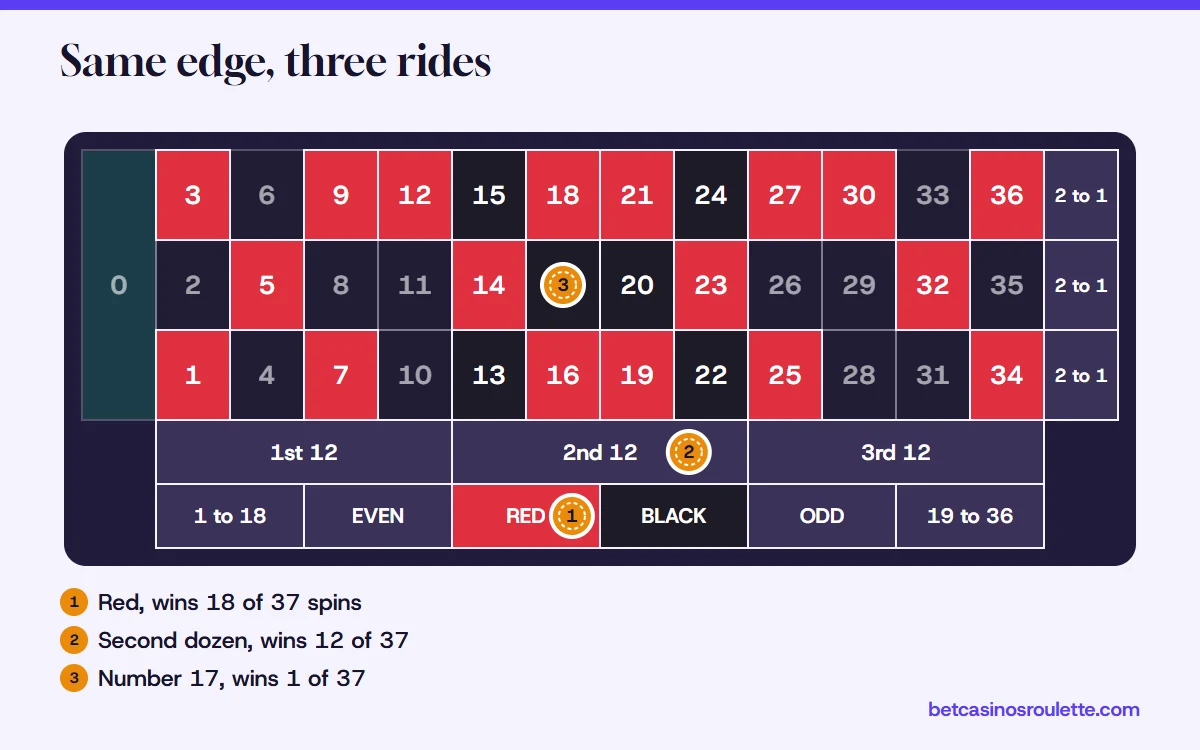
On any one wheel, every bet has an identical edge, the five number bet aside. What changes is how lumpy the results are. I worked out the exact chance of being ahead after 100 flat bets of 1 unit:
| Bet every spin | Pays | Ahead after 100, single zero | Ahead after 100, double zero | What the ride feels like |
|---|---|---|---|---|
| Red | 1 to 1 | 35.53% | 26.50% | Small swings, slow drift down |
| A dozen | 2 to 1 | 40.53% | 33.58% | Medium swings |
| One number | 35 to 1 | 50.94% | 49.16% | Long droughts, big jumps |
A straight up bettor finishes ahead slightly more often here, yet loses the same 2.7 units on average, because the losing sessions are harsher: in roughly 6.46% of sessions the number never shows in 100 spins and all 100 units are gone. The full list of bets explains each one, and best roulette bets compares them.
Is there a most successful roulette strategy?
It depends on what you call success. If it means ending most sessions ahead, the Fibonacci did best in our tests, with roughly three sessions in four finishing up. If it means losing the least, flat betting won, at about 2.7 units per 100 spins. No approach did both, and none had a positive average.
That trade is the honest core of every system. The ones with a high win rate hide a small chance of a large loss inside the average. The ones that never blow up rarely produce a big night. Pick the shape you can live with, then keep the stake small enough that the bad tail does not hurt. The strategy chart lays the options out on a single page.
How to win at roulette: the parts you control
You cannot control the ball. You can control everything around it:
- Wheel: single zero, or French rules for the outside even chances.
- Stake size: small enough for at least a few hundred spins of play.
- Stop rules: a loss limit, a time limit, and a win point where you leave.
- Pace: fewer spins per hour means less money exposed to the edge.
- Bets to skip: the five number bet, and side games with worse odds.
More practical habits are in roulette tips, and the honest limits of beating the game are in how to beat roulette. If you are working with a short stack, roulette strategy for a small bankroll shows how to stretch it.
Online and American roulette strategy
Licensed online and electronic games get their results from certified random generators or from a live wheel streamed to your screen, and regulators insist on the testing. Nothing about the math differs from a casino floor: same payouts, same edge, no memory between spins. So the same approach applies. Look for the single zero version, avoid fast auto play if you want your bankroll to last, and ignore anyone selling a pattern.
On an American wheel, each wager gives up 5.26%, and the five number bet (0, 00, 1, 2, 3) gives up 7.89%. Systems behave the same way there, only worse: in the Martingale test, sessions ran out of chips about 55% of the time instead of 50%.
Winning numbers history and hot streaks
The board showing the last results is there because players like it, not because it helps. Each spin is independent. A streak of ten reds shows up roughly once per 1,350 attempts with one zero, and the eleventh spin still gives red 18 chances in 37. Hot and cold numbers are a normal side effect of randomness: try the wheel spinner with Spin 1,000 and watch some numbers come up twice as often as others for no reason. Roulette prediction covers the myths in more depth.
Test any roulette strategy on the free simulator
Flat betting is what loads first in the tester above, because it is the plain baseline every other approach should be measured against. A useful first run:
- Bet 5 units flat from a 500 unit bankroll on the European wheel, with sessions of 200 spins, 1,000 times over.
- Press run. The average result should land near minus 27 units, which is 2.7% of the 1,000 units staked per session.
- Switch the system to Martingale, then Fibonacci, keeping every setting. Compare the share ahead, the broke share and the average.
- Finally, try the same settings on the American wheel.
If a strategy only looks good in the sample session line, run more sessions. Over 1,000 sessions the edge always shows. For a hands on feel, the free roulette table lets you place any of these bets with play credits.
Set your limits before the first spin
The single most effective strategy habit costs nothing. Pick a number you can afford to lose and an hour to stop, settle both at home, and walk away the moment one of them comes up. Never chase a loss with a bigger bet than you planned.
Questions players ask
What is the best roulette strategy?
Play a single zero wheel, bet amounts that let your bankroll last, and set a loss and time limit before you start. Where French half back rules apply, the even chances cost about half as much. No betting system improves on that.
Is there a roulette strategy that works every time?
No. Every bet is priced below fair, so any mix of bets loses on average. In our tests seven systems all lost close to 2.7% of their action on a European table.
What is the best mathematical roulette strategy?
The lowest price wins: about 1.35% for even chances under French half back rules, then 2.70% for anything on a European table. Putting fewer total units into action also shrinks the expected loss, because that loss equals the edge multiplied by your action.
How do you win at online roulette?
You can win a session through luck, but no method wins over time. Licensed online games use tested random results and pay the same as a live table. Choose a single zero game, keep stakes small and quit at a preset limit.
Does the roulette double up strategy work?
That is the Martingale. Small wins pile up, then one large loss arrives when a losing streak meets the bankroll or the table maximum. In testing, half of the 100 spin sessions from a 100 unit stack could not afford the next doubled bet.
What are the best odds to win at a casino roulette table?
The six even money chances come in on 48.65% of spins with one zero (18 of 37), or 47.37% with two (18 of 38). A dozen or column comes in about 32% of the time. Higher chances come with lower payouts, and the edge stays the same.
Is there a roulette strategy simulator?
Yes. The tester on this page can play up to a thousand sessions of any system right in your browser, using play credits. Choose a system, adjust the settings and compare how each one ends.