
Roulette prediction does not work on a fair wheel or a properly tested random number generator, because each spin is independent of every spin before it. A predictor app can read past numbers, draw charts and suggest bets, but it cannot raise your chance above what the pockets allow: 1 in 37 for one number on a European wheel. Here is why, and how to test any predictor yourself without risking a thing.
At the table
Can it be done?
Not on a fair game. Past spins carry no information about the next.Best possible guess
One number: 2.70% single zero, 2.63% double zero.Predictor apps
They only reshuffle past results. Their hit rate matches random picks.Devices
Using one to forecast a casino game is illegal in Nevada.Free test
Track a predictor's picks on a simulator for a few hundred spins.
Roulette prediction: what the math allows
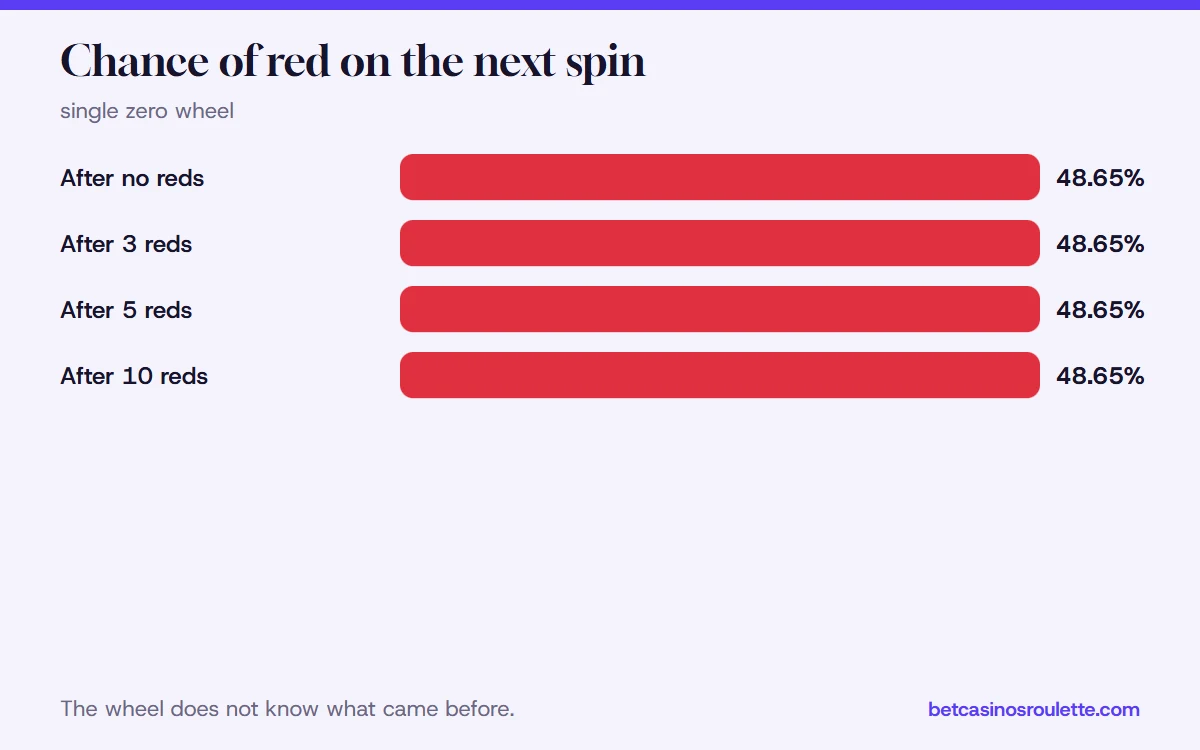
A prediction only works if the past tells you something about the future. On a roulette wheel it does not. The ball lands in one of 37 or 38 equal pockets, and the wheel holds no record of earlier results. So the chance of red after ten reds is the same as after ten blacks, or after nothing at all.
That sets a hard ceiling. Name one number and the ceiling is 2.70% at a European table. Name twelve and it rises to 32.43%. No method can beat those figures, because they come from counting pockets, not from guessing.
How roulette predictor apps and software work
Most roulette prediction software follows the same recipe. You type in the last numbers, or the app reads them from a results screen. It looks for patterns: hot numbers, cold dozens, repeating sectors. Then it suggests what to bet next.
The problem is the input. Past results from a fair game are random, so any pattern the app finds is a pattern in noise. Say an app tells you to bet a dozen each spin. Any dozen hits 32.43% of European spins, whether an app picked it, you picked it, or a coin did. Over 370 spins you should expect about 120 wins from any dozen pick, and the app will average the same.
Is there a roulette prediction formula?
There are real roulette formulas, but they describe chance, not the future.
- Chance: pockets that win split by pockets in total. A corner gives 4 winners among 37, 10.81%.
- Payout: 36 divided by numbers covered, minus 1. A corner works out to 8 to 1.
- Expected loss: stake times the house edge. A 10 unit stake at European odds costs about 0.27 units per spin.
Formulas sold as prediction systems usually take a form like "bet the dozen that has missed six spins in a row." Six straight misses for one dozen come along in 9.52% of cases at a European table, so it feels rare. But the seventh spin still gives that dozen a 32.43% chance, no more. The roulette probability page shows how to work out these numbers.
Roulette prediction charts and past results
Results screens and prediction charts look like data, so they feel useful. Think of them instead as a picture of randomness. Over 370 spins each number is expected about 10 times, yet the leader often reaches 17 or 18 and the tail sits around 4. Charts make that spread look meaningful. It is the normal shape of chance.
The best numbers guide shows a full session of this spread, and the is roulette rigged page covers why streaks look planned when they are not.
Ball tracking and prediction devices
Some players have tried to forecast where the ball will land by measuring its speed on a physical wheel. Casinos defend against this in plain ways: betting closes before the ball slows, varies the spin, and staff watch for unusual behavior. Nevada treats using or possessing a forecasting device in a casino as a criminal act. On an RNG game there is no ball to measure at all.
This is not a path worth looking for. The honest choices you can make, like picking one zero over two and fixing a budget, are on how to beat roulette.
Test any roulette predictor yourself, for free
You do not need to take my word for it. Put a predictor to a fair test with play credits.
- Open the free roulette simulator on a European wheel.
- Before each spin, write down the predictor's pick.
- Spin and mark hit or miss. Keep going for at least 370 spins.
- Compare. Single number picks should hit about 10 times in 370 spins, dozen picks about 120 times. A predictor close to those numbers is doing exactly what random guessing does.
| Kind of pick | Hit chance each spin | Hits a random guesser averages |
|---|---|---|
| One number | 2.70% | 10 |
| A split | 5.41% | 20 |
| A dozen | 32.43% | 120 |
| A color | 48.65% | 180 |
Run it twice with different starting points. You will see the predictor's "accuracy" bounce around the random average and never settle above it.
Where prediction claims leave your bankroll
The danger in a predictor is not the app itself. It is the confidence it gives. Someone who believes they can see the next number tends to bet bigger and play longer, and the house edge works on every unit bet. At European odds, 1,000 units bet costs about 27.03 units on average no matter what the screen suggested.
Questions players ask
Can roulette numbers be predicted?
Not on an honest wheel, and not on a certified random number generator either. Every spin is independent, so past numbers give no clue about the next one. No guess on one number can beat 2.70% at European odds.
Does roulette prediction software work?
No. It reads past results and finds patterns that are just random noise. Its picks win at the same rate as any other picks, and any fee it charges adds to your cost.
What is the best roulette predictor app?
There is no app that predicts a fair game, so there is no best one. A results tracker can be fun for watching patterns, but it cannot change the odds of the next spin.
Is there a formula to predict roulette?
There are formulas for chance, payout and expected loss, and they are exact. None of them can name an upcoming result, since results do not depend on earlier ones.
Is using a roulette predictor illegal?
Nevada law bans using or possessing devices designed to project casino game results. Rules differ by place. Apps that only show past results do not predict anything either way.