
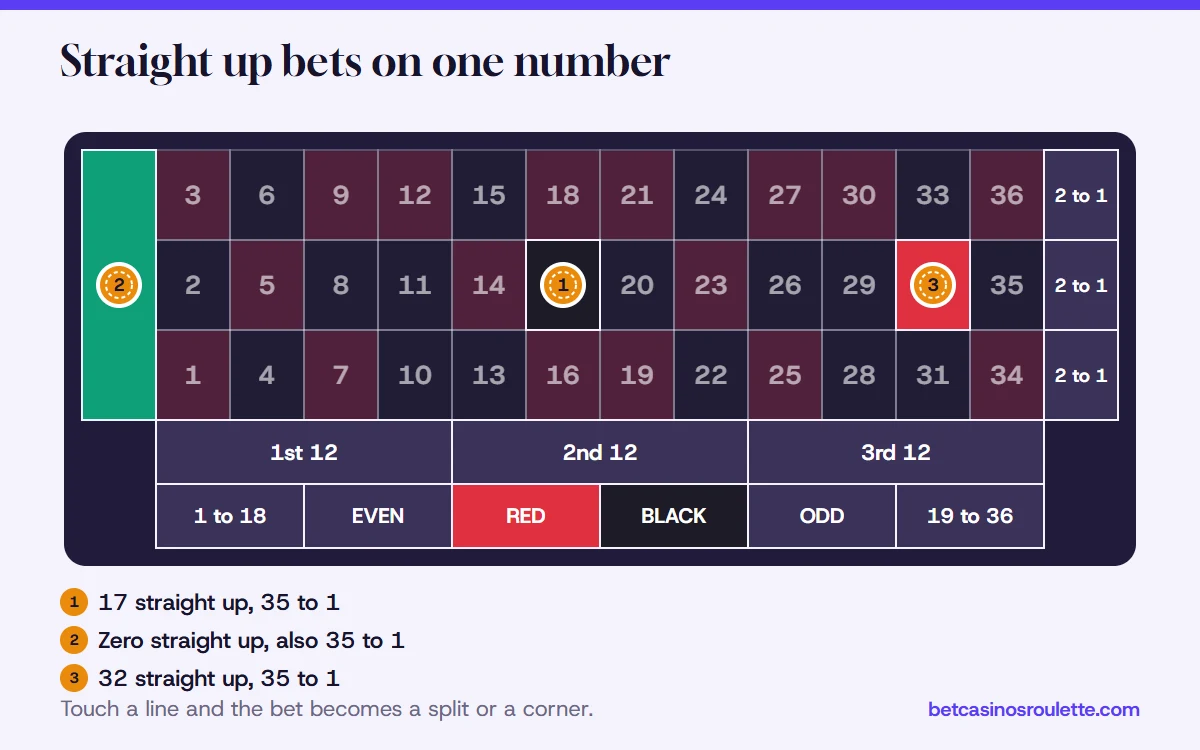
The roulette single number payout is 35 to 1: put 1 unit on one number, and if the ball drops into that pocket you are paid 35 units and you keep the unit you bet, so you end up holding 36 units. Dealers call this a straight up bet. It is the biggest standard payout on the table, and it is also the bet that most often leaves people wondering why a number they backed for an hour never showed. This page covers where the chip goes, the true odds on each wheel, why the payout is exactly one chip short of fair, and a few sessions worked out in units.
At the table
What it covers
One number: any of 1 to 36, the 0, or the 00 on an American tablePayout
35 to 1, so a 1 unit chip returns 36 units in totalChance, single zero wheel
1 in 37, which is 2.70% per spinChance, double zero wheel
1 in 38, which is 2.63% per spinHouse edge
2.70% on European and French wheels, 5.26% on AmericanChip placement
In the middle of the number's box, clear of every line
Where the chip goes for a straight up bet
Put the chip in the center of the box with your number printed in it. That is the whole skill. If the chip sits on a line, the dealer reads it as a split, a street or a corner instead, and those pay less. On a busy table, chips get nudged, so glance at yours before betting closes and the ball starts to slow.
You can back any box that holds a single number. With one zero that makes 37 choices: the numbers 1 to 36 plus the green 0. A double zero table gives you 38, because 00 has its own box. A triple zero table has 39. A zero is paid at exactly the 35 to 1 rate of any plain number, which surprises people who think green must pay extra.
If you want several numbers, each one needs its own chip. Five numbers straight up cost five chips. When you cannot reach the far end of the table, slide the chips toward the dealer and say the number out loud, for example "17 straight up, please". The dealer will place it for you before betting closes.
Roulette single number payout, chip by chip
The phrase "35 to 1" means the dealer pays 35 chips for every chip you risked, and your original chip stays yours. Some games quote "for 1" instead, which counts your stake inside the number. Roulette always quotes "to 1", so the money in front of you after a hit is 36 times your bet.
| Chips on your number | Dealer pays you | You then hold |
|---|---|---|
| 1 unit | 35 units | 36 units |
| 2 units | 70 units | 72 units |
| 3 units | 105 units | 108 units |
| 5 units | 175 units | 180 units |
| 10 units | 350 units | 360 units |
Dealers learn the 35 times table by heart, so they can stack a payout without a calculator: 2 chips is 70, 4 chips is 140, 7 chips is 245. If you are checking a payout, multiply your chips by 35 and add your stake back.
Single number odds on European, American and triple zero wheels
Your number is one pocket out of the whole wheel. That makes the odds easy to state but hard to feel. With 37 pockets you have 36 ways to lose and 1 way to win, so the odds against you are 36 to 1. Add the 00 pocket and they stretch to 37 to 1. The payout stays at 35 to 1 everywhere, and that gap is where the house earns its keep.
| Wheel | Pockets | Your chance | Odds against | A fair price would be | House keeps |
|---|---|---|---|---|---|
| European or French | 37 | 2.70% | 36 to 1 | 36 to 1 | 2.70% |
| American | 38 | 2.63% | 37 to 1 | 37 to 1 | 5.26% |
| Triple zero | 39 | 2.56% | 38 to 1 | 38 to 1 | 7.69% |
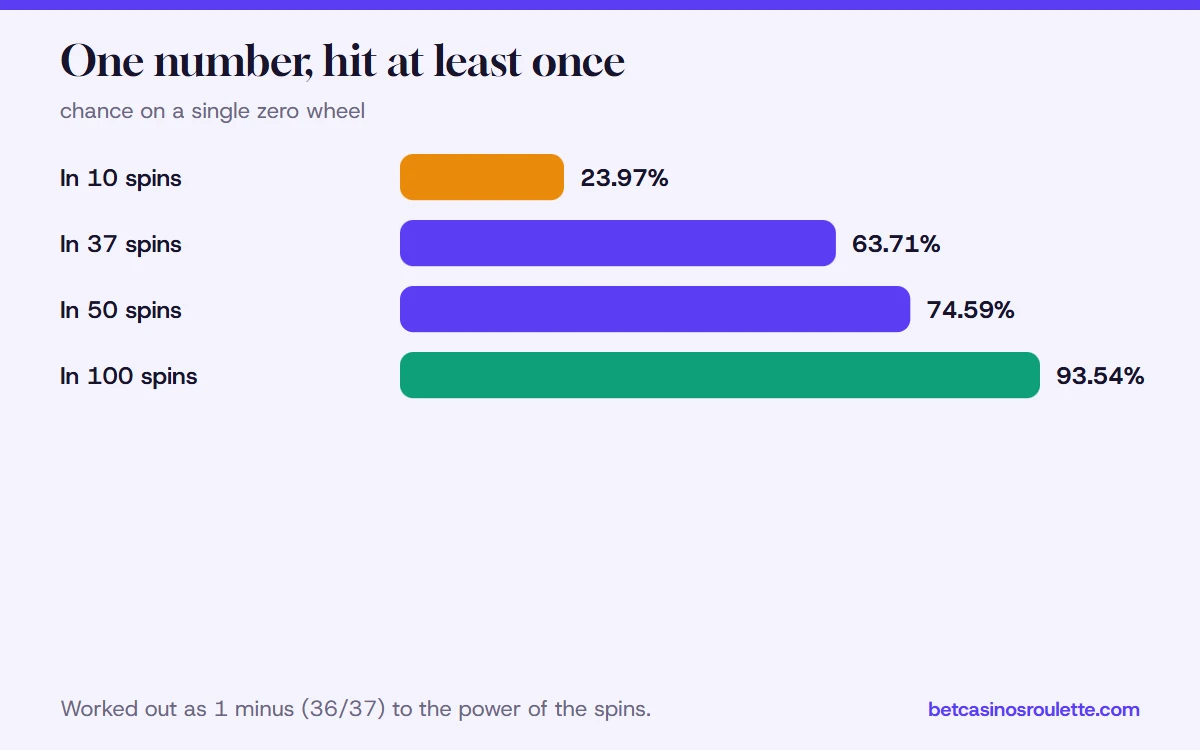
A number also takes a while to come up. The chart below shows how likely it is to see your number at least once over a run of spins on the European wheel. Even after 100 spins there is about a 6.46% chance it never lands at all, and with 0 and 00 in play that rises to 6.95%.
Why the payout is 35 to 1 and not 36 to 1
Picture a player who puts 1 unit on every pocket of a single zero wheel. That costs 37 units. Whatever number lands, one chip wins and returns 36 units. The player is down 1 unit on every spin, no matter what. That missing unit, 1 out of 37, is the 2.70% house edge.
Try the same trick where 00 sits beside 0 and you need 38 units to cover everything, but the winning chip still returns only 36. Now 2 units vanish each spin, 2 out of 38, which is 5.26%. Nothing about your number choice changes this. Hot numbers, birthdays and the zero all carry the same edge, because they all pay the same price for the same one pocket.
Worked examples: a session on one number
Say you back 17 with 1 unit for 37 straight spins of a European wheel, 37 units in all. Here is how the session can end:
- 17 never lands: you are down 37 units. This happens about 36.29% of the time over 37 spins.
- 17 lands once: you get back 36 units, so you finish 1 unit down.
- 17 lands twice: 72 units back, so you finish 35 units up.
The average result over many such sessions is a 1 unit loss, which is the 2.70% edge on 37 units. Most sessions are either a clear loss or a clear win, not a gentle drift, and that is what a single number feels like in real play.
Now spread out instead: 1 unit on each of five numbers, 5 units per spin. If any one of them hits, it returns 36 units, so you net 31 units on that spin. Your chance of a hit rises to 5 in 37, or 13.51%, but each spin also costs five times as much. The edge per unit bet is still 2.70%.
You can test both ideas without risk on the free roulette simulator, or price a whole spread of chips in the payout calculator.
Straight up, en plein and other table talk
In English the bet is called a straight up, a straight bet, or just "on the number". On French tables it is en plein, which means "in full". When the ball lands, the dealer calls the number and color, sets the marker on that box, sweeps away the chips that missed, and only then starts paying, often saving straight up bets for last because they take the most counting.
| Phrase | What it means |
|---|---|
| "Seventeen straight up" | One chip on 17 only |
| "Two on the zero" | Two chips straight up on 0 |
| "En plein" | French name for a straight up bet |
| "Number and the splits" | A straight up plus chips on every split that touches it |
Table limits often set a cap on how much you can put straight up on one number, which is lower than the cap on outside bets. Read the limit sign before you stack chips; our page on table limits explains how those signs work.
Mistakes people make with one number bets
- Letting the chip touch a line. A chip on the edge of 17 and 20 is a split, paid 17 to 1, not 35 to 1.
- Chasing a number you think is overdue. The wheel has no memory. A number that has stayed away for 80 spins still has its plain 1 in 37 shot next time. Our page on roulette probability walks through why.
- Choosing a double zero wheel when a single zero wheel is open. The payout is the same but the edge nearly doubles.
- Raising the bet to win back losses. A long dry spell is normal for one number, and bigger chips only make it more expensive.
Want to see how this bet compares with others? The guide to inside bets lines up every chip spot on the layout.
Questions players ask
How much does a single number pay in roulette?
Every standard table pays a lone number at 35 to 1, whatever the wheel style. A 1 unit bet wins 35 units, and you keep your 1 unit stake, so 36 units come back. A 10 unit bet returns 360 units.
Roulette odds on one number: how likely is a hit?
With 37 pockets your number has a 1 in 37 chance, which is 2.70%. With 38 pockets it drops to 1 in 38, or 2.63%. Put another way, the odds against you are 36 to 1 and 37 to 1.
Is the roulette straight up bet payout 35 to 1 on zero too?
Yes. A chip straight up on 0, or on 00 at an American table, earns 35 to 1 just as 17 or 36 would. The zeros are only special for outside bets, which lose when a zero lands.
Does an American table pay less on one number?
No, the price is still 35 to 1, but the wheel holds 38 pockets instead of 37. The extra 00 pocket lifts the edge to 5.26%, nearly double the European 2.70%, so the same bet costs you about twice as much over time.
Is betting on a single number a good idea?
Its edge matches nearly every other bet on that wheel, so it is not better or worse on average. It is just much streakier: long losing runs and rare big wins. If you like it, keep the chip size small and set a stop point before you start.
Can I bet more than one single number at once?
Yes. Put a separate chip in each number's box. Only the number that lands is paid, at 35 to 1, and every other chip loses. Covering more numbers raises your chance per spin but also the cost of each spin.