
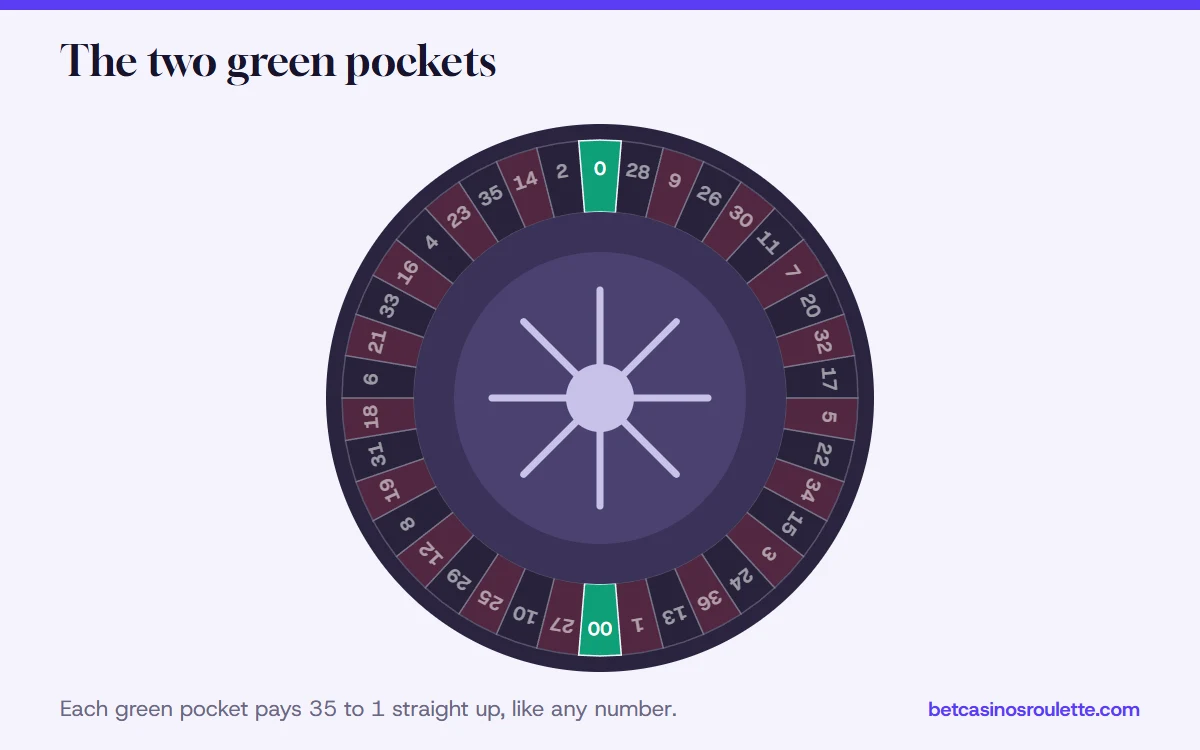
Roulette green is the color of the zero pockets, and a chip on green pays 35 to 1 when its zero comes in, the same as any single number. A single zero wheel has one green pocket, an American wheel has two (0 and 00), and the rarer triple zero version carries three.
Green matters even if you never bet on it. It is the pocket that beats red, black, odd, even, high, low, every dozen and every column, and it is where the casino's whole advantage comes from. Below: what each green bet pays, how often the ball finds green, and the French rules that soften the blow.
At the table
Green payout
35 to 1 on 0, on 00 or on 000, chip placed straight up.0 and 00 split
17 to 1 on American tables, one chip covering both zeros.Green on one spin
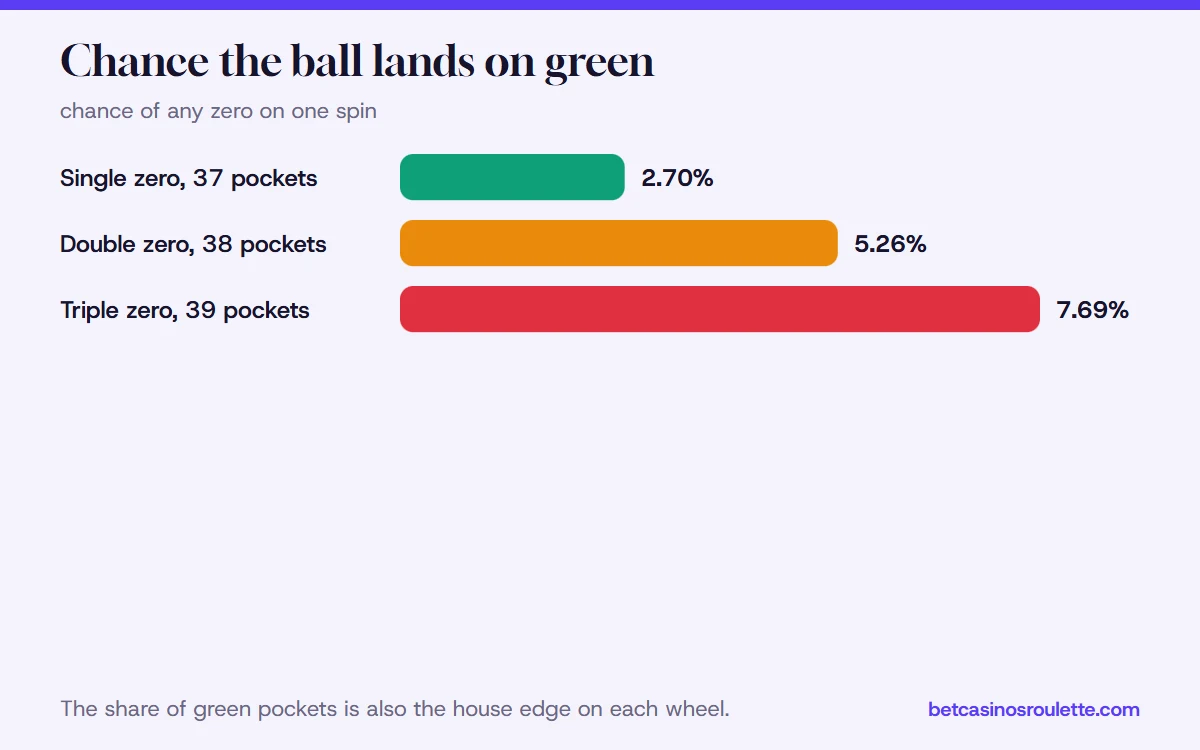
1 in 37 (2.70%) single zero; 2 in 38 (5.26%) for either zero on an American wheel.Outside bets
Lose when green lands, on standard rules.French rules
La partage or en prison cut the even money loss in half.House edge on 0
2.70% single zero, 5.26% double zero, the same as any other number.
What does green pay in roulette?
The roulette green payout has no special box of its own. You bet a zero the way you bet any number, by placing a chip on it, and the casino pays it like any number. So how much does 0 pay in roulette, and what about 00 or 000? All three pay 35 to 1 straight up. The zeros can also be part of a few small group bets, which pay less because they cover more.
| How you bet green | Where it is offered | Odds paid | 5 units returns |
|---|---|---|---|
| 0 on its own | Every wheel | 35 to 1 | 180 (175 won plus your 5) |
| 00 on its own | American and triple zero | 35 to 1 | 180 |
| 0 and 00 as a split | American | 17 to 1 | 90 |
| Trio, a zero plus two numbers | Most wheels | 11 to 1 | 60 |
| First four, 0 with 1, 2, 3 | Single zero | 8 to 1 | 45 |
| Top line: both zeros plus 1 to 3 | American | 6 to 1 | 35 |
A common search asks about 100 on green. With 100 units straight up on 0 and the ball landing there, you win 3,500 units and keep your 100, so 3,600 come back to you. The zero bets that mix in other numbers go by shifting names from casino to casino, and you can match trio, first four and top line to their numbers in the basket bet guide.
Can you bet on green in roulette?
Yes. Put your chip on the zero box at the top of the layout. On a single zero table that one chip covers all the green there is. On an American table you have two greens, and three choices:
- Back just one. Single 0, or single 00, pays 35 to 1 if that exact pocket comes up.
- Split them. Set one chip on the line between 0 and 00 and it pays 17 to 1 if either one lands.
- Back both separately. A chip on each pays 35 to 1 on the winner while the other chip loses, so you net 34 on 2 units staked.
The split and the two separate chips work out the same in proportion: 17 net per unit either way. The split just needs one chip.
You may also see the phrase green multiplier. On a standard casino table there is none, green pays 35 to 1. Some simple wheel games borrow the name roulette and pay a big multiplier on a green slot, but they are a different game, and their odds depend on how many slots that wheel has.
Roulette green odds: how often the ball finds a zero
Every pocket is equally likely, so the chance of green is just the number of zeros divided by the number of pockets.
- Single zero wheel: 1 in 37, or 2.70%. Over 100 spins you would average about 2.7 greens.
- American wheel: 1 in 38 (2.63%) for a single chosen zero, 2 in 38 (5.26%) for either one. That is about 5.3 greens per 100 spins.
- Triple zero wheel: 3 in 39, or 7.69%, close to 7.7 greens per 100 spins.
Averages hide long gaps. On a single zero wheel there is roughly a 64% chance (63.71%) of seeing at least one zero in 37 spins, which means about one time in three you will not. A full 100 spins with no zero turns up in roughly 6.46% of stretches that long. With two zeros in play, a full 100 spins without either green is rare, around 0.45%.
What happens if the ball lands on green?
Here is how the dealer settles the table when the marker goes on a zero, with standard rules.
| Bet on the table | Result on green |
|---|---|
| Straight up on the zero that hit | Wins, pays 35 to 1 |
| Split, trio, first four or top line that includes it | Wins at that bet's rate |
| Any inside bet without that zero | Loses |
| Any even money box (colors, parity, halves) | Loses in full, or half under French rules |
| Dozens and columns | Loses, no exceptions |
Zero sits outside every group on the layout. It carries no color, and for betting it has no parity either. That is why each color falls short of half the spins, worked through in our red or black guide.
La partage, en prison and the half back rule
Some tables soften the hit to even money bets when green lands. Take 10 units on red and a zero result:
- Standard rules: the 10 units are gone.
- La partage: you lose half. The dealer takes 5 and hands back 5.
- En prison: the 10 units stay on the table, locked, for the next spin. If red then wins, you get your 10 back with no profit. If it loses, the bet is gone. What happens on a second zero varies by casino.
Either rule halves the casino's cut on even money wagers, from 2.70% to about 1.35%. Dozens, columns and inside bets keep the normal 2.70%. You will mostly find these rules on French tables, covered in French roulette, and sometimes on European ones.
Should you bet on green?
A chip on 0 costs exactly what a chip on 17 costs. With one zero, each costs 2.70%; with two, each costs 5.26%. Green is not a smart bet or a dumb one, it is just one number.
Two traps catch people. The first is thinking zero is due after a long gap. The wheel keeps no record, so the chance on the next spin is 1 in 37 whether the last zero was two spins ago or two hundred. The second is the American five number bet, which grabs both zeros along with 1, 2 and 3. Fair pay for five pockets out of 38 works out to 6.6 to 1; what you get is 6, which pushes the cost to 7.89%, the worst price on that wheel.
If you like the idea of a green bet, test it on the free roulette simulator and watch how long the dry spells run. For the case against chasing any single number, see which bets cost the least and the full list on all roulette bets.
Common mistakes about zero
- Calling zero even. Mathematically it is even. On the layout it is not, and a chip on Even loses when 0 shows.
- Thinking two zeros pay more. 00 is paid at exactly the rate 0 is. The second zero only adds to the casino's edge.
- Expecting outside bets to push. Without la partage or en prison, every outside bet loses on green.
- Confusing the zero bets. Trio: 11 to 1. First four: 8 to 1. Top line: 6 to 1. Name the numbers when you ask the dealer.
Questions players ask
What does 0 and 00 pay in roulette?
Each pays 35 to 1 as a straight up bet, so 1 unit wins 35 and you keep your stake. On a double zero layout, one chip on the line joining the two zeros pays 17 to 1.
How often does green hit in roulette?
Roughly one spin in 37 with a lone zero, and one spin in 19 for either green when the wheel has two. These are averages, and gaps of 100 spins or more do happen.
What happens if you bet on red and it lands on green?
On standard rules your red bet loses. French tables soften it: la partage refunds half, and en prison freezes the bet for a spin. Certain Atlantic City tables with two zeros hand back half too.
What is the payout on 100 units on green?
If the zero you backed comes in, you win 3,500 units and get your 100 back, for 3,600 in total. If any other number lands, the 100 units are lost.
How much is green on roulette compared with other bets?
No. Its edge equals any other number's: 2.70% European, 5.26% American. It just wins rarely and pays big when it does.
What does 00 pay in roulette?
Double zero pays 35 to 1 straight up, exactly like single zero. Its real effect is on the odds: it adds a second losing pocket for every outside bet, which nearly doubles the house edge.