
The roulette betting system Martingale doubles your even money bet after every loss, so one win pays back the whole losing streak plus 1 unit, but a long streak or the table maximum eventually costs far more than all those small wins. It feels safe because most runs end in profit. It is not safe, because the rare failed run is huge.
I dealt plenty of tables where someone doubled their way up the felt. Below you get the exact steps, a worked run in units, the cost of a bad streak, what the table limit does, and the numbers from 100,000 simulated sessions.
At the table
Bet used
Even money: red, black, odd, even, low or highAfter a loss
Double the last betAfter a win
Drop back to 1 base unitProfit per finished run
1 base unitCost of 7 straight losses
127 units, with 128 needed nextChance of 7 straight losses
About 0.94% per run on a single zero wheelLong run result
Loses about 2.70% of everything staked (European)
How the Martingale works, step by step
The whole method fits on a napkin. You back one even money chance the whole time, and the only thing you ever change is the stake.
- Pick a base bet, for example 1 unit, and one even money box such as red.
- Spin. If red wins, you are 1 unit up. Start again at 1 unit.
- If red loses, double the stake: 2 units, then 4, then 8, and so on.
- Keep doubling until red finally wins. That single win covers every loss in the streak and adds 1 unit.
- Go back to 1 unit and begin the next run.
Zero is the quiet villain here. The green pocket belongs to neither color, so it counts as a loss and pushes the doubling one step higher. On a European wheel your chance on each even money spin is 18 in 37 (48.65%), not one half.
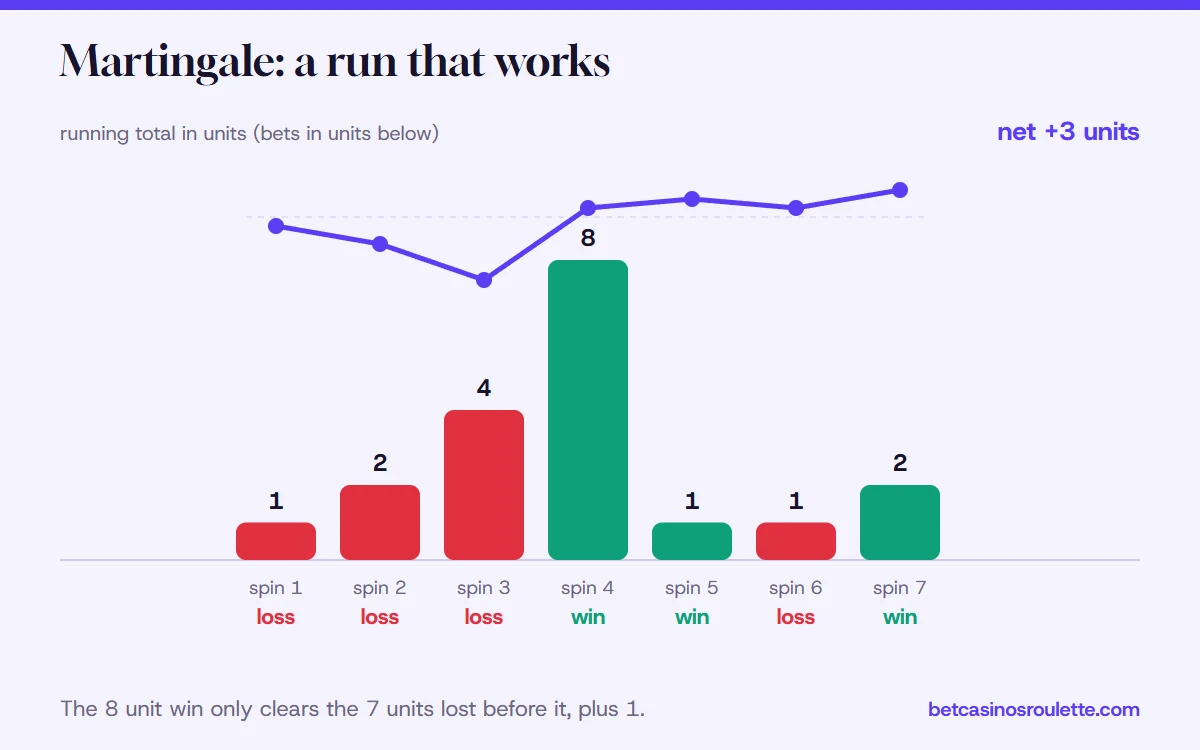
A worked Martingale run in units
Here is a short session on red. Bankroll: 100 units. Opening stake: 1 unit. The numbers are a normal mix you would see on any table.
| Spin | Bet on red | Ball lands | Net so far | Bankroll |
|---|---|---|---|---|
| 1 | 1 | 26 black | -1 | 99 |
| 2 | 2 | 0 green | -3 | 97 |
| 3 | 4 | 11 black | -7 | 93 |
| 4 | 8 | 32 red | +1 | 101 |
| 5 | 1 | 9 red | +2 | 102 |
| 6 | 1 | 17 black | +1 | 101 |
| 7 | 2 | 14 red | +3 | 103 |
Three runs finished, so the player is 3 units ahead. Notice how much was staked to earn those 3 units: 19 units in total. The profit per run never grows. Only the risk grows.
The losing run nobody plans for
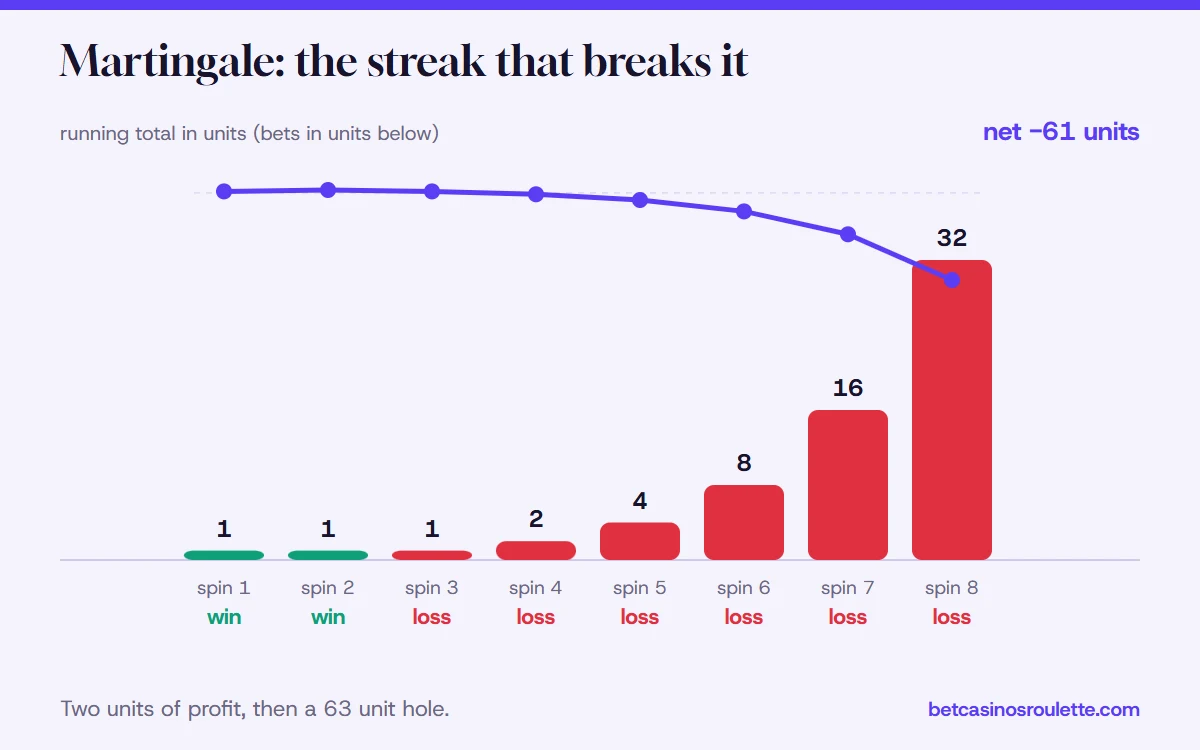
Now the same player, same bankroll, a few spins later. Two quick wins, then six reds in a row fail to show.
| Spin | Stake | Ball lands | Running total |
|---|---|---|---|
| 1 | 1 | 3 red | +1 |
| 2 | 1 | 21 red | +2 |
| 3 | 1 | 4 black | +1 |
| 4 | 2 | 33 black | -1 |
| 5 | 4 | 0 green | -5 |
| 6 | 8 | 29 black | -13 |
| 7 | 16 | 8 black | -29 |
| 8 | 32 | 20 black | -61 |
The system now asks for 64 units. Only 39 are left. The run cannot continue, and the session is down 61 units, which wipes out sixty one finished runs worth of profit. This is not some freak event. Over any 100 spins with one green pocket, at least one run of six or more misses turns up about 60% of the time.
How big a bankroll a losing streak needs, and what the table maximum does
Each extra loss doubles the next stake. The table shows the stake, the total you have put in during that run, and how often a run reaches that point.
| Losses in a row | Next stake | Lost so far | Chance, single zero | Chance, double zero |
|---|---|---|---|---|
| 3 | 8 | 7 | 13.54% | 14.58% |
| 5 | 32 | 31 | 3.57% | 4.04% |
| 6 | 64 | 63 | 1.83% | 2.13% |
| 7 | 128 | 127 | 0.94% | 1.12% |
| 8 | 256 | 255 | 0.48% | 0.59% |
| 10 | 1,024 | 1,023 | 0.13% | 0.16% |
To survive seven losses you need 255 units: 127 already lost plus the 128 unit bet. Ten losses in a row needs 2,047 units, all to win 1.
The table maximum is the second wall. Say the base is 1 unit and the limit is 100. After seven losses the system calls for 128, and the dealer has to refuse that stake. You must eat the 127 unit loss and start over. Casinos set table limits for many reasons, and one side effect is that doubling has a ceiling no matter how rich you are.
Does the roulette betting system Martingale work over time?
No. It changes the shape of your results, not the average. I scripted 100,000 sessions for each setup below. Red every spin, 1 unit to start, a cap of 100 spins, and a session ended early only when the next doubled stake was more than the chips left. Treat every figure as approximate.
| Setup | Finished up | Could not cover the next bet | Mean result |
|---|---|---|---|
| European, 100 unit bankroll | 49% | 50% | -6.2 units |
| American, 100 unit bankroll | 44% | 55% | -12.2 units |
| European, 1,000 unit bankroll | 90% | 8% | -13.7 units |
| European, 1,000 units, table max 100 | 63% | 0% (capped) | -10.2 units |
| European, 100 units, quit at +20 | 69% | 31% | -3.1 units |
Look at the 1,000 unit row. Nine sessions in ten end ahead, which is exactly why the system feels like it works. The sessions that fail lose about 650 units each, and that wipes out the rest. Across all the European rows, the loss came to roughly 2.7% of the total amount staked, the same edge a flat bettor faces. On the double zero wheel it was about 5.3%. The probability of each spin never moves, so neither does the house edge.
Why people still use the Martingale
It is honest to say what the system does well. It turns many small wins into a smooth line, and in a short session that line usually ends up. In the simulation, a 30 spin session with 100 units ended ahead about 74% of the time. Setting a modest stop, such as quitting at plus 20, reached that target in about 69% of sessions.
The catch is that the other sessions carry the big losses, and the averages above already count them. If you enjoy the pattern, treat it as a way to spend a fixed amount slowly, never as income. A fixed stop on the way up and a firm limit on the way down are what make it bearable.
Test the Martingale on the free system tester
The tester above opens with the Martingale already loaded. Try this to see the pattern for yourself:
- Wheel: European. Bankroll: 200. Base bet: 2. Table maximum: 200.
- Spins: 100. Sessions: 1,000. Press run.
- Check three numbers: sessions up, sessions busted, and the largest stake the system ever asked for.
- Switch to the American wheel and run again. The broke share rises and the average gets worse.
- Lift the bankroll to 2,000 and watch the up share climb while the average stays negative.
The sample session line is worth a look too. It usually climbs in small steps and then drops off a cliff. If you would rather double by hand, our practice table deals in play credits.
Martingale roulette system variations compared
The Grand Martingale doubles and adds 1 unit after each loss (1, 3, 7, 15, 31). A win then pays more than 1 unit, but the stakes reach the limit even faster. Some players run the doubling on a dozen instead, where a win pays 2 to 1; seven straight dozen misses happen about 6.4% of the time with one zero, so the streaks come more often.
The opposite idea, raising after wins, is the Paroli system. Gentler negative progressions are the Fibonacci and the Labouchere. For a side by side look at all of them, see roulette betting systems, and for what you can actually control at the table, read roulette tips.
Questions players ask
Does the Martingale system work in roulette?
It wins often in the short run and loses on average in the long run. Most runs end 1 unit up, but a streak of six or seven losses costs 63 or 127 units. Over 100,000 simulated sessions the loss matched the house edge: roughly 2.7 units gone per 100 units bet on a European table.
What are the Martingale strategy roulette risks?
Stakes double with each loss, so a short streak needs a large bankroll. The table maximum can stop the doubling before you recover. Zero counts as a loss, which makes streaks slightly more likely than a coin toss.
How much bankroll does the Martingale need?
From a 1 unit start, six straight losses cost 63 units and seven cost 127. To keep going after seven you need 255 on hand, counting the 128 unit bet. Every extra loss you want to survive doubles the requirement. No bankroll covers every streak.
Is there a Martingale roulette calculator?
The system tester on this page works as one. Enter the wheel, bankroll, base bet, table maximum and number of spins, and it plays up to 1,000 sessions with play credits. It shows how often sessions go broke and the biggest bet needed.
Is the roulette Martingale strategy better on a European or American wheel?
It does less damage on the European game. The extra 00 makes losing streaks more likely and nearly doubles the edge, to 5.26%. In my test the American version could not cover its next bet in roughly 55 of every 100 sessions, against 50 on the European wheel.
Can a casino stop the Martingale system roulette players use?
Casinos rarely need to. The table maximum caps how far you can double, and the house edge works the same on every bet. The system is allowed, it just cannot overcome the math.