
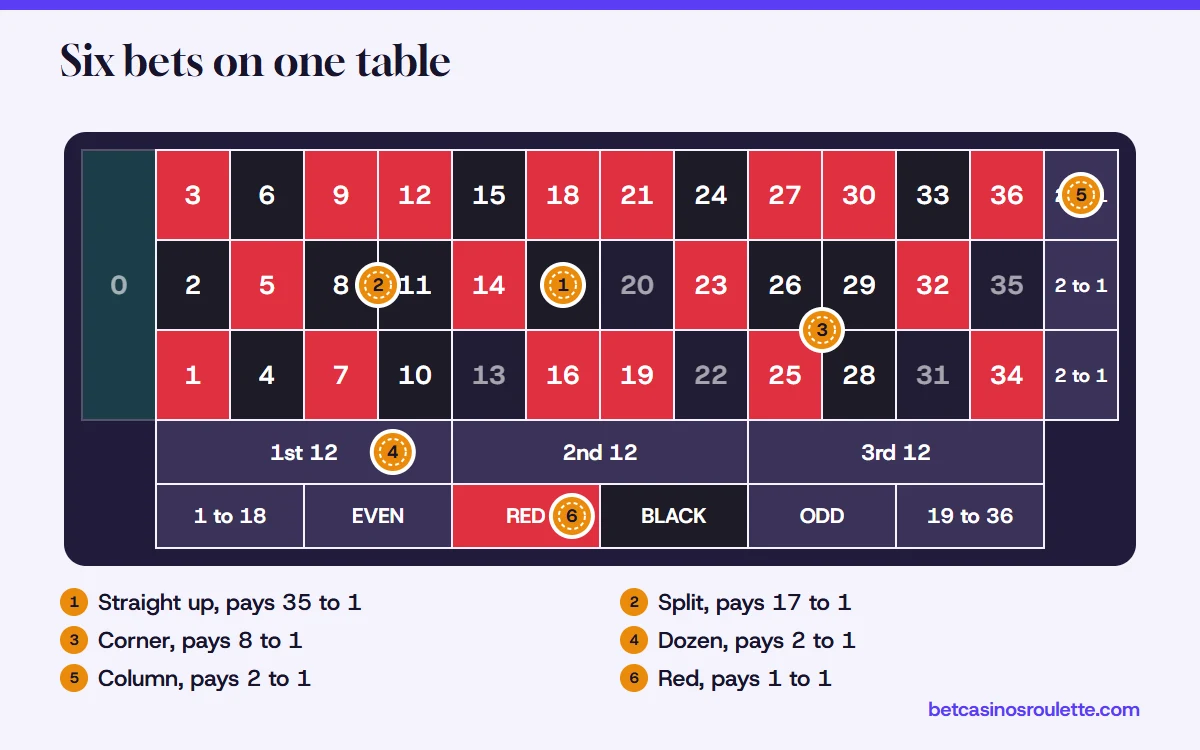
Roulette bets come in two families: inside bets on the numbers themselves, which pay as much as 35 to 1, and outside bets on big groups such as red, odd or a dozen, which pay even money or 2 to 1. Every one of them carries the same house edge on a given wheel, so what really separates them is the size of each win and how often one turns up.
I spent years pushing chips across a layout, and the questions never changed: where does the chip go, what does it pay, and what are my chances. This hub answers all three for every bet, then sends you to the page that covers each one in depth.
At the table
Inside bets
Chips on the number grid: straight up, split, street, corner, six line, plus the zero bets.Outside bets
Boxes around the grid: dozens, columns, red, black, odd, even, low and high.Top payout
35 to 1 on a single number.Best chance
18 in 37 (48.65%) on any even money box, single zero wheel.House edge
2.70% single zero, 5.26% double zero, 7.89% on the American five number bet.Zero
Green 0 and 00 sink every outside bet unless the table uses la partage or en prison.
How to bet on roulette, start to finish
The mechanics take about a minute to learn. Here is the order of play at a real table, and it is the same order the free tools on this site follow.
- Get chips. At most tables you buy colored wheel chips that only you use at that table. Their value is set when you buy in. See roulette chips for how that works.
- Place your bets. Set chips on a number, on a line between numbers, or in an outside box. You can make as many bets as the table limits allow.
- Watch for the call. The ball travels against the turn of the wheel, and shortly before it falls the dealer announces "no more bets". Anything placed after that call is pushed back.
- The result. Once the ball rests, the dealer parks a small marker (most dealers call it the dolly) on top of the number that hit, clears away the losers and then pays out.
- Leave winners or pick them up. A winning chip stays where it was unless you take it back, so it rides again on the next spin.
If you have never sat at a table, how to play roulette walks through a full round with a picture of each step.
All roulette bets in one table: types, pay and chance
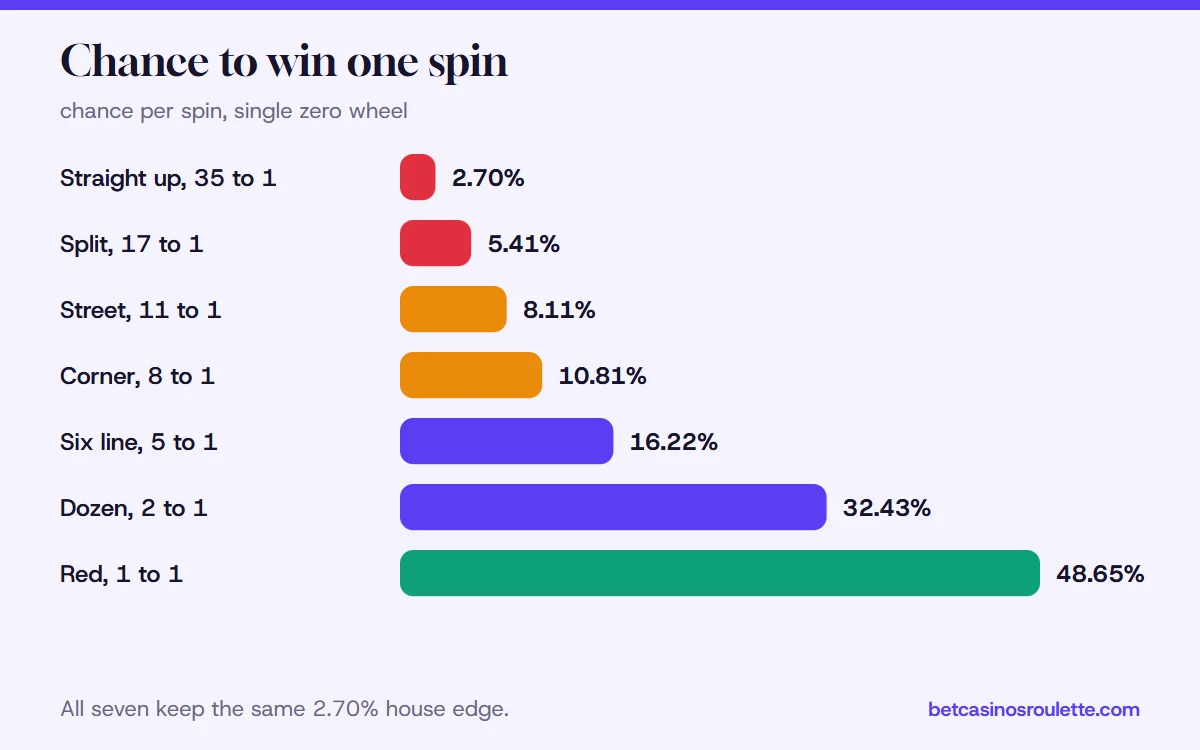
This is the master list. The bet name links to its own guide, the numbers column tells you how much of the wheel the chip covers, and the last two columns give your chance of a win on one spin. A 35 to 1 win returns your stake as well, so 1 unit on a winning number comes back as 36 units.
| Bet | Numbers | Chip placement | Chance with 0 | Chance with 0 and 00 | Pays |
|---|---|---|---|---|---|
| Straight up | 1 | Inside one number square | 2.70% | 2.63% | 35 to 1 |
| Split | 2 | On the line between two neighbors | 5.41% | 5.26% | 17 to 1 |
| Street | 3 | Outer edge of a row of three | 8.11% | 7.89% | 11 to 1 |
| Trio | 3 | Where a zero meets 1 and 2, or 2 and 3 | 8.11% | 7.89% | 11 to 1 |
| Corner | 4 | The point where four squares touch | 10.81% | 10.53% | 8 to 1 |
| First four (basket) | 4 | Corner of 0, 1, 2 and 3 | 10.81% | not offered | 8 to 1 |
| Top line (five number) | 5 | Outer corner where both zeros meet the 1, 2, 3 row | not offered | 13.16% | 6 to 1 |
| Six line | 6 | Outer edge, across two rows | 16.22% | 15.79% | 5 to 1 |
| Dozen | 12 | 1st 12, 2nd 12 or 3rd 12 box | 32.43% | 31.58% | 2 to 1 |
| Column | 12 | 2 to 1 box at the end of a column | 32.43% | 31.58% | 2 to 1 |
| Red or black | 18 | The red or black diamond | 48.65% | 47.37% | 1 to 1 |
| Odd, even, low, high | 18 | Their own boxes on the outer strip | 48.65% | 47.37% | 1 to 1 |
Notice the pattern. The more numbers a chip covers, the smaller the payout, and the payout always falls just short of what the true odds would pay. That shortfall is the casino's cut. The payouts and odds page breaks the gap down bet by bet.
Inside bets: chips on the number grid
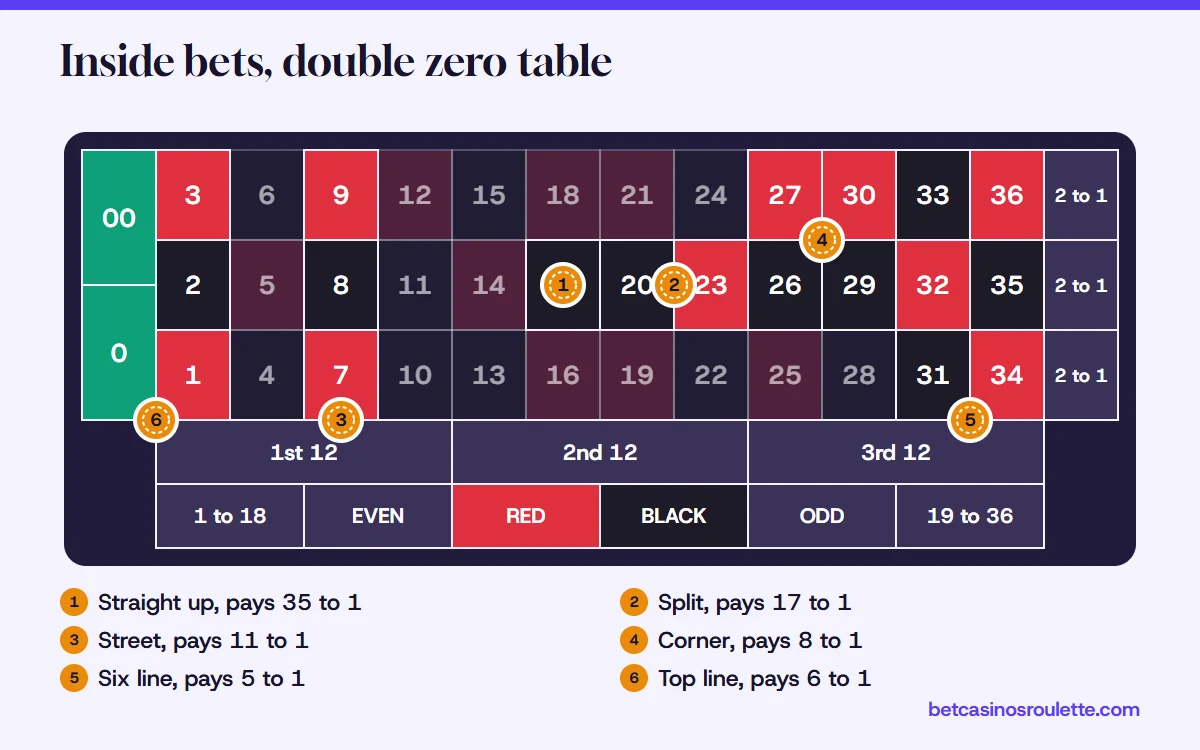
A chip that touches the number grid, whether in a square or across a line, makes an inside bet. They cover from one to six numbers, so they win less often and pay more when they hit. The overview at roulette inside bets compares them side by side, and each single bet has its own page with placement tricks and examples.
- Straight up: one number, including 0 or 00.
- Split: two numbers that touch on the layout, across or up and down.
- Street: a row of three, such as 7, 8, 9.
- Corner: a square of four, such as 17, 18, 20, 21.
- Six line: two streets side by side, such as 31 to 36.
- Zero bets: trio, first four and the American top line. The word basket gets used for different ones of these depending on the casino, so always say the numbers out loud when you ask the dealer. Our basket bet explainer matches each name to its numbers.
Many tables set one minimum for your inside bets in total, which you can spread across several numbers, while each outside bet must meet the minimum by itself. Check the placard, and see table limits for the details.
Outside bets: the boxes around the grid
Outside bets live in the boxes along the edge of the layout. They each cover 12 or 18 numbers, which makes them the steady end of the table. The guide to roulette outside bets covers all six kinds together.
- Dozens and columns cover 12 numbers and pay 2 to 1. Column chips sit in the three little 2 to 1 squares just past 34, 35 and 36. More on these, plus two dozen and two column combinations, at dozens and columns.
- Even money bets come in three pairs: the two colors, odd against even, and the low half against the high half. Each covers 18 numbers and pays 1 to 1. The most popular pair, the colors, has a full red or black breakdown.
Call bets on the wheel
On many single zero tables in Europe you can also bet on a slice of the wheel by telling the dealer, without placing every chip yourself. These spoken bets are called call bets or announced bets. Voisins du zero covers the 17 numbers around zero, tiers du cylindre covers the 12 numbers opposite, and orphelins picks up the 8 numbers left over. Each one is really a bundle of splits and straight ups, so the edge does not change. Roulette call bets lists the chip count for each and shows them on the wheel.
Why every roulette bet costs the same
Here is the arithmetic I used to show new dealers. Picture a single zero wheel landing on each of its 37 pockets exactly once, with 1 unit on number 17 every spin. You win once and collect 35. You lose the other 36 spins. Net result: down 1 unit over 37 spins, which is 2.70%.
Run the same test with 1 unit on a dozen. You win 12 spins at 2 units each for 24, and lose 25 spins for 25. Net: down 1 unit again. Swap in red and you win 18, lose 19. Down 1 again. The bet changes the ride, not the price.
Move the test to a double zero wheel and it takes 38 spins, with the tally ending 2 units short: a 5.26% edge. The American top line breaks the pattern: 5 wins at 6 units is 30, 33 losses is 33, so you finish 3 units down, which works out to 7.89%.
Try any bet on the interactive layout
The layout tool above lets you test placement without any chips at all. Pick a bet type, tap the table, and the covered numbers light up with the payout, the chance of winning and the house edge for both wheels.
Worked example: choose Corner, then tap where 17, 18, 20 and 21 meet. Four squares light up, the payout reads 8 to 1, and the chance reads 10.81% for European and 10.53% for American. Now switch to Dozen and tap 2nd 12: twelve numbers glow, the payout drops to 2 to 1, and the chance climbs to 32.43%. The edge line stays put in both cases.
When you want to see those bets play out over many spins, take them to the free roulette simulator; it runs on play credits and resets on demand.
How to bet on roulette and win: the honest version
No layout, combination or pattern turns roulette into a winning game over time. What you can control is how much each spin costs you and how bumpy the ride feels.
- Pick the wheel first. A single zero table halves the cost of every bet compared with double zero. On French rules, even money bets drop to about 1.35%.
- Skip the American five number bet. It is the only bet that costs more than the rest of its wheel.
- Choose your variance on purpose. Outside bets give many small wins and losses. Straight ups give long dry spells and the odd big hit.
- Bet small against your total. On average, 100 single zero bets of 1 unit lose about 2.7 units. Smaller bets buy more spins.
Our guide to picking the best bets runs through those choices with numbers, while how to beat roulette covers why no system shifts the edge.
Common betting mistakes at the table
- Late chips. A bet placed after "no more bets" is returned or refused. Place early.
- Sloppy placement. A chip half on a line can read as a split or a straight up. Center it, or ask the dealer to check.
- Thinking zero is even. For betting, 0 has no parity at all, so a chip on Even goes down with it.
- Chasing what is "due". The wheel has no memory. Ten reds in a row leave the next spin at 18 in 37 for red, same as always.
- Misreading "to 1". A 17 to 1 split on 2 units returns 34 units of winnings plus the 2 you staked, 36 in all.
- Walking off with wheel chips. They only have value at that table. Cash them in with the dealer first.
Questions players ask
How do you bet on roulette?
Buy chips, then place them on a number, on a line between numbers, or in an outside box before the call of no more bets. When the ball settles, the dealer marks the winning number, clears losing chips and pays the rest.
What can you bet on in roulette?
You can bet on one number, small groups of two to six numbers, or large groups: a dozen, a column, either color, odd, even, low or high. Single zero tables in Europe also take spoken call bets on sections of the wheel.
What are the types of bets in roulette?
There are two types. Inside bets cover one to six numbers and pay between 5 to 1 and 35 to 1. Outside bets cover 12 or 18 numbers and pay double or even money.
How do you bet on roulette and win?
You can win spins and even sessions, but no bet wins over time because the payouts sit below the true odds. The best you can do is play a single zero wheel, avoid the five number bet and keep bets small against your bankroll.
Can you bet on more than one number in roulette?
Yes. You can place as many separate bets as the table limits allow, and many players cover ten or more numbers each spin. Each bet is settled on its own.
Which roulette bet pays the most?
Top of the list is the straight up: one number, paid at 35 to 1, the biggest regular payout on the table. It is also the rarest winner, roughly one spin in 37 where there is only one zero.