
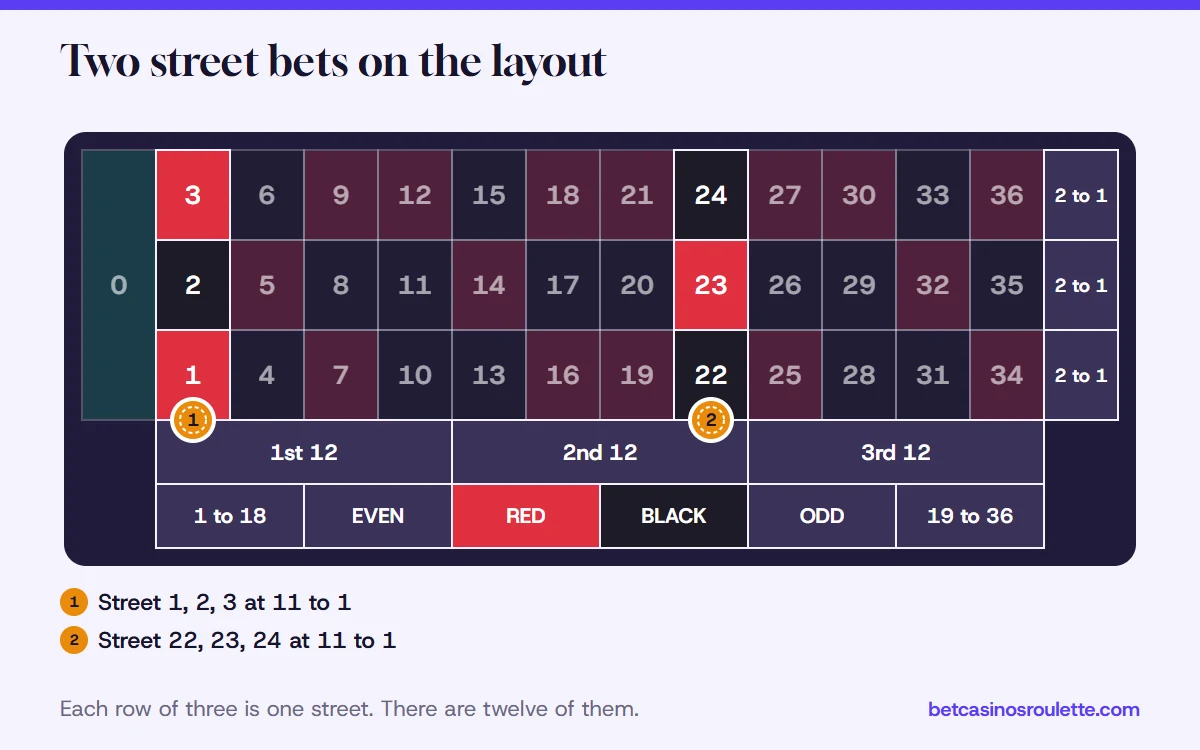
A street bet roulette chip covers one row of three numbers across the layout, such as 7, 8 and 9, and pays 11 to 1 when any of the three lands, so 1 unit brings back 12. There are 12 streets, and every one of them follows the same simple pattern, which makes this the easiest inside bet to read at a glance. Below you will find that pattern, the exact chip spot, the odds on each wheel, worked examples, and the double street, which joins two rows for a 5 to 1 payout.
At the table
Numbers covered
One row of three, for example 22, 23 and 24Payout
11 to 1: a winning unit returns 12Chance, European
3 in 37 spins, 8.11%Chance, American
3 in 38 spins, 7.89%House edge
2.70% with one zero, 5.26% with 0 and 00Where to put the chip
On the outer edge of the row, at the line next to the dozen boxes
What a street is in roulette: the row pattern
The numbers 1 to 36 sit in twelve short rows of three. Each row is a street. The pattern never changes: a street always starts one above a multiple of 3 and ends on a multiple of 3. So if you know the last number of a row, you know the whole row.
| Row | Numbers in it | Last number check |
|---|---|---|
| 1 | 1, 2, 3 | 3 times 1 is 3 |
| 2 | 4, 5, 6 | 3 times 2 is 6 |
| 3 | 7, 8, 9 | 3 times 3 is 9 |
| 4 | 10, 11, 12 | 3 times 4 is 12 |
| 5 | 13, 14, 15 | 3 times 5 is 15 |
| 6 | 16, 17, 18 | 3 times 6 is 18 |
| 7 | 19, 20, 21 | 3 times 7 is 21 |
| 8 | 22, 23, 24 | 3 times 8 is 24 |
| 9 | 25, 26, 27 | 3 times 9 is 27 |
| 10 | 28, 29, 30 | 3 times 10 is 30 |
| 11 | 31, 32, 33 | 3 times 11 is 33 |
| 12 | 34, 35, 36 | 3 times 12 is 36 |
A quick check: street number n holds 3n minus 2, 3n minus 1 and 3n. The 8th street is 22, 23 and 24. Four streets fit inside each dozen, and every street has one number from each of the three columns.
Placing the chip on a street
Set the chip on the outside line at the end of the row, where the number boxes meet the strip of dozen boxes. Half of the chip touches the row, half touches the line, and the dealer reads it as all three numbers. On the diagram above, that is the bottom edge of each column of three.
- Find the row that holds your three numbers.
- Move your hand to the end of that row nearest the dozens.
- Place the chip on the line, centered on the row, not between two rows.
- Look at it once more while the ball is still high on the track. Shifted down to the corner of two rows, it becomes a six line at 5 to 1.
The zero gets its own three number bets. On a table with one zero you can cover 0, 1 and 2, or 0, 2 and 3, by placing the chip where those three boxes meet. Some casinos call this a trio, some call it a street with zero, and some fold it into the word basket. It pays 11 to 1 like a normal street. Our basket bet guide untangles those names.
Street bet roulette payout, worked in units
Eleven to one means the dealer pays 11 for every unit on the row and leaves your stake in place. Every wheel style uses that same price for a row.
| Units on the street | Winnings | Back in your stack | If it misses |
|---|---|---|---|
| 1 | 11 | 12 | minus 1 |
| 3 | 33 | 36 | minus 3 |
| 5 | 55 | 60 | minus 5 |
| 10 | 110 | 120 | minus 10 |
A neat way to remember the price: one chip on each of the three numbers straight up would cost 3 units and return 36 on a hit. One chip on the street costs 1 unit and returns 12, exactly a third of that. A street is three straight up bets folded into one chip.
Street odds and house edge on each wheel
Three pockets win, the rest lose. That makes the street one of the easier bets to price in your head.
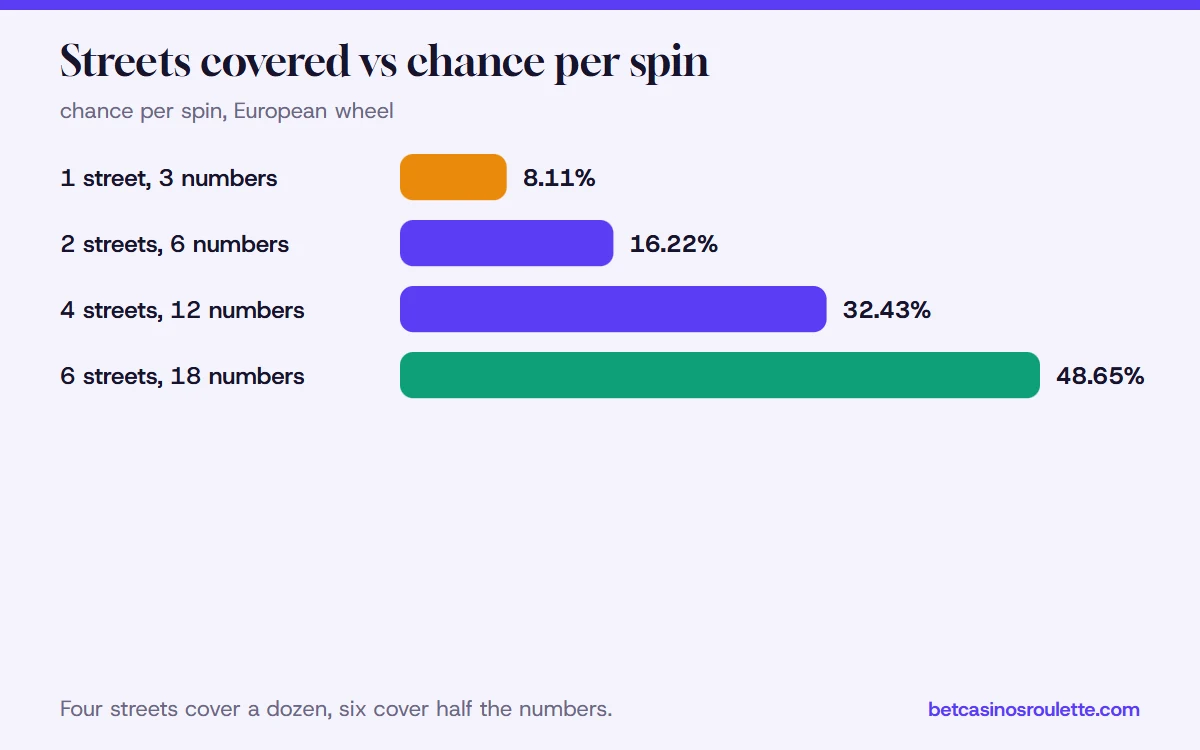
- European and French wheels: 3 winners out of 37 pockets, an 8.11% chance. The odds against are 34 to 3, about 11.33 to 1, while the payout is 11 to 1. Edge: 2.70%.
- American wheel: 3 winners out of 38, a 7.89% chance. Odds against are 35 to 3, about 11.67 to 1. Edge: 5.26%.
- Triple zero wheel: 3 out of 39, 7.69%. Odds against are exactly 12 to 1, payout still 11 to 1, edge 7.69%.
On average a street lands about once every 12.3 spins on a European wheel. In practice the gaps vary a lot: over 10 spins, the chance it never shows is about 42.93%.
Double street: two rows at 5 to 1
A double street, also called a six line or line bet, covers two neighboring rows, six numbers, with one chip. It pays 5 to 1. The chip sits on the same outside line, but right at the corner where the two rows meet. For example, a chip at the point between 13, 14, 15 and 16, 17, 18 covers all six.
Is the double street better? No. Two separate street chips of 1 unit each would return 12 units on a hit, a net of 10 on 2 units staked. A 2 unit double street returns 2 times 5 plus 2, also 12. Same coverage, same cost, same edge. The full breakdown, including all 11 possible six lines, is on our six line bet page.
Examples: one street, several streets, a whole dozen
One street. You put 2 units on 28, 29 and 30. The ball stops on 29. The dealer pays 22 units and you keep your 2.
Three streets in a row. You bet 1 unit each on 1 to 3, 4 to 6 and 7 to 9, 3 units a spin. If 5 lands, the middle street returns 12, so you are 9 units up. If 11 lands, all three chips are lost.
Four streets equal a dozen. Four 1 unit streets covering 13 to 24 return 12 units on any hit, a net of 8. A 4 unit bet on the second dozen at 2 to 1 also nets 8 on the same twelve numbers. The layout is priced so that bundling never changes the result, only the number of chips. You can line these up yourself in the payout calculator.
Transversale, street and trio: what the bet is called
Dealers in English say "street", sometimes "row" or "line of three", and read it back by the first number: "street 7" means 7, 8 and 9. On French tables it is transversale pleine, a full row across. A few casinos and books call a street a trio or triple, which clashes with the trio that includes zero, so say the three numbers if anything is unclear.
A common slip is betting a street because one of its numbers just landed twice. The wheel does not remember. Each row keeps its 3 in 37 chance on every spin, as explained on our probability page.
Questions players ask
What is a street bet in roulette?
It is a single chip covering one row of three numbers on the layout, such as 16, 17 and 18. If any of the three wins, you are paid 11 to 1. There are 12 streets on every standard table.
How much does a street pay in roulette?
The price is 11 to 1. One unit on the row brings back 12 units on a win, 11 in winnings plus your stake. A 5 unit chip returns 60.
Is the European roulette street bet payout 11 to 1 too?
Yes. The street pays 11 to 1 on European, French and American wheels alike. What changes is the chance of winning: 8.11% with one zero against 7.89% with two, which is why the edge differs.
What is a double street in roulette?
A double street is one chip covering two rows next to each other, six numbers in all. Most people call it a six line or line bet. The chip goes at the outside corner where the two rows meet.
How much does a double street pay in roulette?
A double street pays 5 to 1, so 1 unit brings back 6 units. The chance of winning is 16.22% on a European wheel and 15.79% on an American one.
Can you bet a street with zero?
On a single zero table you can cover 0, 1 and 2 or 0, 2 and 3 with one chip where the boxes meet, paid 11 to 1. Casinos call it a trio, a zero street, or sometimes a basket, so say all three numbers out loud.