
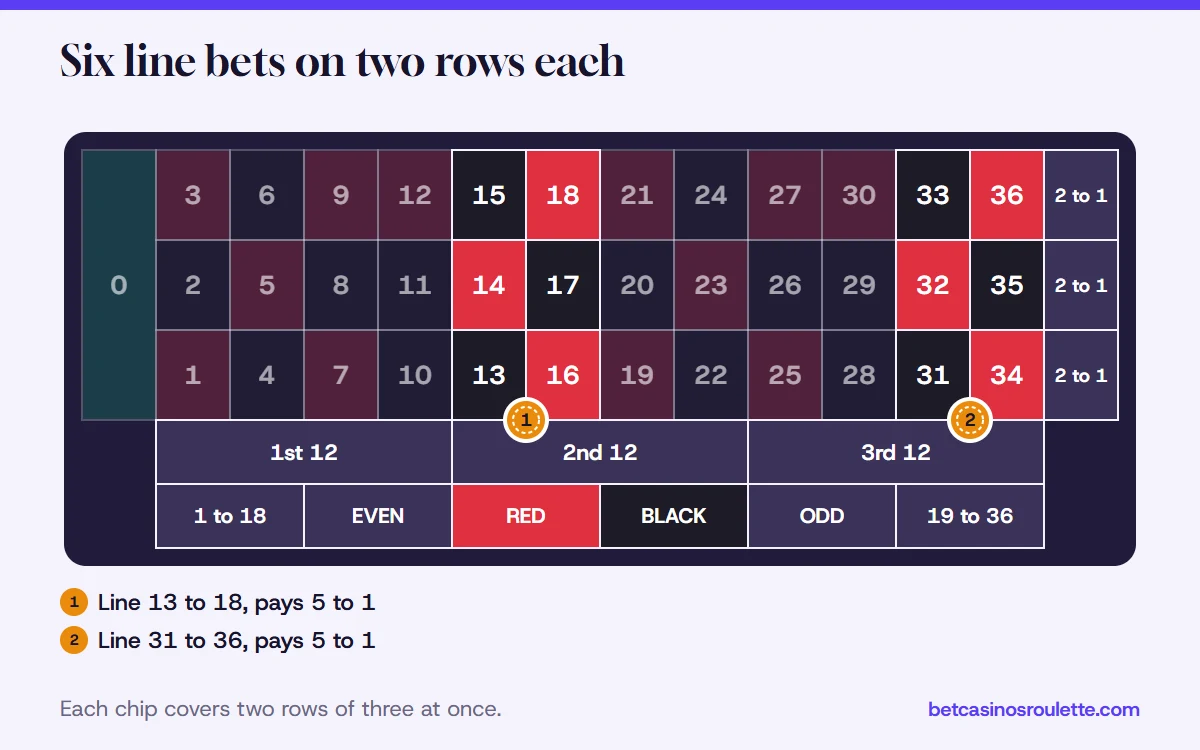
A six line bet roulette dealers also call a line bet or double street covers two neighboring rows of three, six numbers in all, with one chip, and it is paid at 5 to 1: a winning unit comes home with 5 more beside it. It is the biggest group you can cover with one inside chip, and it hits about one spin in six. The word "line" causes most of the confusion around this bet, because a top line on an American table is a different bet with a worse price. This page untangles the names first, then counts the lines, prices them and works through examples.
At the table
Covers
Six numbers: two rows of three that sit side by side, such as 13 to 18Pays
5 to 1, a 1 unit win returns 6 unitsEuropean chance
6 in 37, about 16.22% a spinAmerican chance
6 in 38, about 15.79% a spinHouse edge
2.70% one zero, 5.26% two zerosChip goes
On the outer line, at the corner where the two rows meet
Line bet, six line, double street: one bet, several names
Before anything else, the names. Every term below describes one identical wager:
- Six line, the most common name in the UK and Europe.
- Line bet or just "line", used at many tables and on screens.
- Double street, because it is two streets joined.
- Sixain or transversale simple on French tables.
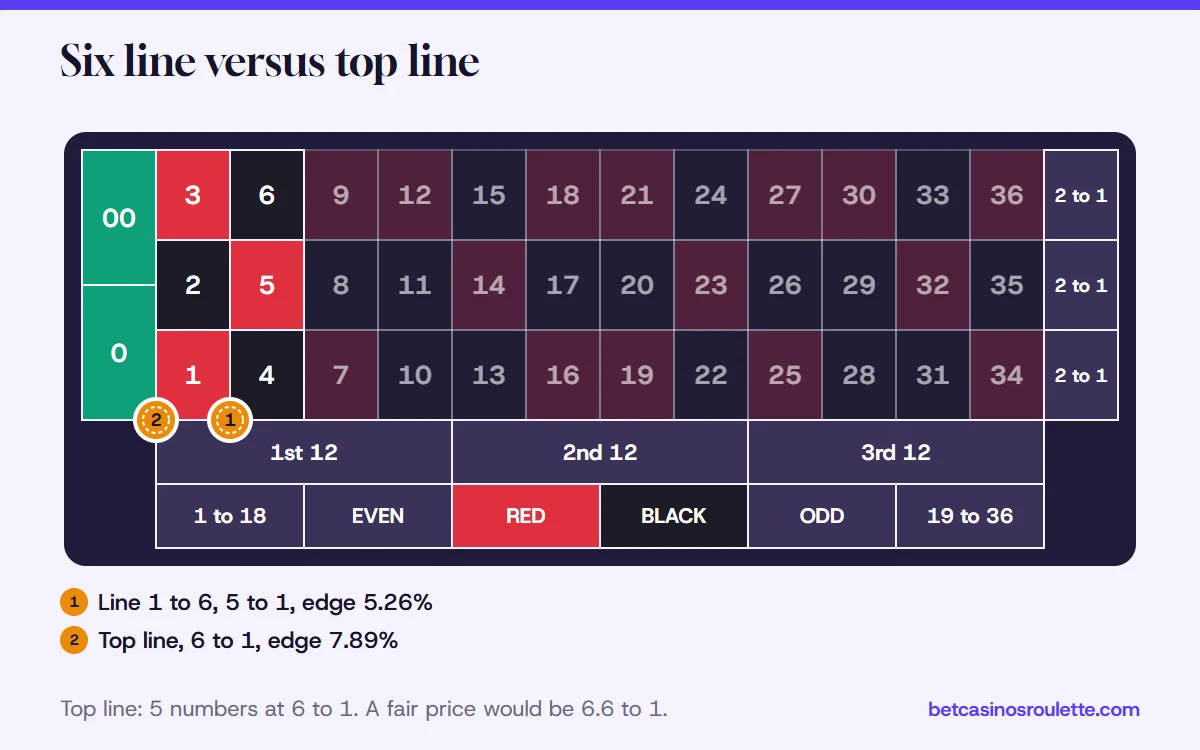
The one that does not belong is top line. On an American table, the top line is the five number bet on 0, 00 and the 1, 2, 3 row. It pays 6 to 1 and carries a 7.89% edge, the worst on that layout. A six line pays less, 5 to 1, but covers more numbers and has the normal edge for its wheel. If a dealer hears "line" at a double zero table, they may ask which one you mean.
Where the chip goes on a line bet
Start at the long outside border of the number grid, the side facing the three dozen boxes. A street chip rests on that border halfway along one row. A line bet chip rests on the very same border, only shifted to the spot where two rows touch, so it claims both. On the diagram above, the chip for 13 to 18 sits on the outer edge between the 13 box and the 16 box.
- Choose a pair of touching rows, say 25 to 27 and 28 to 30.
- Find the line between those two rows.
- Follow it to the outside edge, next to the dozens.
- Set the chip on that corner point.
Slide it inward and it becomes a corner bet at 8 to 1. Slide it along the edge into one row and the dealer will pay it as a street. If you cannot reach, hand the chips to the dealer and say "line, 25 to 30".
All 11 six lines, and how they overlap
Twelve rows give eleven pairs of neighboring rows, so there are 11 six lines. They overlap: every row except the first and the last belongs to two different lines.
| Line covers | Dozen |
|---|---|
| 1 to 6 | first |
| 4 to 9 | first |
| 7 to 12 | first |
| 10 to 15 | first and second |
| 13 to 18 | second |
| 16 to 21 | second |
| 19 to 24 | second |
| 22 to 27 | second and third |
| 25 to 30 | third |
| 28 to 33 | third |
| 31 to 36 | third |
Two lines that do not overlap, like 1 to 6 and 7 to 12, cover a full dozen between them. That is a handy way to see the math: two 1 unit lines on 1 to 12 give back 6 whenever one wins, leaving you 4 up on 2 staked, the same as 2 units on the first dozen at 2 to 1. The dozens and columns page shows the dozen side of that comparison.
Roulette line bet payout: 5 to 1, checked
Every common wheel style prices the line at 5 to 1, and the figure is not random. A line is two streets, and each street pays 11 to 1. Back both rows with 1 unit each and a winner hands you 12 for the pair, which is 6 per unit staked. A line bet of 1 unit returns 6 too. Same thing, one chip.
| Stake | Paid at 5 to 1 | Total returned | Net if it loses |
|---|---|---|---|
| 1 unit | 5 | 6 | minus 1 |
| 4 units | 20 | 24 | minus 4 |
| 6 units | 30 | 36 | minus 6 |
| 20 units | 100 | 120 | minus 20 |
A 6 unit line returns 36 on a hit, exactly what six 1 unit straight up chips on those numbers would return. That pattern runs through every inside bet.
Six line bet roulette odds and the house edge
Six pockets win and 31 lose on a 37 pocket wheel, odds of 31 to 6 against, about 5.17 to 1. The payout is 5 to 1. On a 38 pocket wheel the odds against are 32 to 6, about 5.33 to 1, with the same payout. That gap is the edge, and it lands in the usual place: 2.70% and 5.26%.
Because a line wins about once every 6.2 spins on a European wheel, it can feel steadier than a single number. Across 10 spins your line shows up at least once about 82.95% of the time. That does not make it cheaper. Play a hundred 1 unit lines and the expected bill is near 2.7 units with one zero, near 5.3 with two, identical to a hundred straight ups.
Worked examples with line bets
One line. 3 units on 19 to 24. The ball lands on 22. You get 15 in winnings plus your 3, 18 units back.
Two lines that overlap. 1 unit on 7 to 12 and 1 unit on 10 to 15. Numbers 10, 11 and 12 are in both. If 11 lands, both win: 12 back for 2 staked, up 10. If 8 lands, one wins: 6 back, up 4. If 14 lands, one wins again, up 4. Anything else loses 2.
Three lines with no overlap. 1 to 6, 13 to 18 and 25 to 30, 3 units covering 18 numbers. A hit returns 6, a net of 3, and with 37 pockets that happens 18 times in 37, 48.65%. Compare that with 3 units on red at 1 to 1: same 18 numbers covered, same net of 3 on a win. You can line the two up in the payout calculator or play them for free on the simulator.
Mistakes with six line bets
- Asking for "top line" when you mean a six line. At a double zero table that gets you the five number bet and a 7.89% edge.
- Chip drifting into the grid. One step inward and it is a corner of four numbers, not six.
- Expecting a line to be safer. Winning more often is not the same as losing less. The edge is the same as a single number on that wheel.
- Raising the bet after misses. A run of five or six losing spins is normal for a line bet, and chasing it only speeds up losses. See the Martingale page for what doubling does to a bankroll.
Questions players ask
What is a line bet in roulette?
One chip spread over a pair of touching rows, six numbers side by side such as 4 to 9. It pays 5 to 1. There are 11 possible lines on the layout.
What does the roulette line bet payout come to?
Five to one. Stake 1 unit, collect 5, and your chip comes back too, 6 in all. A 10 unit line returns 60 units when any of its six numbers lands.
Does the European roulette six line bet pay 5 to 1?
Yes. The European price matches the American one at 5 to 1. The one zero wheel, though, lets six numbers win 16.22% of spins against 15.79% with 0 and 00, which is why its edge is lower.
What is a top line bet in roulette?
On an American table, the top line is a five number bet that takes in both green pockets with the lowest row, paid 6 to 1 with a 7.89% house edge. It is not a six line.
Is a six line the same as betting two streets?
Yes, in result. One 2 unit line and two 1 unit streets on the same rows win and lose on exactly the same numbers and pay the same total. The line just uses one chip.
How many six line bets are on a roulette table?
There are 11. Each one joins two neighboring rows out of the twelve rows of three, starting with 1 to 6 and ending with 31 to 36.