
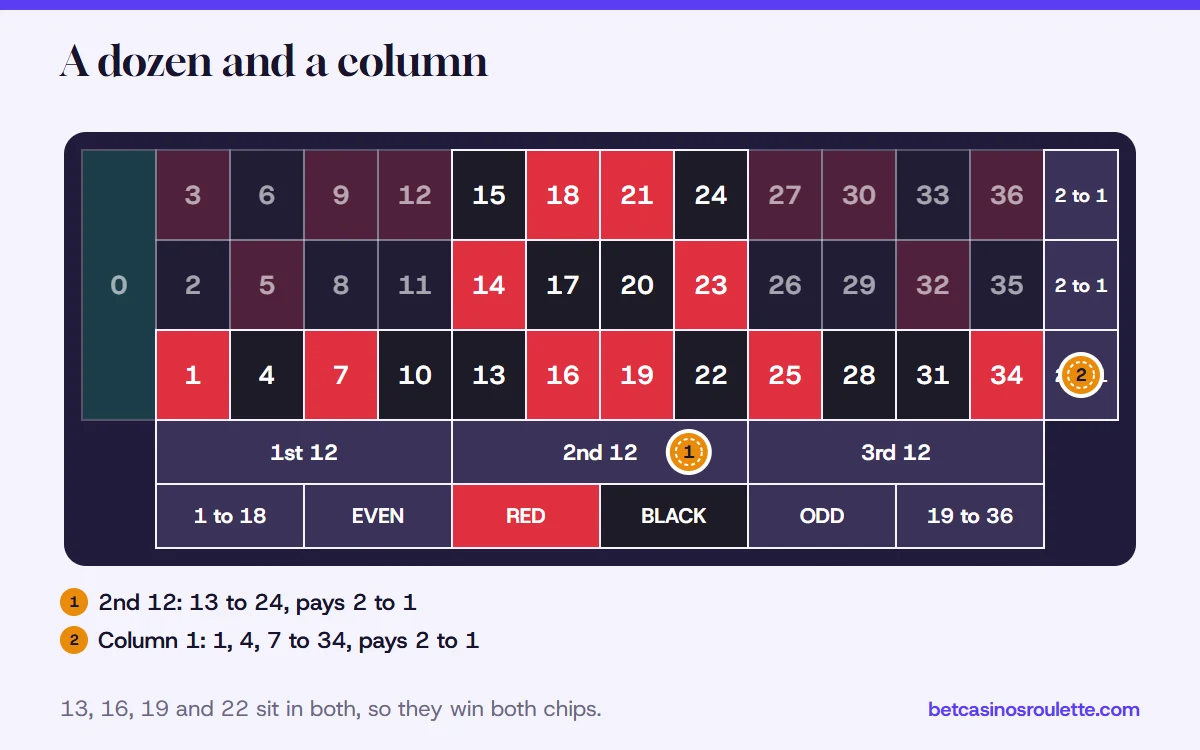
A roulette dozens strategy is any plan built on the three dozens (the numbers up to 12, 13 through 24, and 25 through 36) or the three columns, which pay 2 to 1 and win on 12 pockets out of 37, or 32.43%. No such plan removes the 2.70% house edge, but how you combine these bets decides how frequent your wins are and how hard the misses land.
Dozens and columns are the middle ground of the table: they hit about one spin in three and pay double. Here is how they work, and what happens when you test the popular combinations.
At the table
Dozens
1st 12 (1 to 12), 2nd 12 (13 to 24), 3rd 12 (25 to 36).Columns
Three long rows of 12, bet in the 2 to 1 boxes at the end.Pays
2 to 1: 5 units wins 10, and you keep the 5.Chance per spin
12 in 37 (32.43%) single zero, 12 in 38 (31.58%) double zero.Two at once
24 numbers covered: 64.86% single zero, 63.16% double zero.House edge
2.70% or 5.26%. La partage does not apply to these bets.
Where the dozen bet and the roulette column bet go
The dozen boxes run along the long side of the layout, marked 1st 12, 2nd 12 and 3rd 12. A chip in the 2nd 12 box covers 13 through 24.
The column boxes are the three small squares marked 2 to 1 at the far end of the long rows. Each column holds every third number:
- Column 1: 1, 4, 7, 10, 13, 16, 19, 22, 25, 28, 31, 34
- Column 2: 2, 5, 8, 11, 14, 17, 20, 23, 26, 29, 32, 35
- Column 3: 3, 6, 9, 12, 15, 18, 21, 24, 27, 30, 33, 36
Neither kind of bet includes 0 or 00. For a full picture of the table, see the roulette table layout.
Roulette dozen bet pays 2 to 1: what you get back
Two to one means your profit is twice your stake, and the stake comes back too. Columns pay exactly the same.
| Chip size | Comes back on a win | Profit | Lost on a miss |
|---|---|---|---|
| 1 unit | 3 | 2 | 1 |
| 5 units | 15 | 10 | 5 |
| 10 units | 30 | 20 | 10 |
| 25 units | 75 | 50 | 25 |
The rules on the first dozen, second dozen and third dozen are the same everywhere: the box covers its 12 numbers, pays 2 to 1, and loses on any zero. A fair price would be a bit over 2 to 1, since you have 25 losing pockets against 12 winners on a single zero wheel. Paying a flat 2 to 1 is where the 2.70% edge comes from. On a triple zero wheel the chance falls to 30.77%. For the payout of every bet on the table, see roulette payouts.
Roulette dozens strategy: two dozens at once
The most common dozens play is to back two of them with equal chips, say 1 unit on the 1st 12 and 1 unit on the 3rd 12.
- Ball in either covered dozen (24 numbers): one chip wins 2, the other loses 1. Net plus 1.
- Ball in the open dozen or on zero (13 numbers): both chips lose. Net minus 2.
You win about 64.86% of spins on single zero, 63.16% on double zero. But every loss costs twice what a win pays. Over one 37 spin cycle that is 24 units won and 26 lost: 2 down on 74 staked, the same 2.70%.
Losing runs come sooner than people expect. The open dozen or zero shows three times running about 4.34% of the time on single zero, a little over 1 in 23 tries. That is a 6 unit hole from a bet that only earns 1 unit at a time.
Roulette 1st and 3rd column strategy
Backing columns 1 and 3 is the same bet as two dozens in different clothes: 24 numbers, plus 1 on a hit, minus 2 on a miss, 2.70% edge. The difference is which numbers you hold. Columns cut across all three dozens, and they are not balanced by color.
| Column | Red numbers | Black numbers |
|---|---|---|
| Column 1 (starts at 1) | 6 | 6 |
| Column 2 (starts at 2) | 4: 5, 14, 23, 32 | 8 |
| Column 3 (starts at 3) | 8 | 4: 6, 15, 24, 33 |
That imbalance does not change any odds on its own. It does let you build combinations with a color, which is where the next idea comes from.
The big black column strategy, checked
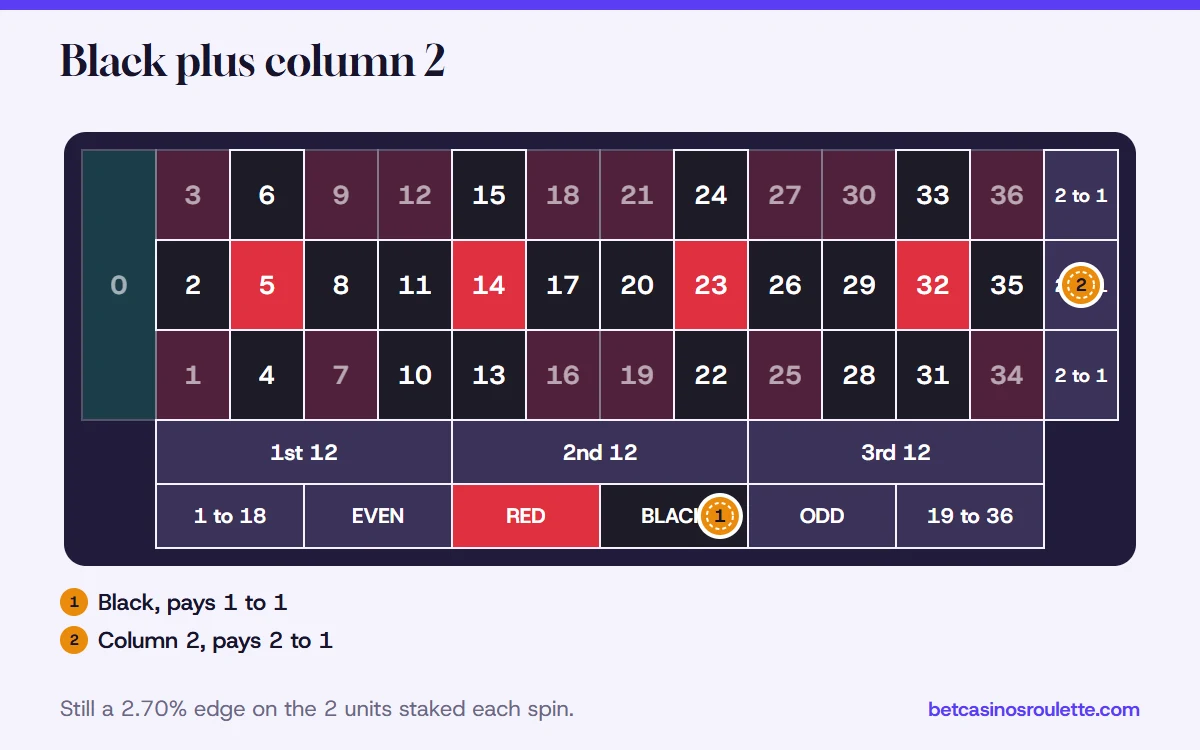
Column 2 holds 8 black numbers and only 4 red, so it gets called the black column. Players pair it with a color bet. Here are both versions, 1 unit per bet, European wheel.
| Where the ball lands | Black plus column 2 | Red plus column 2 |
|---|---|---|
| Black in column 2 (8 numbers) | plus 3 | plus 1 |
| Red in column 2 (4 numbers) | plus 1 | plus 3 |
| Black elsewhere (10 numbers) | even | minus 2 |
| Red elsewhere (14 numbers) | minus 2 | even |
| Zero | minus 2 | minus 2 |
| Spins that do not lose | 22 of 37 | 26 of 37 |
Black with column 2 gives more triple wins and more losing spins. Red with column 2 loses on only 11 numbers but rarely wins big. Total either version over 37 spins: 2 units lost on 74 wagered. The color column trick changes the shape of the results and nothing else.
Roulette columns strategy and dozen progressions
Some players raise their dozen bet after each miss so one win covers the losses. Because the payout is only double, the chips must climb fast, and a dozen can easily go quiet: it misses five spins in a row about 14.08% of the time on single zero. Every progression still loses 2.70% of all money wagered over time, as the testers on betting systems show.
To watch a dozens plan unfold, load the free roulette simulator and give it a few hundred spins; it uses play credits. Agree with yourself on a maximum loss and a quitting time before the first spin, and end at whichever comes first.
Common dozen and column mistakes
- Mixing up the boxes. Column chips belong in the little boxes after the last number of each row. Dozens use the long boxes on the side.
- Expecting la partage. Half back rules cover only the even money bets. A dozen loses in full on zero.
- Backing all three dozens. You win 2 and lose 2 on every number, and lose 3 on zero. It only pays the house.
- Chasing the dozen that is behind. A dozen that has missed ten spins is still 12 in 37 on the next one.
For other ways to cover the outside of the table, see roulette outside bets and red or black.
Questions players ask
What does a dozen bet pay in roulette?
Two to one. A winning 10 unit chip returns 30 units: 20 profit plus your 10.
Is betting on two dozens a good strategy?
It wins about 65% of spins, but each loss costs twice a win, and the edge stays 2.70% on single zero. It suits players who like frequent small wins, not anyone hoping to beat the game.
What numbers are in each roulette column?
Column 1 is 1, 4, 7 and so on up to 34. Column 2 runs 2, 5, 8 up to 35, and column 3 runs 3, 6, 9 up to 36.
Do dozens and columns lose on zero?
Yes. Neither includes 0 or 00, and la partage or en prison do not cover them, so they lose in full on any green result.
Which roulette column has the most black numbers?
Column 2, with 8 black and 4 red. Column 3 has 8 red and 4 black, and column 1 is split 6 and 6.
Which dozen is best to bet on?
None. Each dozen holds 12 numbers, pays 2 to 1 and has an identical chance each spin. Past results do not make one dozen more likely.