
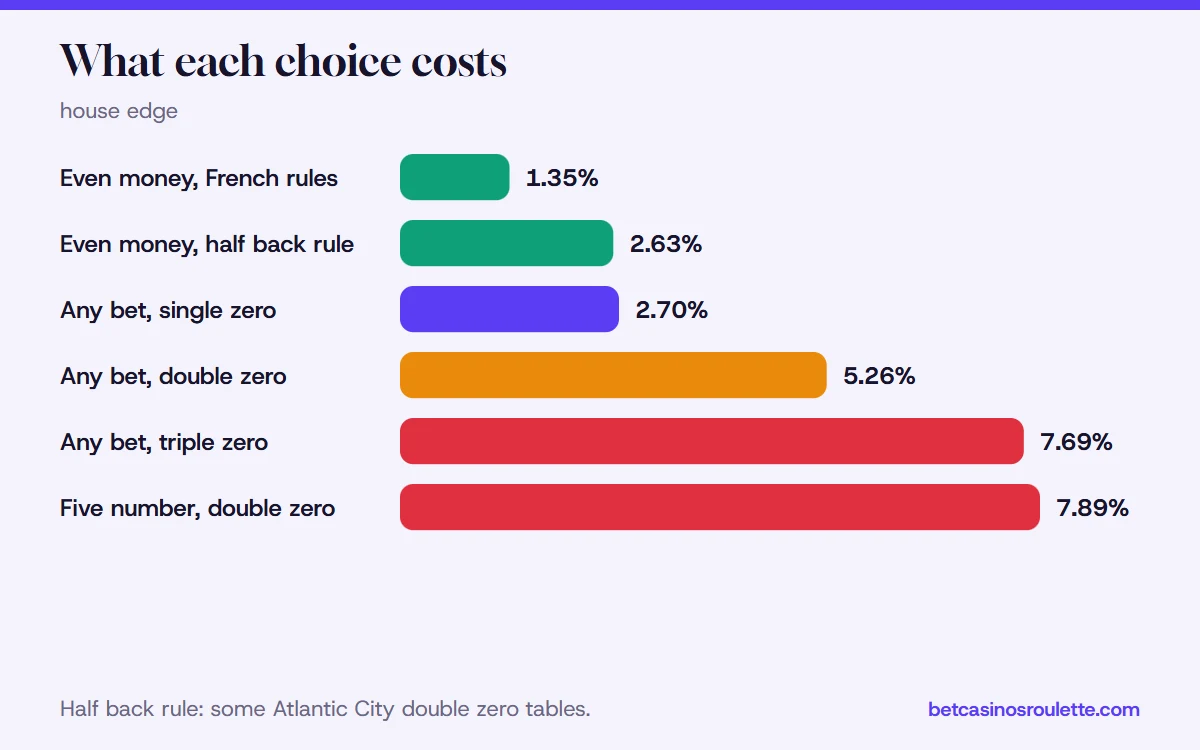
The best way to play roulette is to choose the wheel before you choose the bet, because a single zero wheel takes half as much from every bet as a double zero wheel does, while French rules cut the even money bets in half again. Once you are at a table, almost every bet on it costs exactly the same, so the rest is about how often you want to win and how big you want the swings to be.
That is not the exciting answer people hope for when they search for the best bet in roulette. It is the true one, and the numbers below show why.
At the table
Lowest edge
About 1.35% on even money bets with la partage or en prison.Best plain wheel
Single zero: 2.70% on every bet.Double zero
5.26% on every bet, almost twice the cost.Worst bet
The American five number top line, 7.89%.Most frequent win
Any even money box: 48.65% of spins on single zero, 47.37% on double zero.What it changes
Bet choice changes your swings, not your average loss.
Why no single bet is the best bet in roulette
Casinos set every payout on a wheel to the same price. You can check any of them by imagining a single zero wheel that lands on each pocket once in 37 spins, with 1 unit bet each time.
- Corner: 4 wins at 8 units is 32. 33 losses cost 33. You end 1 unit down.
- Six line: 6 wins at 5 units is 30. 31 losses cost 31. Down 1 again.
- Black: 18 wins, 19 losses. Down 1 once more.
One unit out of 37 bet is the 2.70% edge, and no bet on that wheel escapes it. On a double zero wheel every bet loses 2 units per 38, which is 5.26%, with one exception covered below. So the useful question is not which box to put a chip in. It is which table to sit at, and how much swing you can live with.
The best odds in roulette, ranked
Here every option is put in order of what it costs. The last column is the average loss for every 100 units you put through, the cleanest way to compare.
| Rank | Table and bet | Edge | Average loss per 100 units wagered |
|---|---|---|---|
| 1 | French rules, the even money boxes only | about 1.35% | about 1.35 units |
| 2 | Double zero with the half back rule, even money only | about 2.63% | about 2.63 units |
| 3 | Single zero, any bet at all | 2.70% | 2.70 units |
| 4 | Double zero, every bet but the five number one | 5.26% | 5.26 units |
| 5 | Triple zero, standard payouts | 7.69% | 7.69 units |
| 6 | Double zero five number bet, zeros through 3 | 7.89% | 7.89 units |
On a French table, dozens, columns and inside bets stay at 2.70%. The discount applies only to the six even money boxes, because those are the bets la partage and en prison protect when zero lands. The French roulette guide explains both rules, and roulette green shows exactly what happens to each bet on a zero.
What is the safest bet in roulette?
If safest means the bet that wins most often, it is an even money box, meaning a color, odd or even, or either half of the board. Those come up 18 times per 37 spins with one zero, 18 per 38 with two. Still under half, because zero belongs to none of those groups. Full color math lives on red or black.
You can win more spins by covering more numbers, but each win then pays less and each miss costs more. Two dozens cover 24 numbers, landing about 64.86% of spins with one zero. Each hit nets 1 unit on 2 staked, and each miss loses both. A Romanosky layout covers 32 numbers, winning 1 unit on most spins and losing 8 units on the five it misses. Both still lose 2.70% of everything bet, as the Romanosky page shows.
Pick your swing: the best way to bet on roulette for you
Since the price is fixed, the real decision is variance, which means how far your results wander from the average. I worked out one standard deviation for 100 spins at 1 unit each, European wheel. Every row shares the same expected cost, 2.7 units. The swing differs a lot.
| Bet | Wins per 100 spins, on average | Typical swing either way | What it feels like |
|---|---|---|---|
| Any even money box | about 49 | about 10 units | Slow, lots of small ups and downs |
| A dozen or a column | about 32 | about 14 units | Short losing runs, then a double sized win |
| A six line | about 16 | about 22 units | Longer gaps, wins of 5 units |
| One number | about 3 | about 58 units | Mostly losing, now and then a big jump |
A small bankroll lasts longest on the even money boxes, so you get more spins for the same cost. A reader who wants a shot at a big session accepts the straight up's long droughts. Neither is wrong, as long as you know which one you picked. For bankroll sizing see roulette with a small bankroll.
Best roulette bet combinations, checked
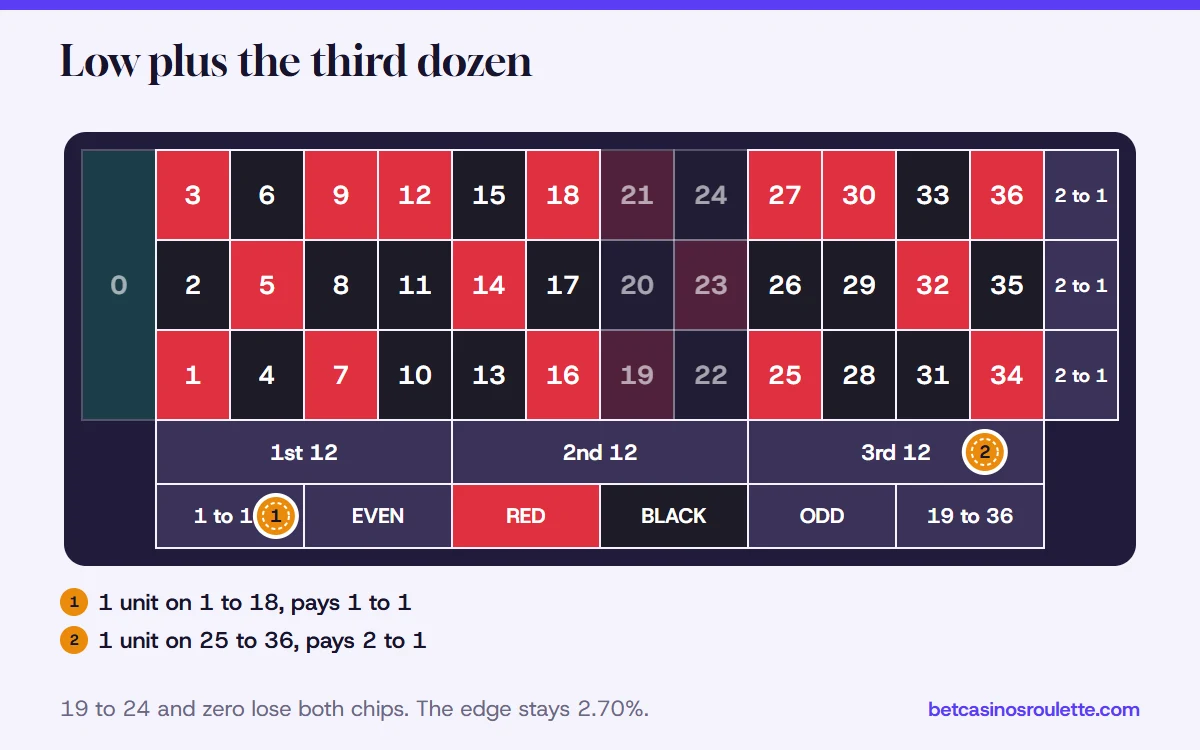
Combining bets can shape the ride, but it never stacks the odds in your favor. Take a mix many players like: 1 unit on low (1 to 18) and 1 unit on the third dozen (25 to 36). It covers 30 numbers, which sounds great.
- Ball on 1 to 18: low wins 1, the dozen loses 1. Net 0, and that happens on 18 numbers.
- Ball on 25 to 36: the dozen wins 2, low loses 1. Net plus 1, on 12 numbers.
- Ball on 19 to 24 or zero: both lose. Net minus 2, on 7 numbers.
Over 37 spins that is 12 units won and 14 lost, so you are down 2 units on 74 units bet: 2.70% again. Covering 30 numbers bought you a lot of break even spins, not an edge. More combinations are tested on dozens and columns and the strategy chart.
The best way to play roulette to win: what actually helps
Nothing on this list makes roulette a winning game, because nothing can. These are the levers that really move your results.
- Play single zero. Halving the edge does more than any system ever claims to.
- Hunt for a table posting la partage or en prison if you bet even money. That brings the cost down to about 1.35%.
- Bet smaller, play fewer spins. Your average cost is simply the edge times your total action. 200 units through a single zero wheel cost about 5.4 units on average; 50 units cost about 1.35.
- Decide when to stop before you start. A win goal and a loss limit do not change the math, but they stop one bad hour from becoming a bad night.
Betting systems that raise stakes after a loss just reshuffle when the wins and losses arrive. You can watch that happen on the testers linked from betting systems, and how to beat roulette lays out the math plainly.
Bets and tables worth skipping
- The five number bet. Five pockets out of 38 deserve 6.6 to 1, yet the payout on zero, double zero and 1 through 3 is just 6 to 1, so this one bet costs 7.89%.
- Triple zero wheels. A third green pocket pushes every bet to 7.69%. See triple zero roulette.
- Double zero when single zero is nearby. Same game, nearly double the cost. In Las Vegas single zero tables exist but often carry higher minimums.
- Chasing a number because it is hot or cold. Earlier spins carry no information about later ones.
For the whole menu of bets with their payouts, start at roulette bets.
Questions players ask
Which is the best bet in roulette?
Even money at a table running la partage or en prison, costing about 1.35%. Without them, all bets on a one zero wheel tie at 2.70%, and all but the five number bet tie at 5.26% when there are two zeros.
What is the safest bet in roulette?
Even money boxes top the list for frequency: 18 pockets of 37 each, or 48.65%, with one zero. They still lose more than they win over time, so safe only means steady.
What are the best odds on a roulette table?
Highest chance per spin: the even money boxes. Lowest cost: even money bets under French rules, then anything on a single zero wheel. Worst of all for value is the American top line.
What are the 5 best roulette bets?
Ranked by cost: even money under French zero rules, even money with the Atlantic City half back rule, any bet on single zero, any regular bet on double zero, and last a triple zero wheel. The five number bet does not make the list.
Is roulette the casino game with the best odds?
Not quite. Single zero roulette is fair value as casino games go, but some games, such as blackjack with good rules and correct play, cost less. Our comparison of casino game odds lines them up.
Can a combination of bets beat roulette?
No. Each bet in a combination carries the house edge, so the total does too. A combination changes how many spins break even, win or lose, never the average.