
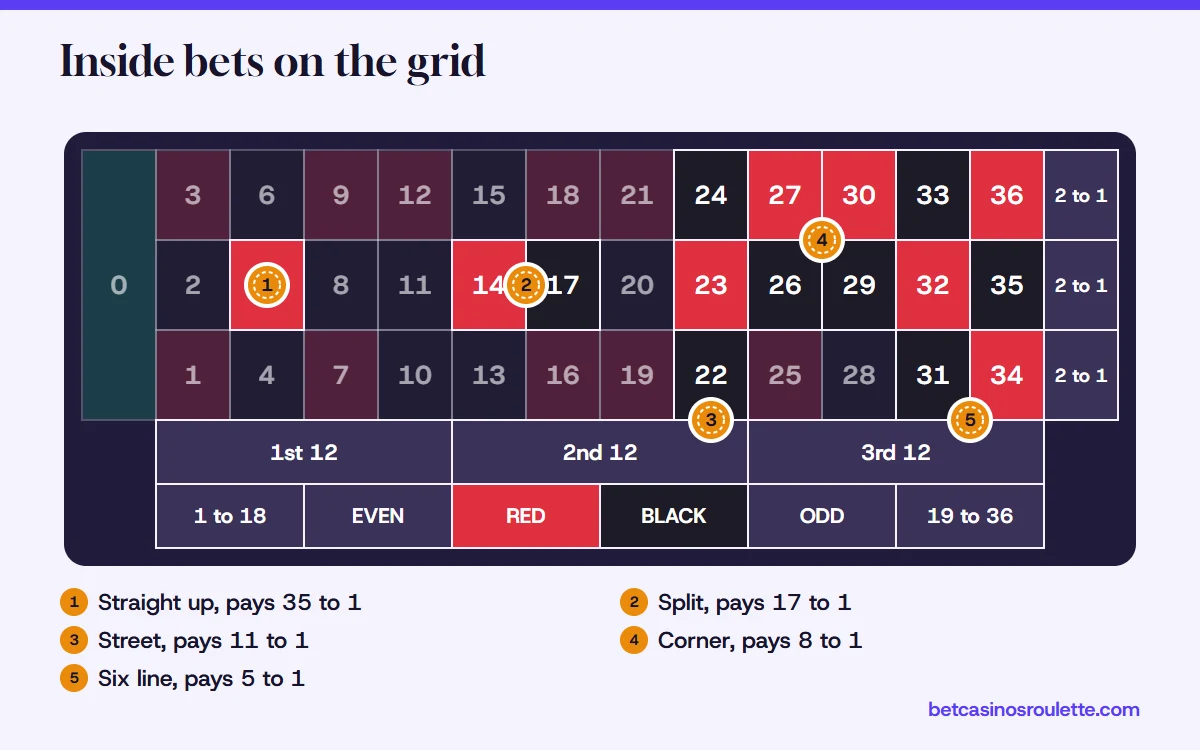
A roulette table is the felt board where bets are made: a grid holding 1 through 36, three columns wide and twelve rows deep, green zero pockets across the top, and wider boxes along the sides for dozens, columns, colors, odd and even, and the two halves. The interactive board below lets you pick any bet, tap it, and see which numbers it covers, what it pays and its chance of winning on both wheel types. It works like a roulette board that answers questions.
At the table
Grid
12 rows of 3 numbers, 1 at the top left nearest the zeroSpaces
37 numbered on a single zero layout, 38 with 00, 39 with 000Inside area
The numbers themselves: bets on 1 to 6 numbersOutside area
Boxes around the grid: bets on 12 or 18 numbersSame pay everywhere
Payouts match on all layouts; only the zeros change the oddsTool
Tap a bet, see coverage, payout, chance and edge
The roulette table layout explained
Stand at the end of the table nearest the wheel and look down the felt. The zero, or 0 and 00, sits at the head. Below it runs a long block of numbers three wide: 1, 2, 3 in the first row, 4, 5, 6 in the next, all the way to 34, 35, 36. Each number square is red or black.
Along one long side are three boxes for the dozens (1st 12, 2nd 12, 3rd 12) and beyond them six boxes for the even money bets: low (1 to 18), then even, then the red diamond, the black diamond, then odd, and finally high (19 to 36). At the far foot of each column is a box marked 2 to 1, which is the column bet. Everything inside the number block is the inside area; everything around it is the outside area.
How to use the interactive roulette table
- Pick a bet type from the list above the board, for example Corner.
- Tap the spot where four numbers meet, such as the point shared by 26, 27, 29 and 30.
- Those four squares light up. The panel shows the payout, 8 to 1.
- Read the chance: 10.81% when there is one green pocket, 10.53% when there are two.
- Read the edge: 2.70% against 5.26%. Then try another bet and compare.
Worked example: put 2 units on that corner. If 29 lands you win 16 units and keep your 2, so 18 come back. Across 100 spins at 2 units each you would stake 200 units, and the board's edge figure tells you the long run cost: about 5.4 units with one zero, about 10.5 with two.
Where every chip goes on a roulette table
| Chip position | Bet name | How many numbers | Paid |
|---|---|---|---|
| Centered on a number square | Straight up | 1 | 35 to 1 |
| Straddling the border of two squares | Split | 2 | 17 to 1 |
| Outside line of a three number row | Street | 3 | 11 to 1 |
| Corner where zero meets the 1 2 pair, or the 2 3 pair | Trio | 3 | 11 to 1 |
| Where four squares meet | Corner | 4 | 8 to 1 |
| Outer corner of 0 and 1 (single zero) | First four | 4 | 8 to 1 |
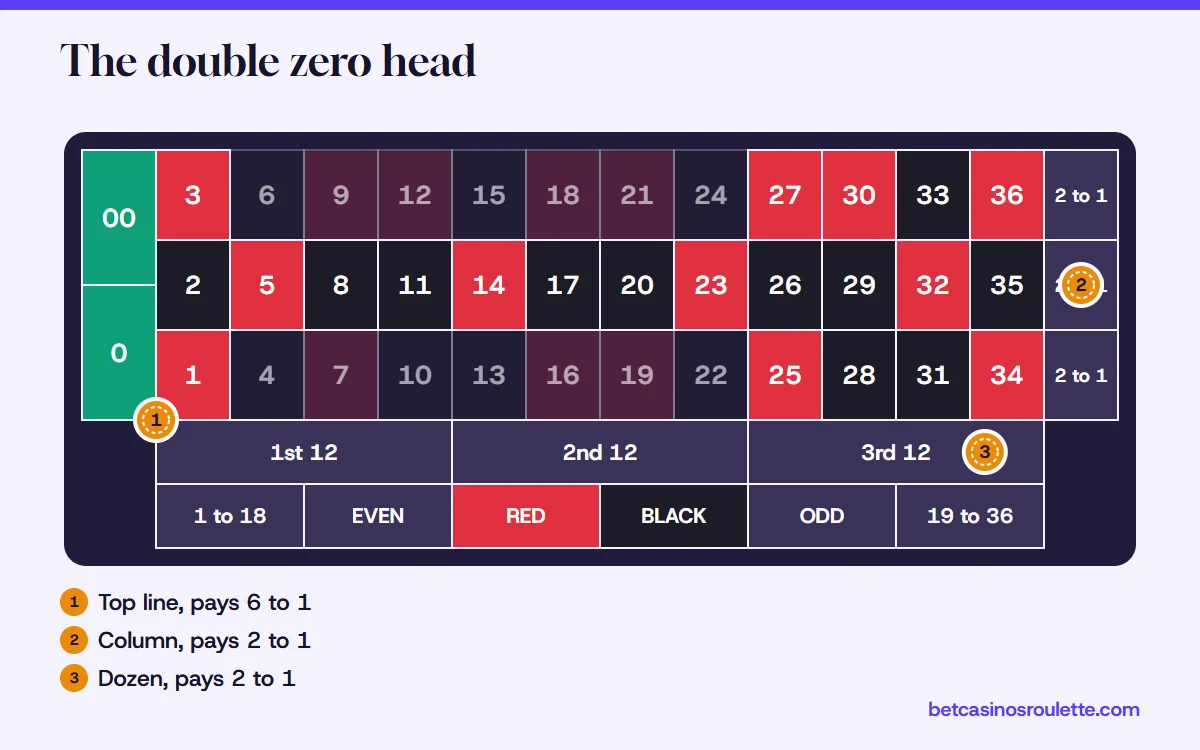
| Outer corner of 0 and 1 (with 00) | Top line, five numbers | 5 | 6 to 1 |
| Outer edge, on the line between two rows | Six line | 6 | 5 to 1 |
| A dozen box or a 2 to 1 box | Dozen or column | 12 | 2 to 1 |
| Any of the six side boxes | Even money | 18 | 1 to 1 |
Tap through any bet name for a full guide with odds for both wheels, or browse all roulette bets.
European, American and triple zero roulette tables
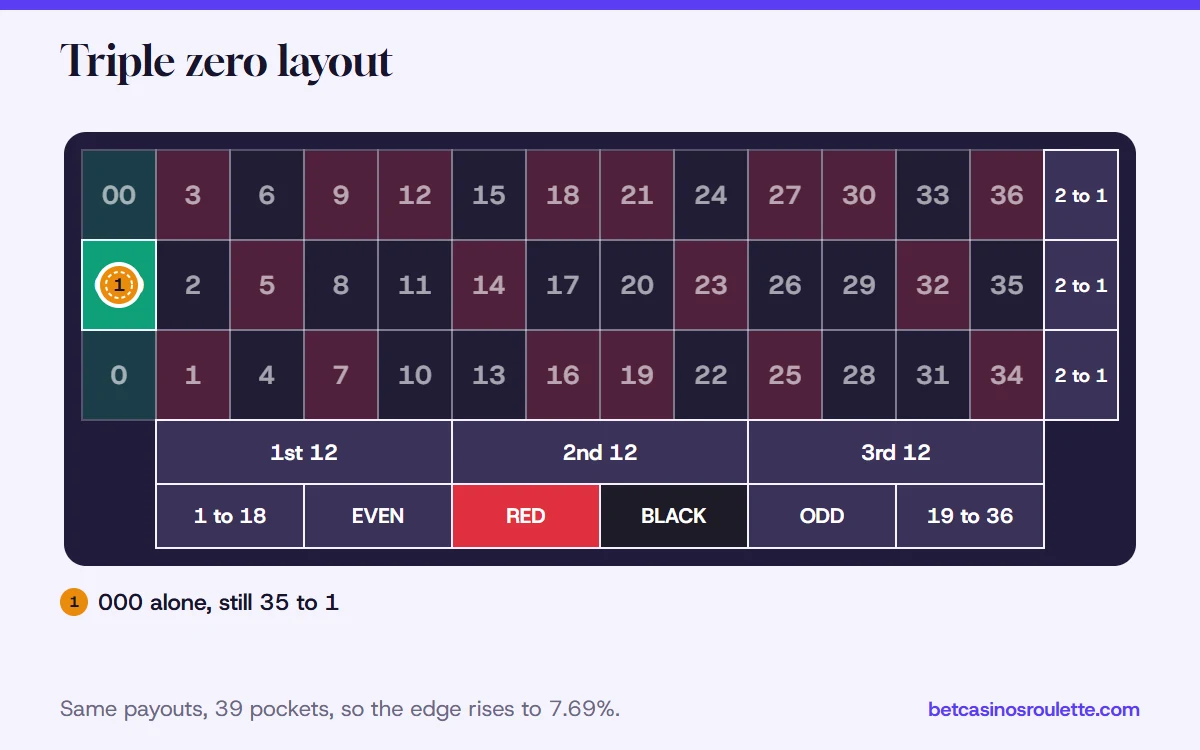
The grid of 1 to 36 never changes. The head of the table does. A single zero layout has one green box; an American layout has 0 and 00 side by side; a triple zero layout squeezes in 000 as a third. The American and triple zero tables add the top line bet across all the zeros plus 1, 2 and 3, which is the costliest wager on any 00 felt at a 7.89% edge.
French tables use the same numbers but print the outside boxes in French: manque (1 to 18), passe (19 to 36), pair (even), impair (odd), rouge and noir, and the dozens as P12, M12 and D12. Compare the games on European roulette, American roulette and triple zero roulette.
Roulette table numbers: patterns worth knowing
- Colors follow a rule. In the first ten numbers, and again in the ten that run 19 up to 28, red belongs to odd. In the other two blocks, 11 up to 18 and 29 up to 36, red belongs to even.
- The columns are lopsided on color. The first column has 6 reds and 6 blacks, the middle column only 4 reds, and the third column 8 reds.
- Numbers beside each other on the felt are not neighbors on the wheel. The wheel order is mixed on purpose.
- Each dozen holds 6 reds and 6 blacks.
The wheel order is a different map entirely, shown on roulette numbers and the wheel spinner.
Roulette table rules for placing chips
| Problem | Cause | What to do |
|---|---|---|
| Dealer reads your split as a straight bet | Chip drifted off the line | Set the chip so it clearly overlaps both squares |
| Your street became a six line | Chip sat on the line between rows | Place a street at the outer edge, centered on the row |
| Another player's chip sits on your number | Shared bets are allowed | Your color keeps the bets apart, so no action needed |
| The bet you want is out of reach | Long table | Hand chips to the dealer before the call and say the bet |
| Chips placed after the call | Late bet | They are returned, so bet right after the payout |
Home roulette tables, mats and online boards
On a casino floor, the roulette table has the wheel built into one end and the layout running away from it. For home games, a felt roulette mat and a small wheel do the same job. Make sure the mat matches the wheel: a 00 mat with a single zero wheel leaves one box that can never win. Online boards are drawn the same way, often with a wheel window on top and a racetrack for call bets on single zero games.
Whatever the surface, a roulette layout carries identical math. A chip covering more squares lands more often and pays a smaller multiple, and the edge comes from the green boxes alone. The payout table shows why the board pays what it pays.
Questions players ask
What does a roulette table look like?
A long felt board with a grid of 1 to 36 in three columns, green zero boxes at the top, and outside boxes along the side for dozens, colors, odd and even, and the two halves. The wheel sits at one end.
How does a roulette table work?
You place chips on the layout to show your bet, then the dealer spins the wheel. Whichever pocket catches the ball decides which chips win, and each winning bet is paid at its fixed rate.
How many spaces does a roulette table have?
On a single zero table there are 37 spaces (0 and 1 to 36), thirty eight with 00, and thirty nine on a triple zero table. The highest number is always 36.
Are roulette table layouts the same everywhere?
The number grid is the same everywhere. The zeros at the top and the language on the outside boxes change between European, American and French tables.
What are the boxes marked 2 to 1 below each column?
It is the column bet. A chip there covers all twelve numbers in that column and pays 2 to 1.
What is a roulette mat?
A printed felt layout used for home games. It should match your wheel, single zero or double zero, so every box on the mat can win.