
Learning how to play roulette takes about five minutes: you swap money or credits for chips, set those chips on the numbers or groups you think the ball will find, and the dealer spins. If the ball stops on something you covered, you are paid at a fixed rate and keep the chip you bet; if not, the chip is taken. Everything else on this page is detail that makes those five minutes go smoothly, plus a worked round so you can see the arithmetic before you try it.
At the table
Goal
Guess where the ball will stop, from one pocket to eighteenRound length
About a minute at a live table, seconds on a screenSimplest first bet
Red or black, paid 1 to 1Bigger swing
One number, paid 35 to 1The catch
Green zero beats every outside betCheapest table
Single zero, 2.70% edge, versus 5.26% with 0 and 00
How to play roulette in seven steps
- Find a table and read the sign. A small placard shows the wheel type and the lowest and highest bet allowed. Pick one with a single zero if you can.
- Buy in between spins. Put your cash on the felt, never in the dealer's hand, and say you want roulette chips. You get a stack in your own color, and the dealer marks what each chip is worth.
- Place your chips. A chip can sit in the middle of one number, straddle the border of two, perch where four meet, or go in one of the big boxes around the edge. Spread chips over as many bets as you like.
- Watch the spin. The dealer sets the wheel turning and sends the ball the other way. You can keep betting for a few more seconds.
- Stop at the call. When the dealer says no more bets and passes a hand over the layout, hands off. Late chips are pushed back.
- See the result. The ball settles, the dealer announces the number and its color, and puts the dolly on that square.
- Get paid. Losing chips are raked in, then winners are paid next to the winning bet. Leave everything alone until the dolly is lifted.
Rather rehearse first? The free roulette simulator lets you repeat these steps with play credits until they feel automatic.
How roulette works: what decides the number
The wheel has a spinning center, called the rotor, with numbered pockets around its edge. Above it sits a sloped bowl with a track for the ball. As the ball loses speed it falls toward the pockets, hits small metal deflectors, bounces between pocket dividers, and comes to rest. Because so many tiny bounces happen, nobody can steer the result.
Each spin starts fresh. The wheel does not remember that red came up five times, and it does not owe anybody a black. A streak of ten reds on a single zero wheel turns up about once in 1,350 tries, which sounds rare until you remember how many spins a busy table sees in a week.
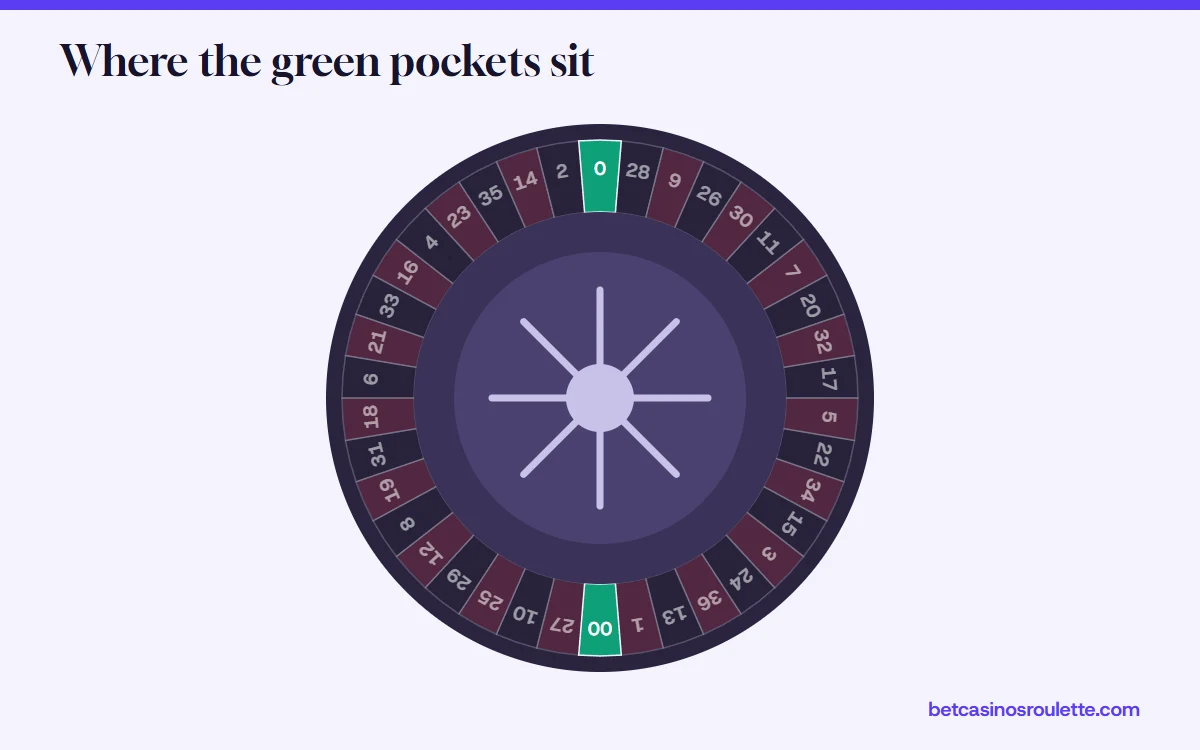
The order of numbers around the rim is fixed and deliberately mixed. You can watch it on the spinning wheel tool, and the full sequence with its color pattern is on roulette numbers.
Choosing your first roulette bets
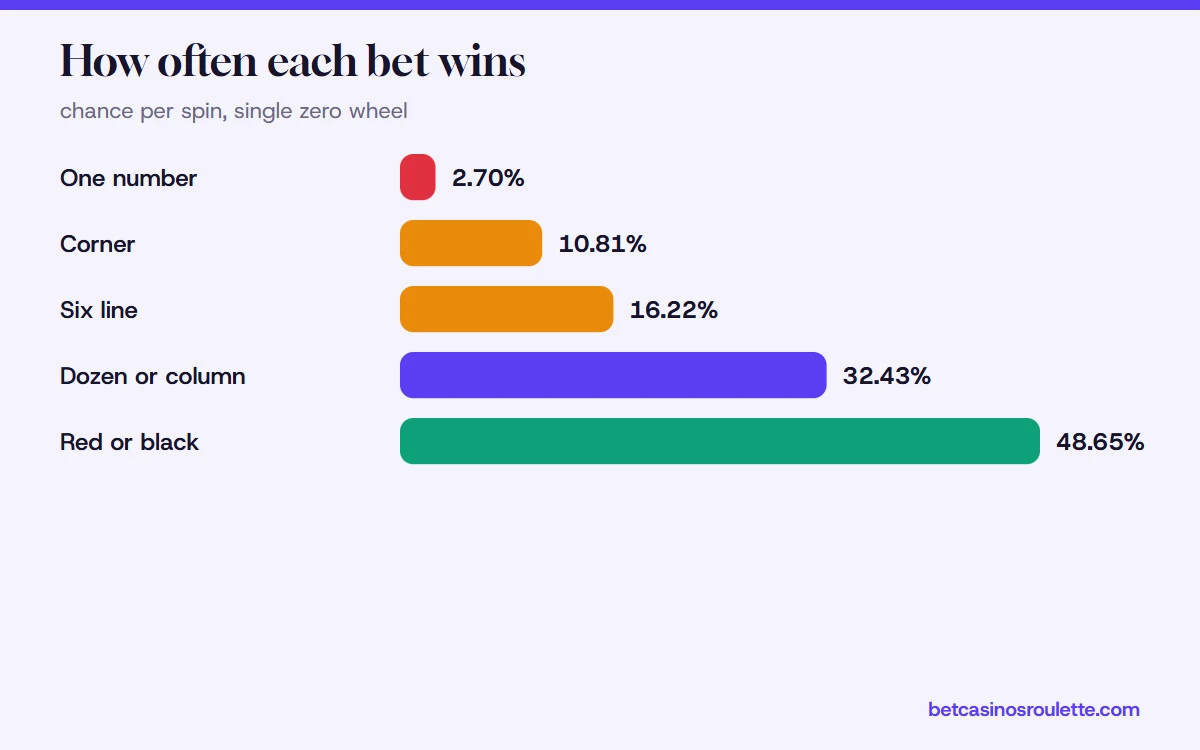
A good first bet is one you understand completely. Start wide, then try narrower bets once the payouts make sense.
| If you want | Try this bet | It covers | Expect a win about | Paid |
|---|---|---|---|---|
| Frequent small wins | Any of the six even chance boxes | eighteen | every second spin, a bit less | 1 to 1 |
| A middle path | Any dozen or column | twelve | one spin in three, a bit less | 2 to 1 |
| A little more punch | A six line | 6 numbers | one spin in six | 5 to 1 |
| Four chances on one chip | A corner | 4 numbers | one spin in nine | 8 to 1 |
| The long shot | One number | 1 number | once in 37 spins (38 on American) | 35 to 1 |
Each bet has its own page in the roulette bets guide with a picture of where the chip goes.
A worked round: 10 units on three bets
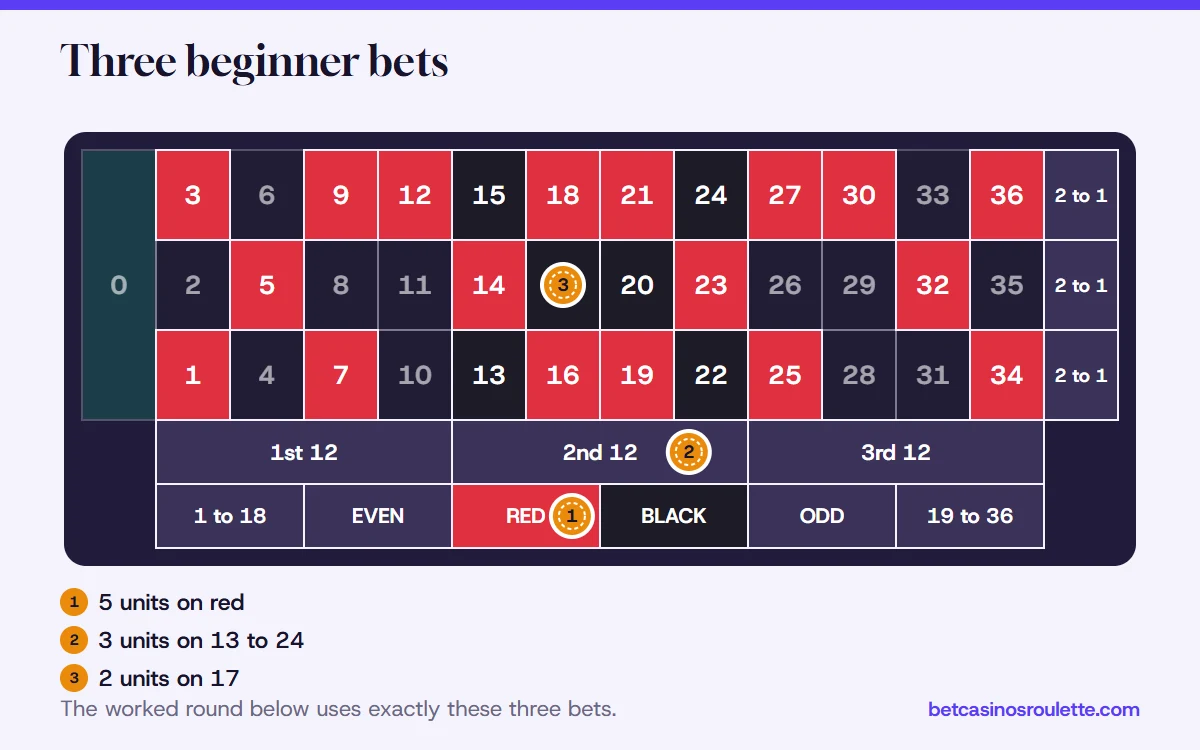
Picture a 10 unit round split three ways: red takes 5, the middle dozen (13 through 24) takes 3, and the single number 17 takes 2. Here is what happens on six different landings:
| Ball lands on | Red (5) | Second dozen (3) | Number 17 (2) | Net for the round |
|---|---|---|---|---|
| 17, black | lose 5 | win 6 | win 70 | plus 71 |
| 14, red | win 5 | win 6 | lose 2 | plus 9 |
| 5, red | win 5 | lose 3 | lose 2 | 0, break even |
| 20, black | lose 5 | win 6 | lose 2 | minus 1 |
| 31, black | lose 5 | lose 3 | lose 2 | minus 10 |
| 0, green | lose 5 | lose 3 | lose 2 | minus 10 |
Notice that most landings give a small gain or a small loss, and one rare landing gives a big jump. That is how mixed bets feel at the table. Over many rounds the average still drifts down by roughly 0.27 of a unit for every 10 units staked at a 37 pocket table.
How to play roulette at a casino without looking new
- Wait for the dolly to come off before you buy in or bet.
- Can't reach a number? Set the chips near the dealer between spins and say the bet clearly, for example "5 on 17".
- Stack chips neatly, one bet per stack, so the dealer can read them.
- Your wheel chips are worth something only at that table. Before leaving, push them to the dealer and swap them for regular casino chips. See roulette chips.
- Keep drinks and phones off the felt.
Beginner problems and the fix
| What goes wrong | Why it happens | Fix |
|---|---|---|
| Your chip is pushed back | It went down after the call | Bet right after the payout, not during the spin |
| Your outside bet is refused | It is below the table minimum | Each outside bet needs the full minimum on its own |
| You were paid less than you expected | The chip sat on a line, not a number | Center chips inside the square for a single number |
| Red lost but the ball looked close | It landed on green | Remember zero beats all outside bets |
| Your stack disappears fast | Bets too big for the bankroll | Size each bet at 1 to 2 percent of what you brought |
Playing online or on the free simulator
The rules do not change on a screen. Electronic games either film a real wheel or use a random number generator that regulators require to be tested. You tap a chip value, tap the layout, and press spin. The only real difference is speed: a screen can deal several hundred rounds an hour, so the house edge works on your balance faster than at a slow live table.
On this site the roulette simulator gives you a full table with 1,000 credits, the wheel spinner shows the pocket order and fast batches of spins, and the interactive table layout shows what any bet covers before you place it.
Every guide in the Play group
Once the basics click, these pages fill in the rest, grouped by what you will want to know next.
| Topic | Guides |
|---|---|
| The game itself | What is roulette, Wheel numbers |
| Free practice | Free roulette simulator, Spin the wheel, Table layout |
| Game versions | European roulette, American roulette, French roulette, Triple zero roulette |
| The wheels up close | European wheel, American wheel |
| Chips and money rules | Roulette chips, Table limits |
| Playing in a place | Roulette in Las Vegas, California roulette |
Can you play roulette and win? What really helps
No way of playing wins every time, and anyone selling one is selling a story. The edge is fixed per wheel, identical for a corner or a color, so the choices that matter are the wheel (single zero over double zero), the size of each bet against your bankroll, and when you stop. Betting systems like the Martingale only rearrange wins and losses; the roulette strategy section tests each one in units.
Questions players ask
How do you play roulette at a casino?
Buy in at the table between spins, place your wheel chips on the layout, and keep hands off once betting is closed. After the dolly lands, the losers are scooped and the winners are counted out. Cash your wheel chips in at the same table before you leave.
What are the basic rules of roulette?
Bet before the call, one ball decides every bet, and payouts follow a fixed table from 35 to 1 down to 1 to 1. Zero is green and makes all outside bets lose. Each table sets its own minimum and maximum.
How do you play roulette for beginners?
Start with one outside bet such as red or a dozen, at the table minimum. Watch a few rounds to see how the dealer pays. Then add an inside bet or two once the payouts feel familiar.
Is there a way to play roulette and win all the time?
No. Over time every bet hands back about 97.3% of its stake at a 37 pocket table and about 94.7% at a 38 pocket table. You can win sessions, but no method makes wins certain.
What happens when the ball lands on 0?
Anything that covers the zero, such as a straight bet on it or a split with 1, collects. Every box outside the grid is swept, though French rules can soften that for the even chance boxes: half comes back, or the chip waits in jail until the next result decides it.
Can I learn roulette without spending anything?
Yes. The simulator on this site hands you 1,000 play credits, and one tap starts over. It follows the same payouts and rules as a casino table.