
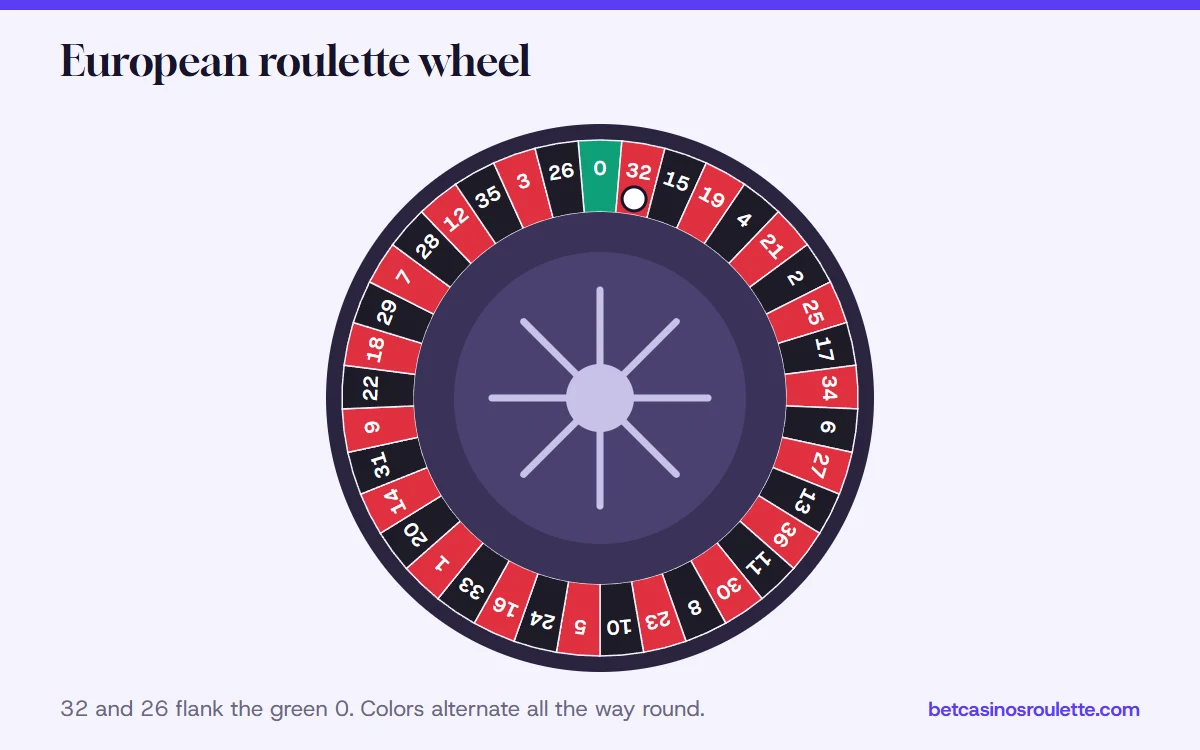
A European roulette wheel has 37 pockets, a lone green 0 plus thirty six numbers that swap between red and black, laid out in a fixed sequence that runs clockwise from 0 as 32, 15, 19, 4, 21 and onward until it returns through 26. That sequence is the same on every standard single zero wheel, including the ones used for French roulette. This page gives the complete order position by position, explains the design choices behind it, and maps the sectors that dealers and players name when they talk about parts of the wheel.
At the table
Pockets
37: a single green 0 plus 1 to 36Starts
Clockwise from 0: 32, 15, 19, 4, 21 ...Next to 0
32 on one side, 26 on the otherColors
Red and black alternate with no breakLow and high
Alternate everywhere except where 10 meets 5Used for
European and French roulette, 2.70% edge
The single zero roulette wheel at a glance
Seen from above, the single zero wheel is a ring of 37 numbered pockets around a turning center. One pocket is green, the 0. The other 36 switch between red and black the whole way around, with no two of the same color touching. The ball travels around the rim in one direction while the wheel turns in the other, and the pocket where it comes to rest is the result.
Each pocket is equally likely: 1 chance in 37, about 2.70% per spin. That fact does not depend on the order of the numbers at all. The order is about appearance and balance, so that no arc of the rim is crowded with reds, or with small numbers, or with high ones.
European roulette wheel number order, clockwise
Below is the official sequence, starting at 0 and moving clockwise. The range column shows the low numbers (1 to 18) and high numbers (19 to 36), which makes the design easy to spot.
| Position | Color | Low or high | |
|---|---|---|---|
| 0 | 0 | Green | Zero |
| 1 | 32 | Red | High |
| 2 | 15 | Black | Low |
| 3 | 19 | Red | High |
| 4 | 4 | Black | Low |
| 5 | 21 | Red | High |
| 6 | 2 | Black | Low |
| 7 | 25 | Red | High |
| 8 | 17 | Black | Low |
| 9 | 34 | Red | High |
| 10 | 6 | Black | Low |
| 11 | 27 | Red | High |
| 12 | 13 | Black | Low |
| 13 | 36 | Red | High |
| 14 | 11 | Black | Low |
| 15 | 30 | Red | High |
| 16 | 8 | Black | Low |
| 17 | 23 | Red | High |
| 18 | 10 | Black | Low |
| 19 | 5 | Red | Low |
| 20 | 24 | Black | High |
| 21 | 16 | Red | Low |
| 22 | 33 | Black | High |
| 23 | 1 | Red | Low |
| 24 | 20 | Black | High |
| 25 | 14 | Red | Low |
| 26 | 31 | Black | High |
| 27 | 9 | Red | Low |
| 28 | 22 | Black | High |
| 29 | 18 | Red | Low |
| 30 | 29 | Black | High |
| 31 | 7 | Red | Low |
| 32 | 28 | Black | High |
| 33 | 12 | Red | Low |
| 34 | 35 | Black | High |
| 35 | 3 | Red | Low |
| 36 | 26 | Black | High |
After position 36 (pocket 26) the next pocket is 0 again. To learn the order, practice it in small chunks of five or six and say them aloud. Dealers learn it the same way, because they need to find any number on the wheel at a glance when calling bets on neighbors.
Why the single zero order looks the way it does
The sequence is not random. It follows a few rules that keep the wheel balanced:
- Color never repeats. Red, black, red, black, for all 36 numbers. The green 0 sits between a red (32) and a black (26).
- Low and high take turns. Every low number is next to high ones, with a single exception: 10 and 5, both low, sit side by side opposite the zero.
- Two equal halves. Split the rim with a cut through 0 and through the gap between 10 and 5. Each half then holds 18 numbers: 9 red, 9 black, and a total of 333, half of the 666 you get by adding 1 to 36.
- Odd and even are mixed with no strict pattern, which helps keep any short arc from leaning one way.
The point of all this is that a ball landing in one part of the wheel does not favor any outside bet. It is cosmetic fairness on top of the real fairness, which comes from each pocket being the same size.
Sectors of the European wheel
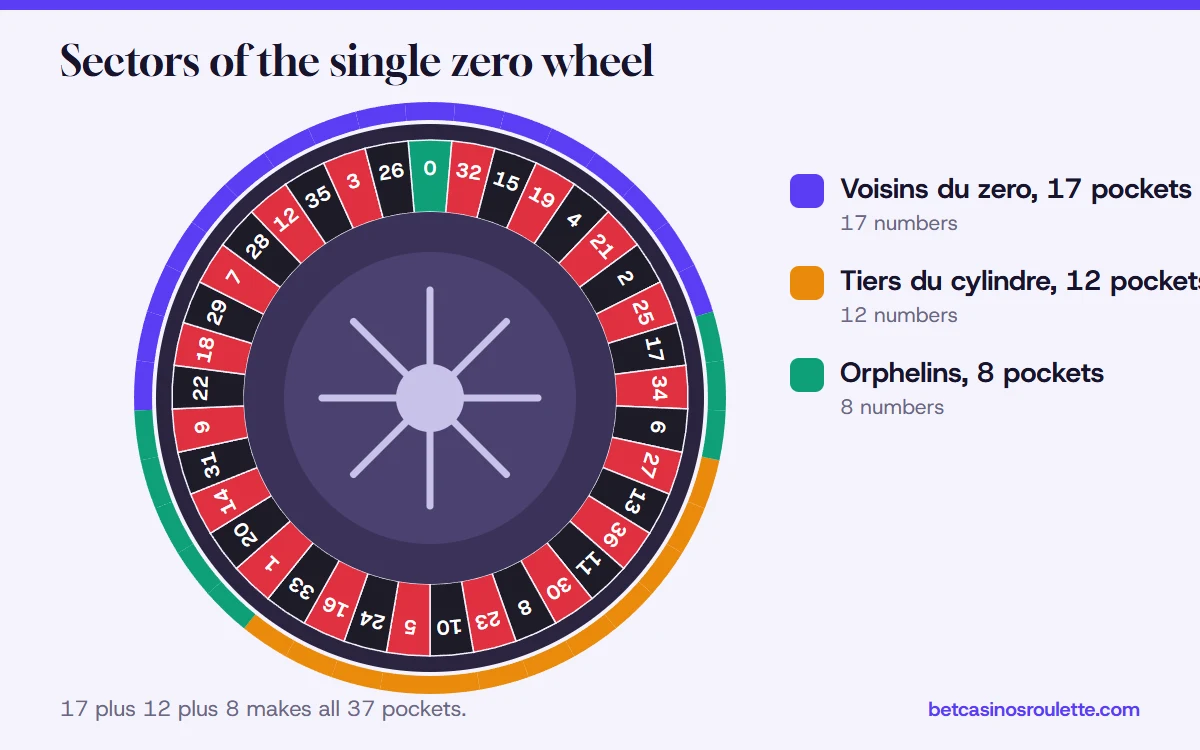
Because the order never changes, players and dealers name whole regions of it. These sectors are the basis of call bets on French and many European tables.
| Sector | Pockets | Where it sits | Count |
|---|---|---|---|
| Voisins du zero (neighbors of zero) | 22 through to 25, passing over 0 | The arc around the green pocket | 17 |
| Jeu zero (zero game) | 12, 35, 3, 26, 0, 32, 15 | The tight core of that arc | 7 |
| Tiers du cylindre (third of the wheel) | 27 through to 33 | The arc facing the zero | 12 |
| Orphelins (orphans) | 17, 34, 6 and 1, 20, 14, 31, 9 | Two short arcs left between the others | 8 |
Voisins, tiers and orphelins together cover all 37 pockets once. Betting a whole sector leaves the casino's margin untouched; each chip is still a normal split or straight bet at 2.70%. How these bets are placed and paid is on call bets.
European roulette wheel numbers and colors list
Here are the colors read in wheel order rather than counting order, which is how you would see them if you followed the ball around the rim.
- Red, clockwise from 0: 32, 19, 21, 25, 34, 27, 36, 30, 23, 5, 16, 1, 14, 9, 18, 7, 12, 3.
- Black, clockwise from 0: 15, 4, 2, 17, 6, 13, 11, 8, 10, 24, 33, 20, 31, 22, 29, 28, 35, 26.
- Green: 0, the only one.
On the felt the same numbers keep their colors, but they sit in counting order, where the rule is easier: odd means red in the bands up to 10 and from 19 through 28, while even means red in the bands 11 through 18 and 29 through 36. The full list with payouts is in wheel numbers.
The wheel and the European roulette table layout
The single zero table layout is a grid in counting order, three columns of twelve numbers each, topped by a wide 0 box. The wheel scatters those numbers. For example, 5 and 8 sit next to each other on the felt (a split), yet on the wheel 5 is beside 10 and 24 while 8 sits between 30 and 23.
That gap between felt and wheel explains why two kinds of betting exist. Bets on the felt group numbers by their place in the grid. Call bets group numbers by where they sit around the rim. Either style costs 2.70% over time. To compare with the double zero wheel, where every number faces its partner across the rim, see the American roulette wheel page.
Are all European roulette wheels the same?
The number sequence is standard: every single zero wheel uses the order shown above, and French roulette uses the very same wheel. Size, finish, pocket dividers and the shape of the center turret differ from maker to maker and casino to casino.
Casinos check wheels for level and wear and swap them between tables, since a damaged wheel could stop being random. A player cannot read that from a few spins, and trying to is a waste of time. Online single zero games either stream a physical wheel or run software whose randomness the UK Gambling Commission, among other regulators, requires to be tested.
Questions players ask
What is the number sequence on a European roulette wheel?
Going clockwise from 0, in groups of five: 32, 15, 19, 4, 21; next 2, 25, 17, 34, 6; next 27, 13, 36, 11, 30; next 8, 23, 10, 5, 24; next 16, 33, 1, 20, 14; next 31, 9, 22, 18, 29; next 7, 28, 12, 35, 3; and finally 26, beside the 0.
How many pockets does a European roulette wheel have?
There are 37: thirty six numbered pockets, half red and half black, plus one green 0. That single zero gives the wheel its 2.70% house edge.
Which numbers are next to 0 on a single zero wheel?
32 sits on one side of the 0 and 26 on the other. Just beyond them are 15 and 3, which is why those numbers appear in the zero game sector.
Is the French roulette wheel the same as the European wheel?
Yes. Both use the same 37 pocket single zero wheel in the same order. French roulette differs in the table language and its zero rules for even money bets, not in the wheel.
Why are roulette numbers not in order on the wheel?
The order spreads colors, low and high numbers, and odd and even numbers around the rim, so no part of the wheel favors one outside bet. It does not change the odds, since all 37 pockets are equally likely.