
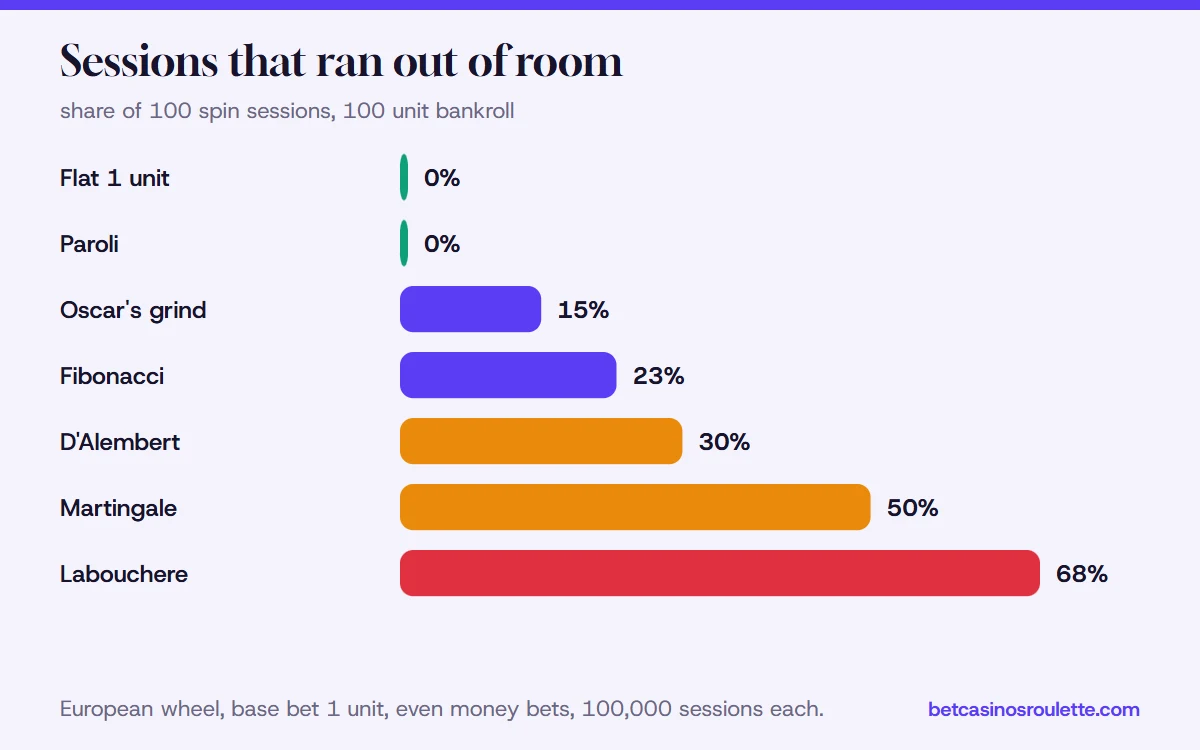
Roulette betting systems are rules for sizing or placing your bets, such as doubling after a loss or covering most of the layout, and not one of them beats the house edge: they only change how frequently a session ends up and how deep the bad ones go. A European wheel keeps 2.70 units of every 100 you bet, and no order of bets adds up to anything better.
That does not make them useless to understand. Below, each well known system is explained in a line, then all of them are run through the same 100,000 simulated sessions so you can see the trade each one makes. You can rerun any of them on the free tester.
At the table
Systems covered
Martingale, Fibonacci, D'Alembert, Labouchere, Paroli, Oscar's grind, James Bond, RomanoskyDoes any beat the edge?
No. All lost about 2.7% of stakes in testing (single zero)Negative progressions
Raise after losses: many small wins, rare big lossesPositive progressions
Raise after wins: many small losses, rare bigger winsCoverage patterns
Spread chips over many numbers at onceBest use
Shaping a session for fun, with a fixed loss limit
What roulette betting systems actually change
A system can change three things: how often a session ends ahead, how big the worst sessions get, and how many units you put into action. It cannot change what each bet pays or how often it wins. Red still lands in 18 of every 37 spins over time when there is one zero, whatever came before.
Here is the trade in one picture. Raising after losses buys a high chance of a small win with a real chance of losing most of the bankroll. Raising after wins does the opposite.
Every system in one table
| System | Type | Next bet when you lose | Next bet when you win | Full guide |
|---|---|---|---|---|
| Martingale | Negative | Double the bet | Back to 1 unit | Martingale |
| Fibonacci | Negative | One step along the Fibonacci list | Two steps back | Fibonacci |
| Labouchere | Negative | Write the stake at the end | Cross off first and last | Labouchere |
| D'Alembert | Negative | Add 1 unit | Take away 1 unit | Below on this page |
| Paroli | Positive | Back to 1 unit | Double, bank after three | Paroli |
| Oscar's grind | Positive | Same bet | Add 1 unit while behind | Below on this page |
| James Bond | Coverage | Same 20 unit spread | Same 20 unit spread | James Bond |
| Romanosky | Coverage | Same 8 unit spread | Same 8 unit spread | Romanosky |
Negative progressions chase losses. Positive progressions press wins. Coverage patterns keep the stake flat but spread it so that most numbers pay something, which simply trades big payouts for frequent small ones.
Roulette systems compared: 100,000 sessions each
Identical conditions for each method: a European wheel, red on every spin, 1 unit as the first stake and 100 units of bankroll. A session lasted 100 spins unless the system demanded a stake larger than the chips remaining. These are simulation results, so treat them as approximate.
| System | Sessions up | Went bust | Average | Units bet per session |
|---|---|---|---|---|
| Flat bet, 1 unit | 36% | 0% | -2.7 | 100 |
| Paroli | 38% | 0% | -4.6 | 169 |
| Fibonacci | 74% | 23% | -5.9 | 214 |
| Martingale | 49% | 50% | -6.2 | 232 |
| Oscar's grind | 68% | 15% | -7.1 | 258 |
| D'Alembert | 55% | 30% | -12.6 | 462 |
| Labouchere | 31% | 68% | -17.2 | 631 |
Read the last two columns together. Divide each average loss by the units staked and every row lands near 2.7%. The systems that look worst simply put more chips through the wheel. With 00 added, that rerun lost about 5.3% of stakes for every system. The house edge is a tax on action, and a progression only changes how much action you take.
The D'Alembert roulette system
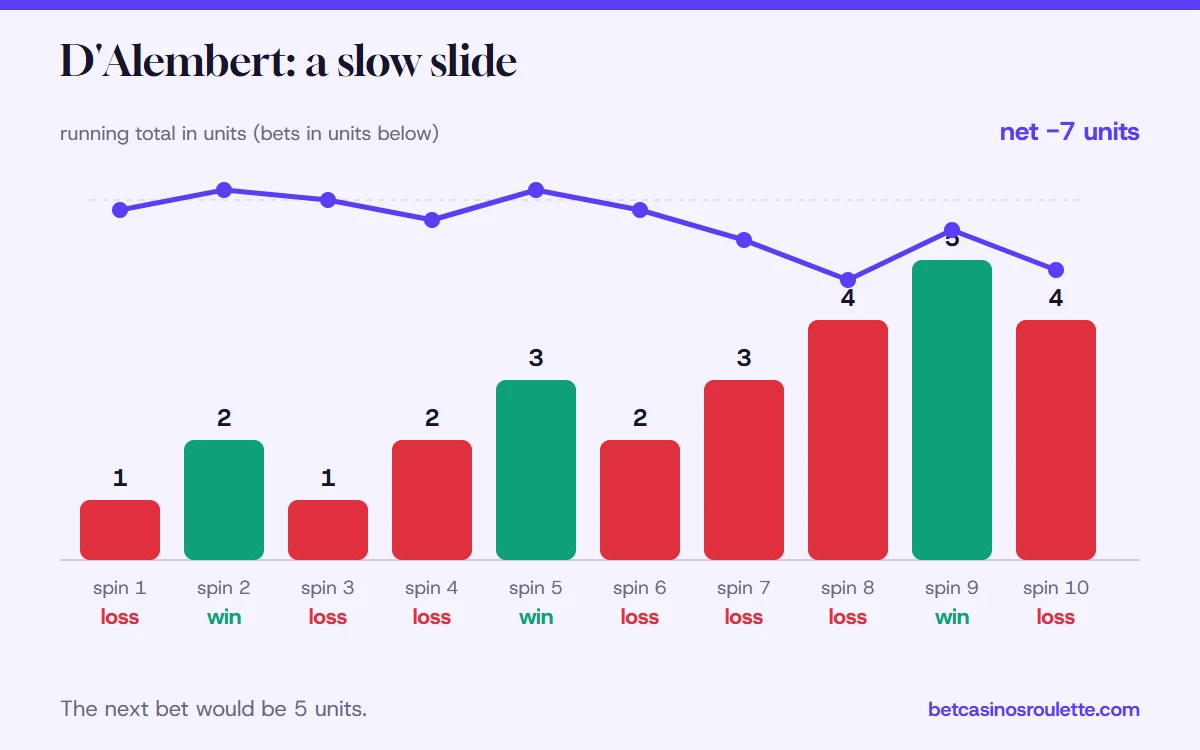
D'Alembert is the gentlest negative progression. It rests on the idea that wins and losses even out, which they do not in any way you can bet on, but its small steps keep the damage slow.
- Open each session with a single unit on an even money chance.
- After a loss, add 1 unit to the next bet.
- After a win, take 1 unit off, never going below 1.
- Stop at your time or loss limit.
| Spin | Stake | W or L | Net |
|---|---|---|---|
| 1 | 1 | L | -1 |
| 2 | 2 | L | -3 |
| 3 | 3 | L | -6 |
| 4 | 4 | W | -2 |
| 5 | 3 | L | -5 |
| 6 | 4 | W | -1 |
| 7 | 3 | W | +2 |
| 8 | 2 | L | 0 |
| 9 | 3 | L | -3 |
| 10 | 4 | W | +1 |
Four wins and six losses still gave a 1 unit profit, because the wins landed on bigger bets. Shuffle the same results into another order and you can finish behind. A cold spell climbs steadily: ten losses in a row would ask for an 11 unit bet after 55 units lost.
Oscar's grind
Oscar's grind aims for exactly 1 unit of profit per series, then starts over. It raises only after a win, and only while the series is still behind.
- Start a series with a 1 unit bet.
- After a loss, keep the same bet.
- After a win, add 1 unit, unless a win at that size would take the series past plus 1. Then bet just enough to reach plus 1.
- When the series reaches plus 1, start a new series at 1 unit.
| Spin | Stake | Hit or miss | Series total |
|---|---|---|---|
| 1 | 1 | Miss | -1 |
| 2 | 1 | Miss | -2 |
| 3 | 1 | Hit | -1 |
| 4 | 2 | Miss | -3 |
| 5 | 2 | Hit | -1 |
| 6 | 2 | Hit | +1, series done |
Six spins for 1 unit. It feels calm, and 68% of test sessions ended ahead. The 15% that ran dry lost about 93 units each, because a long series keeps the bet raised while the losses pile up.
Coverage systems, PDFs and winning formulas
Coverage patterns spread one stake over many numbers. The James Bond pattern puts 20 units across 25 numbers and loses all 20 when 1 to 12 hits. The Romanosky spreads 8 units across 32 numbers and loses all 8 on the other five. Both win on most spins and still give back 2.70% of every stake over time.
You will also find systems sold as a PDF or a winning formula, with names built from numbers. Check any of them the same way: list every number on the layout, add up what each one pays against the total staked, and divide by 37. If the answer is below the stake, and it always is, the formula loses. A layout cannot be covered in a way that pays more than it costs, because each number pays 35 to 1 where 36 to 1 would only break even.
How to use the free roulette betting system simulator
The Martingale is preloaded in the tester above, and its menu also holds every other progression on this page plus flat betting. A quick experiment:
- Enter 100 for the bankroll and the table limit, 1 for the base bet, 100 for spins and 1,000 for sessions, on the European wheel.
- Run the Martingale. Jot down the up share, the bust share and the peak stake.
- Switch to D'Alembert, then Paroli, keeping every other setting. Write the three results side by side.
- Swap in the American wheel, then run all three once more.
You will see the shares move around a lot and the average result stay negative every time. That is the most useful thing a roulette system simulator can show you. If you want to spin by hand, the roulette simulator runs on play credits.
Choosing a roulette staking system honestly
If you use one at all, pick it for the session you want, not for a promised profit. Want long, quiet play? Flat bets or Paroli. Like frequent small wins and accept a rare heavy loss? Fibonacci or Oscar's grind with a firm stop. The best roulette betting strategy for your odds is still choosing a single zero table, or one with la partage, which cuts the price of even money bets in half. For the full picture start at roulette strategy, and for honest limits on what is possible read how to beat roulette.
Questions players ask
What is the best roulette betting system?
None of them wins over time, so the best one is the one that fits how you want to play. In testing, flat betting and Paroli lost the least per session because they staked the fewest units. Fibonacci and Oscar's grind ended ahead most often but carried rare heavy losses.
Are there roulette systems that actually work?
Not in the sense of beating the house. Every system tested gave up about 2.7% of its stakes with one zero and about 5.3% with two. A system can only reshape the wins and losses.
How does the D'Alembert roulette system work?
You bet 1 unit on an even money box, add 1 unit after each loss and take 1 unit away after each win. Stakes rise slowly, so streaks hurt less than with doubling. The edge still wins in the end, and in testing about 30% of 100 spin sessions with 100 units ran out of chips.
Is there a roulette betting system PDF that works?
No printed method can change what the numbers pay. Test any system by adding up its payouts over all 37 numbers and comparing that with the total staked. It always comes out short by the house edge.
Which roulette system is safest for a small bankroll?
Flat bets and Paroli never ran out of chips in our 100 spin tests with 100 units, because the biggest bet stayed tiny. Doubling systems ran dry in half the sessions. Small stakes and a fixed stop matter more than the system.
Do betting systems work better on European roulette?
They lose about half as fast, because the single zero edge is 2.70% against 5.26% for the double zero wheel. The system itself does nothing extra. The wheel choice is what helps.