
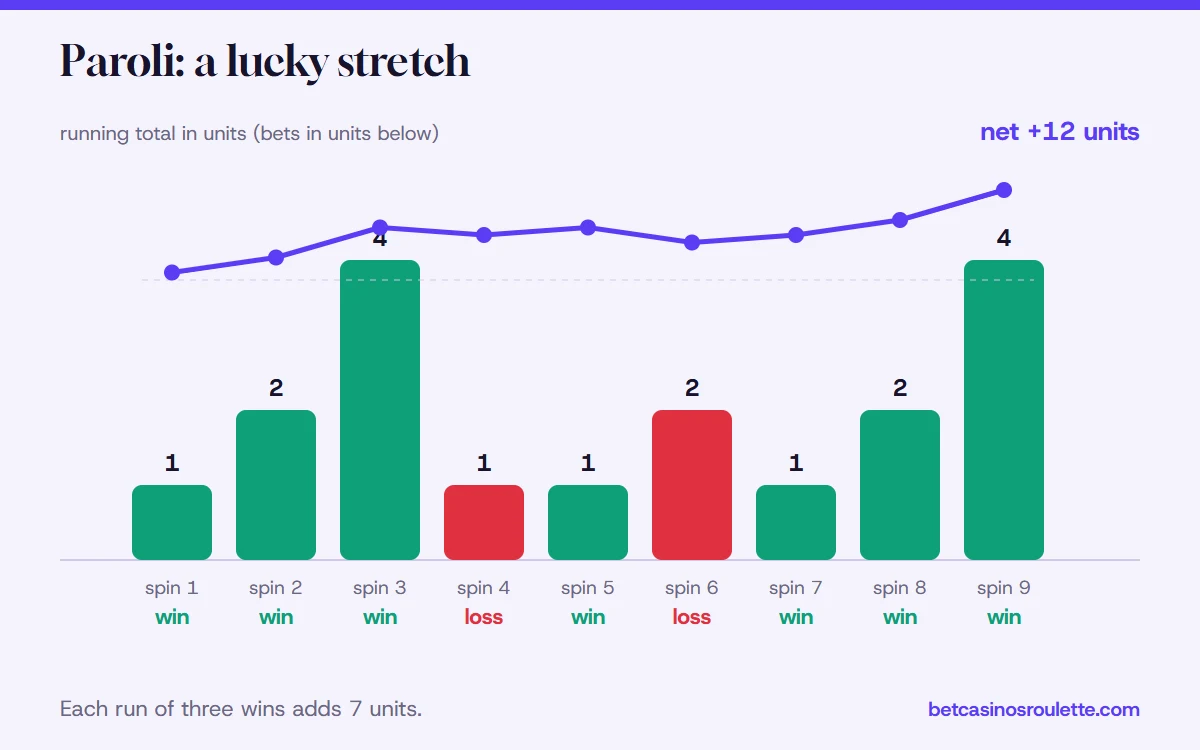
The Paroli roulette system raises an even money stake to twice its size after each win and returns to the base bet after any loss or after three wins in a row, so your losses stay small while a lucky streak pays 7 units, but the house edge still wins over time. It is the mirror image of the Martingale. You risk the casino's chips on the way up instead of your own on the way down.
Here are the rules, a worked run, the exact chance of finishing a streak, and what happened across 100,000 test sessions.
At the table
Kind of system
Positive progression: stakes rise after winsStakes in a cycle
1, 2, 4 units, then back to 1Full streak pays
7 units for three wins in a rowChance of three wins in a row
11.51% European, 10.63% AmericanMost a cycle can lose
1 unitLong run result
About 2.70% of all stakes lost on a single zero table
How the Paroli roulette system works
Every cycle opens with 1 unit on red or another even chance and ends after one loss or three wins.
- Bet 1 unit on red (or black, odd, even, low, high).
- Win, and you leave the 1 unit stake and its 1 unit payout on the table: the next bet is 2.
- Win again, and the bet becomes 4.
- Win a third time and take the chips back. You are 7 units ahead for the cycle. Start again at 1.
- Lose at any point and the cycle ends 1 unit down. Start again at 1.
Why does every losing cycle cost exactly 1 unit? Because the 2 and the 4 were made of winnings. Lose the 4 unit bet and you have given back the 3 units you won plus your first unit. That is the charm of the method: no cycle can ever dig a deep hole.
A worked Paroli example in units
| Spin | Stake | Outcome | What happens next | Session net |
|---|---|---|---|---|
| 1 | 1 | Win | Let it ride: 2 | +1 |
| 2 | 2 | Win | Let it ride: 4 | +3 |
| 3 | 4 | Win | Bank, back to 1 | +7 |
| 4 | 1 | Loss | Back to 1 | +6 |
| 5 | 1 | Win | Up to 2 | +7 |
| 6 | 2 | Loss | Back to 1 | +5 |
| 7 | 1 | Win | Up to 2 | +6 |
| 8 | 2 | Win | Up to 4 | +8 |
| 9 | 4 | Win | Bank, back to 1 | +12 |
This is the session people remember: two streaks in nine spins. It happens, but it is not typical. A full streak comes in about one cycle in nine on a single zero wheel.
The usual Paroli session: a slow leak
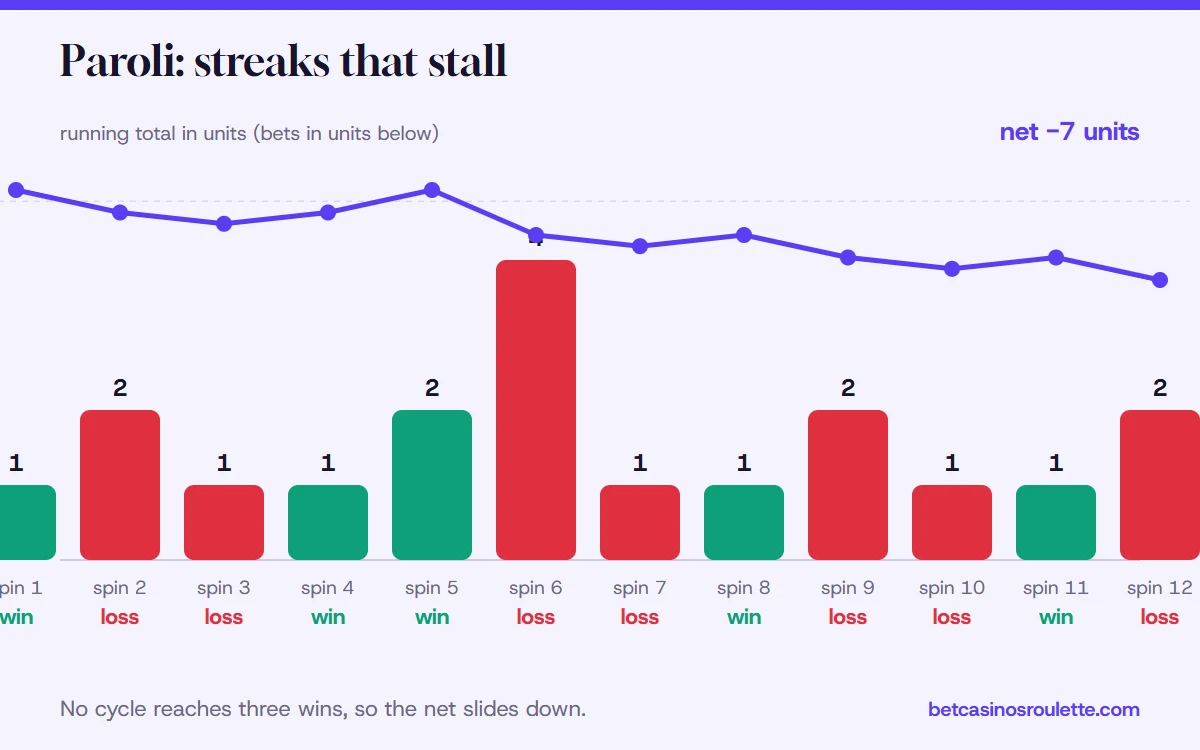
Far more often, the wins arrive one or two at a time and the third never comes.
| Spin | Stake | Outcome | Net |
|---|---|---|---|
| 1 | 1 | Won | +1 |
| 2 | 2 | Lost | -1 |
| 3 | 1 | Lost | -2 |
| 4 | 1 | Won | -1 |
| 5 | 2 | Won | +1 |
| 6 | 4 | Lost | -3 |
| 7 | 1 | Lost | -4 |
| 8 | 1 | Won | -3 |
| 9 | 2 | Lost | -5 |
| 10 | 1 | Lost | -6 |
| 11 | 1 | Won | -5 |
| 12 | 2 | Lost | -7 |
Seven cycles, seven losses of 1 unit, even though five of the twelve spins were winners. The math per cycle: 11.51% of cycles pay +7, the other 88.49% cost 1. That works out to about 0.08 units lost per cycle, which is the edge showing up.
Bankroll and the table maximum in the roulette Paroli system
This is where Paroli is kind. Starting from 1 unit, the largest stake you ever place is 4, and the worst a cycle can do is cost 1. A 100 unit bankroll lasts a long time; in the simulation not one session of 100 spins ran out.
The table maximum only matters if you let wins ride longer. Some players skip the bank at three and keep doubling, which is called the reverse Martingale. Then the limit caps the streak: start at 5 units under a 100 unit ceiling and the sixth bet would be 160, which the dealer must refuse. Most of the time the streak ends with a loss well before that, and the whole pile goes back.
What 100,000 simulated Paroli sessions show
100,000 sessions per row: red every time, opening stake 1 unit, 100 unit stack. Numbers are approximate.
| Session | Finished ahead | Average result | Average total staked |
|---|---|---|---|
| 100 spins, European | 38% | -4.6 units | 169 units |
| 100 spins, American | 30% | -8.8 units | 167 units |
| 30 spins, European | 39% | -1.4 units | 50 units |
The picture is the reverse of the Martingale: fewer winning sessions, but no disasters. The loss per unit staked came out at about 2.7% on the European wheel and 5.3% on the American one, the same as flat betting. The probability of each spin is fixed, so a positive progression cannot tilt it.
Who likes the Paroli, and how to test it first
Players like it because a bad night costs little and a good one feels big. It fits short sessions with a firm cap, for example 30 spins or 50 units of loss, whichever comes first. If you want to stretch play credits, it is one of the gentler patterns, along with flat bets.
Open the tester above, which starts on Paroli. Try a short night: 50 units of bankroll, an opening stake of 1, a limit of 25, the European wheel, 30 spins and 1,000 sessions. You will see almost no busted sessions, and yet more of them finish down than up. Then compare the same settings on the Fibonacci preset to see the opposite shape. A full comparison of methods is on roulette betting systems, and practical table habits are in roulette tips.
Questions players ask
Does the Paroli roulette strategy work?
It limits losses per cycle to 1 unit and pays 7 units when you win three in a row. The edge still comes out ahead: in simulation the average 100 spin session still lost about 4.6 units on a European wheel. It changes how losses feel, not how big they are on average.
How is the Paroli system different from the Martingale?
The Martingale raises the bet after a loss and needs a big bankroll for rare streaks. The Paroli raises the bet after a win and risks only 1 unit per cycle. Martingale gives many small wins and rare big losses; Paroli gives many small losses and occasional bigger wins.
How often does a Paroli streak of three wins happen?
With one green pocket, three even money wins in a row come about 11.51% of the time, so roughly one cycle in nine. With 0 and 00 both on the wheel it drops to about 10.63%. Any zero ends the streak.
Why bank after three wins in a Paroli?
Each extra win has the same chance as the first, so the streak gets less likely the longer it runs. Banking at three locks in 7 units before the next loss takes them back. Some players bank at two for a smaller, more frequent gain.
Can I use the Paroli system roulette players favor on dozens or columns?
Yes. Dozen winnings are twice the stake, so pressed bets grow faster, but you only win about 32% of spins. Three dozen wins in a row happen about 3.4% of the time on a European wheel.