
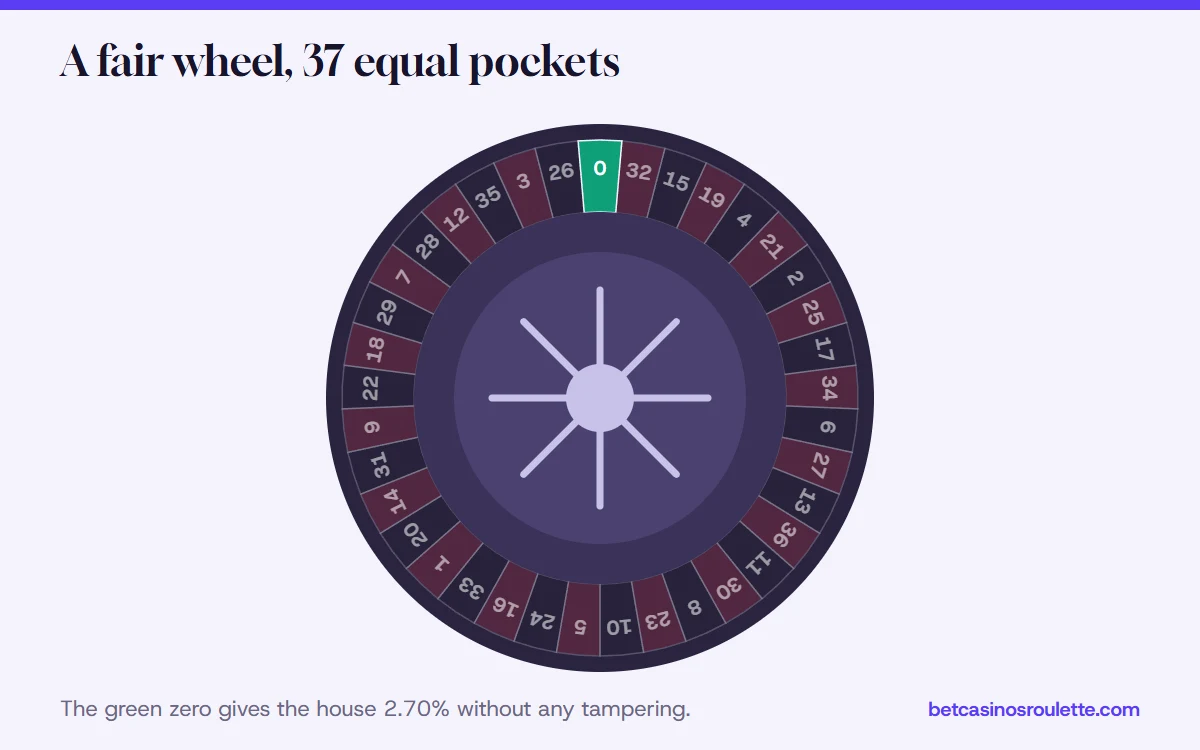
Is roulette rigged? In a licensed casino or a licensed online game, no: the wheels and the software are tested, and the casino has no reason to cheat because the green pockets already give it a steady edge. What fools people is how random results look. Streaks, cold numbers and repeats all happen on a fair wheel, and they happen more often than most players expect.
At the table
Licensed games
Wheels and random number generators are tested before use and checked after.Why cheat?
The edge is 2.70% or 5.26% on every bet, built into the payouts.Streaks
A run of 7 of one color shows up in about 47.85% of 100 spin stretches.Worn wheels
Casinos level, inspect and rotate wheels to keep pockets even.Cheating
Devices and late bets are crimes, and tables are watched closely.
Is roulette rigged at casinos? The short answer
So, are roulette tables rigged? A casino does not need a crooked wheel. The math pays it already. With one green pocket, the house keeps 2.70% of everything bet over time. If players wager 1,000,000 units in a month, the expected take is about 27,027 units with a perfectly fair wheel. With two, the figure is about 52,632 units. A rigged game would risk the license that makes all of that possible.
That is why regulators care so much about fair equipment, and why casinos log results and inspect wheels themselves. The edge comes from the payouts sitting below true odds, not from tricks.
How licensed roulette games are tested
In regulated markets, roulette equipment and software must be approved before a player ever touches it. Bodies like the Nevada Gaming Control Board in the US or the UK Gambling Commission in Britain insist on testing, and independent labs check that random number generators produce even, unpredictable results.
For physical wheels the casino does its own upkeep. Staff check that the wheel is level, look for loose pocket separators, and move wheels between tables. Many casinos also record every result, so a wheel that drifts from normal patterns gets pulled and serviced.
Electronic roulette: real wheel or random number generator
Electronic roulette, also sold as digital roulette, comes in three common forms, and it helps to know which one you are sitting at.
- Automated wheel: a real wheel and ball under a clear cover, spun by a machine. Players bet on touch screens.
- Video roulette: no physical wheel at all. A random number generator picks the pocket and the screen animates it.
- Linked terminals: screens around a live dealer's wheel, so many players can bet on the same spin.
To play electronic roulette in a casino, you load credits at the terminal, tap your chips onto the screen layout, and wait for the spin. The payouts match the table game. The house edge on an electronic roulette table depends on the wheel shown: one zero or two. The real difference is speed. Machines usually spin faster than a dealer, and more spins per hour means a bigger expected loss for the same bet size.
Online roulette, RNG and provably fair games
A licensed online RNG roulette game uses software that has been tested for fairness, with results that cannot be predicted from earlier spins. No pocket is favored on any spin, just as on a well kept wheel.
Some games are labeled provably fair roulette. Before the spin, the game shows a scrambled code of a secret value. After the spin, it reveals the value, and you can check that the result came from it. That proves the outcome was fixed before your bet and not changed after. It does not lower the house edge.
The risk sits with unlicensed sites. With no regulator behind them, nobody checks their software and nobody handles complaints. If a game will not tell you who licenses it, treat that as your answer.
Why streaks happen on a fair wheel
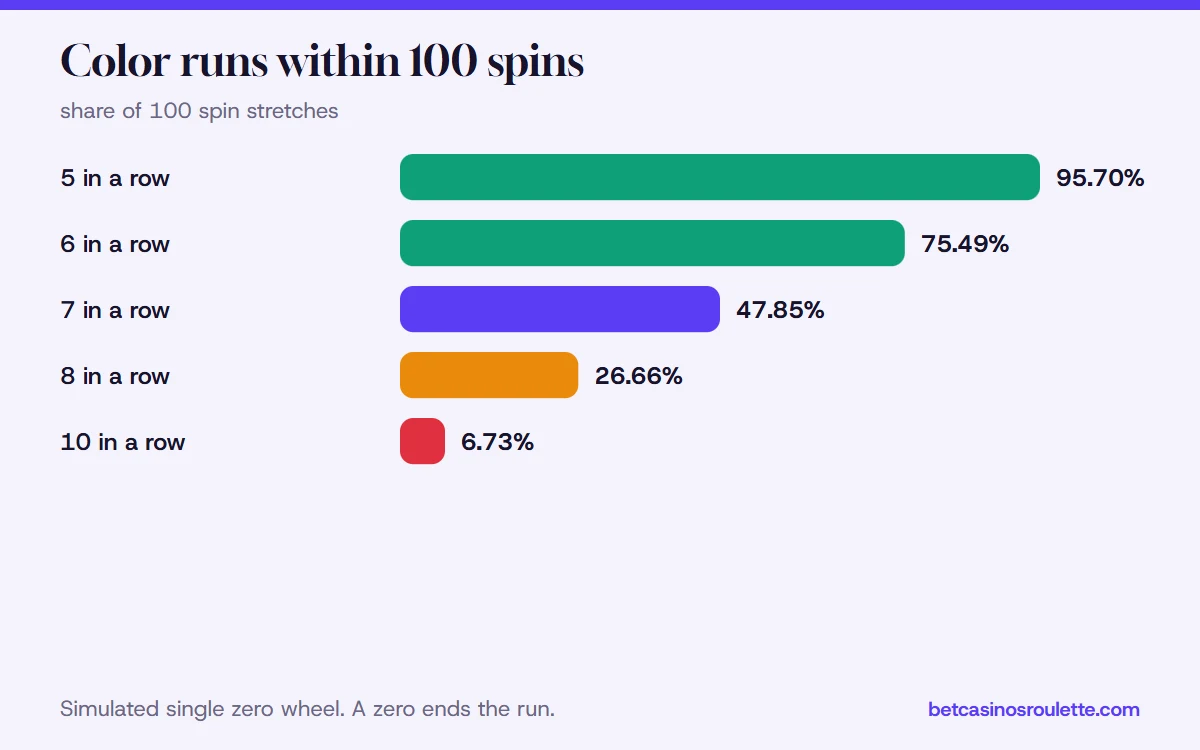
Most "this wheel is rigged" complaints start with a streak. Here is how common they really are. I ran 40,000 stretches of 100 single zero spins and counted how often a run of one color reached each length. Zero breaks a run.
| Run of at least | Share of 100 spin stretches |
|---|---|
| 5 in a row | 95.70% |
| 6 in a row | 75.49% |
| 7 in a row | 47.85% |
| 8 in a row | 26.66% |
| 10 in a row | 6.73% |
So a run of 7 reds or 7 blacks turns up in nearly half of all 100 spin stretches. Our brains expect colors to alternate, so a run like that looks planned. It is not. The roulette probability page has a streak calculator if you want to test other lengths.
What a worn or tilted wheel means
A physical wheel is a machine, and machines wear. A loose separator, a worn pocket or a wheel that is not level can make some numbers land a little more often. That is not rigging; it is a fault, and casinos look for it. They level wheels, inspect them, swap parts and rotate wheels between tables so no flaw lasts.
Can you tell if a wheel is off by watching it? Not really. Fair results look uneven over short stretches. In 370 spins each number should appear about 10 times, yet in our tests the busiest number averaged about 17 hits and the quietest about 4. A real fault would need many thousands of recorded spins to show, which is part of why casinos track results themselves. Our best numbers page walks through that spread.
How to cheat roulette? You do not
People search for roulette cheats and cheat codes for machines. There are none that work, and the ones that exist are crimes. Placing or moving chips after the result, known as past posting, is cheating. Under Nevada law it is a crime to use or even carry a gadget designed to project a game's outcome inside a casino. Tables are watched by dealers, supervisors and cameras, and electronic games log every bet.
The honest route to keeping more of your bankroll is choosing a single zero wheel, avoiding the American five number bet and setting limits. You can practice with play credits on our roulette simulator, where nothing is at stake.
Questions players ask
Are online roulette tables fixed?
A licensed online game runs on certified number generators or streams a real wheel, and a regulator oversees it. Unlicensed sites have no such checks, so there is no way to know. The house edge alone keeps a licensed game profitable.
Is electronic roulette rigged?
Electronic roulette in a licensed casino is tested and approved like table games. It pays the same, and the edge depends on whether the screen shows one zero or two. It often runs faster, which raises the cost per hour.
Can a roulette wheel be rigged?
In theory any machine can be tampered with, which is exactly why licensed casinos face testing, inspection and surveillance. A wheel can also wear out, and casinos service and rotate wheels to stop that from affecting results.
How does a random number generator pick a roulette number?
It runs a constant stream of numbers and maps the one drawn at the moment of the spin to a pocket. Each pocket gets the same share of outcomes. Testing labs check that the results are even and cannot be predicted.
Are there roulette cheat codes for machines?
No. Codes and tricks sold online do not change the game, and tampering with equipment is a crime. Machines and tables log activity, so cheating is also likely to be caught.
Electronic roulette vs table: which is better?
Both pay the same and follow the same odds for the same wheel type. Table play is usually slower, so the same bet size costs less per hour.