
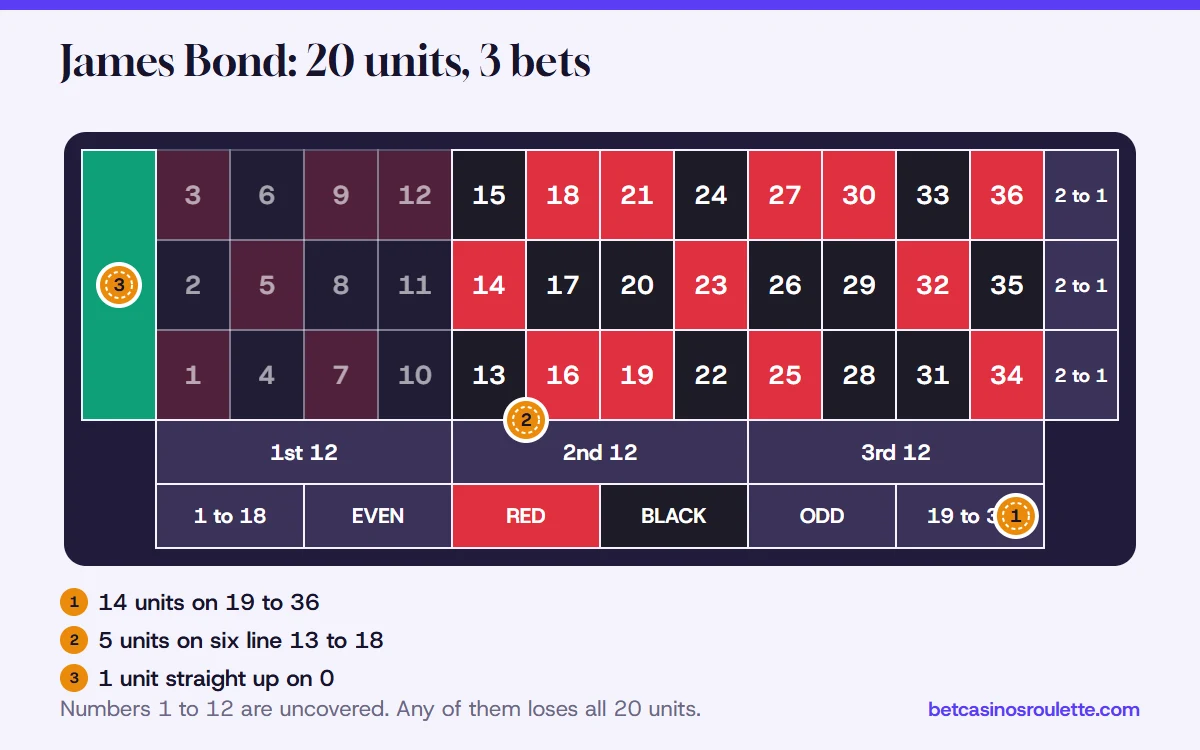
The James Bond roulette strategy is a fixed 20 unit bet: 14 units on high (19 to 36), 5 units on the six line 13 to 18, plus a single unit on zero, which together cover 25 of 37 European pockets. Three outcomes win and one loses. The losing one is the low dozen, 1 to 12, and it takes all 20 units at once.
It is a neat pattern, easy to place and fun to watch. It is not a way around the house edge. Below are the chip positions, the settlement for every result, the long-run math, and what happened when I ran it through 100,000 simulated sessions.
At the table
Stake per spin
20 units: 14 on 19 to 36, 5 on the 13 to 18 six line, 1 on zero.Covered
25 numbers. Wins 67.57% of spins single zero, 65.79% double zero.Wins
Plus 8 on 19 to 36, plus 10 on 13 to 18, plus 16 on zero.Loses
Minus 20 on any of 1 to 12 (and 00 on an American wheel).House edge
2.70% single zero, 5.26% double zero.Average loss per spin
About 0.54 units single zero, 1.05 units double zero.
How to place the James Bond roulette bet
The whole pattern is three stacks of chips. The ratio is what matters, so read units as whatever chip value you use.
- 14 units on high, the box marked 19 to 36 on the outside of the layout.
- 5 units on the six line 13 to 18. Set them on the border line of the grid, right where the 13, 14, 15 row touches the 16, 17, 18 row.
- 1 unit straight up on 0.
That is 20 units per spin. Bigger players often use ten times the pattern, 140, 50 and 10, but the proportions never change. If any of these bet types is new to you, the six line guide and the outside bets guide show exactly where the chips sit.
The result for every number on the wheel
Here is how each spin settles. High pays 1 to 1, a six line pays 5 to 1, and zero pays 35 to 1.
| Ball lands in | Pockets | Chip that wins | Profit on it | Units lost on the rest | Spin result | Chance (37 / 38 pockets) |
|---|---|---|---|---|---|---|
| 19 to 36 | 18 | high (14) | 14 | 6 | plus 8 | 48.65% / 47.37% |
| 13 to 18 | 6 | six line (5) | 25 | 15 | plus 10 | 16.22% / 15.79% |
| 0 | 1 | zero (1) | 35 | 19 | plus 16 | 2.70% / 2.63% |
| 1 to 12 | 12 | none | 0 | 20 | minus 20 | 32.43% / 31.58% |
| 00 | 1 (American) | none | 0 | 20 | minus 20 | not on the wheel / 2.63% |
So the pattern covers 25 numbers and leaves 12 bare on a European wheel, 13 bare on an American one. On a European wheel that means a win 67.57% of the time and a loss 32.43% of the time.
James Bond roulette strategy math: why it still loses
Walk through one ideal cycle of 37 spins with each pocket showing once. The high numbers bring 18 times 8, or 144. The six line brings 6 times 10, or 60. Zero brings 16. That is 220 units won. The low dozen costs 12 times 20, or 240. Net: minus 20 units on 740 wagered, which is the familiar 2.70%.
On an American wheel the 00 pocket joins the losers: 220 won against 260 lost over 38 spins, minus 40 on 760 wagered, or 5.26%.
The feel of the system comes from the size mismatch. A typical win is 8 units. A loss is 20. One loss erases two and a half of the usual wins. Two losses in a row, a 10.52% event on any given pair of spins, take 40 units, which is a fifth of a 200 unit stake.
James Bond roulette sessions over 100,000 simulations
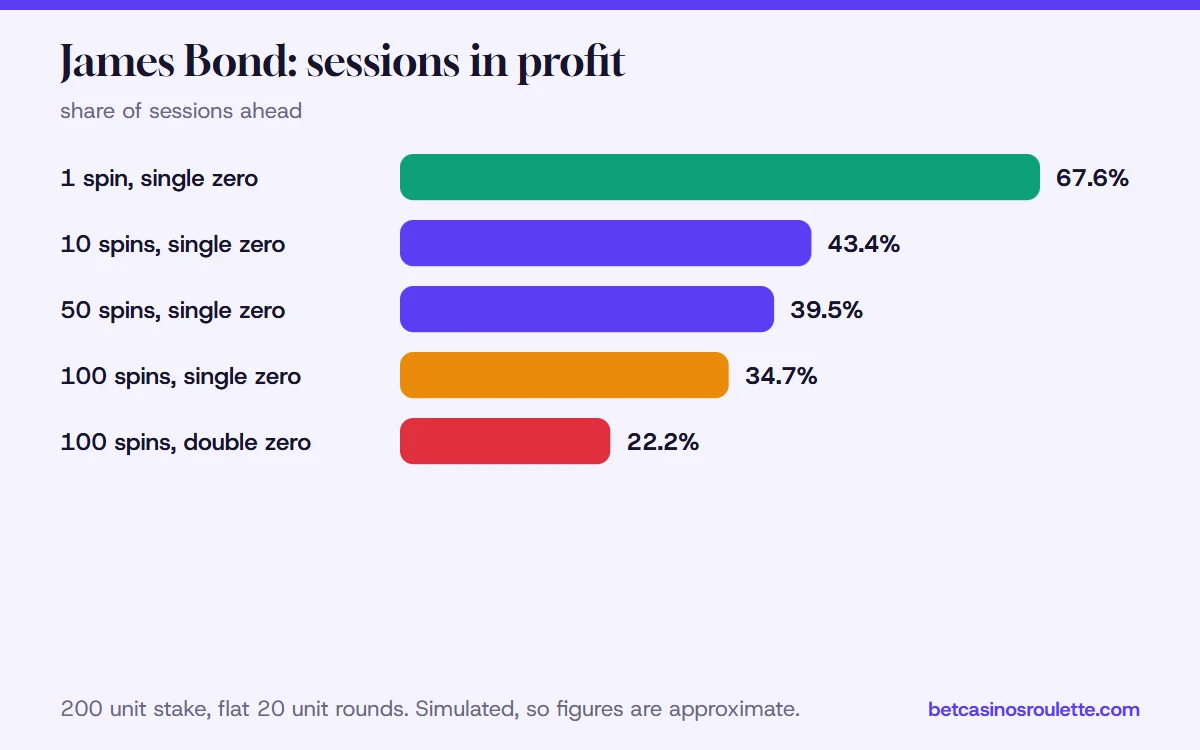
I gave each simulated player 200 units, enough for ten full rounds, and played flat 20 unit bets until the spin limit arrived or fewer than 20 units were left. Results are approximate; I also checked the shares with an exact calculation and they matched closely.
| Spins played | In profit (single zero) | In profit (double zero) |
|---|---|---|
| 1 | 67.57% | 65.79% |
| 5 | 47.92% | 44.41% |
| 10 | 43.43% | 38.96% |
| 20 | 43.2% | 37.1% |
| 50 | 39.5% | 29.7% |
| 100 | 34.7% | 22.2% |
After 50 spins with one zero, the mean finish was roughly 26.2 units under the start, and 9.0% of players were wiped out. Two zeros dragged the mean to about minus 50.5, with 13.9% wiped out. Stretch the European game to 100 spins and the bust rate reached 27.5%, with an average result near minus 48.2 units.
Variations of the James Bond roulette bet
- Scaled up or down. Any multiple of 14, 5 and 1 keeps the same odds. Only the swings change size.
- With a progression. Some players double the 20 units after a loss. That is Martingale on top of a spread: three misses in a row ask for 160 units on the next spin, and the edge is unchanged.
- At an American game. The 1 unit can sit on 0 or 00, but not both, so one green pocket is always bare. That is why the edge doubles.
None of these fixes the gap in 1 to 12. If you want a spread that wins more often with smaller swings, compare it with the Romanosky spread(8 units spread over 32 numbers) on the roulette strategy chart.
Run the James Bond pattern on the system tester
The tester near the top loads with James Bond already chosen and counts everything in play units.
- Keep the system on James Bond and select the European wheel.
- Enter 200 as the bankroll and 1 as the base unit, so each round places 20.
- Choose 50 spins and 1,000 sessions, then run.
- Compare with the table above: roughly 40% of sessions ahead, about 9% busted, and an average close to minus 26.
- Try the American wheel next, then raise the spins to 100, and watch the busted share climb.
With 1,000 sessions your numbers will wobble by a point or two from mine. That wobble is luck. The drift downward as sessions get longer is the edge.
Should you play the James Bond strategy?
Play it if you like the look of the table and want winning spins about two thirds of the time. Do not play it expecting profit. It is three standard bets stacked together, and each one pays slightly under its true odds.
If you use it, choose a single zero wheel, keep a stake of at least ten rounds, and set a loss limit and a stop time before you start. The betting systems guide covers how progressions differ from fixed spreads like this one, and the strategy hub lists every approach we have tested.
Questions players ask
What is the James Bond roulette strategy?
It is a flat bet of 20 units split three ways: 14 on high (19 to 36), 5 on the six line 13 to 18, and 1 on zero. It covers 25 numbers and loses only when 1 to 12 comes up, or 00 on an American wheel.
Does the James Bond roulette strategy work?
It wins about two spins in three, yet the casino's cut survives untouched. Each 20 unit round costs roughly 0.54 units on average with one zero. Over 100 spins, about 34.7% of simulated players finished up.
How many numbers does the James Bond bet cover?
It covers 25 numbers: 19 to 36, 13 to 18 and zero. With one zero, that is 25 pockets out of 37, a 67.57% hit rate.
What does the James Bond strategy win on zero?
The 1 unit on zero pays 35, and the other 19 units are lost, so the spin nets plus 16. It is the best single result in the pattern, and the rarest.
Can you use the James Bond method on an American wheel?
Yes, but 00 is left uncovered, so 13 numbers lose instead of 12. The edge rises to 5.26%, and only about 22.2% of simulated 100 spin sessions ended ahead.
How much bankroll does the James Bond roulette bet need?
Each round uses 20 units, and a loss takes all of them. With 200 units, or ten rounds, about 9% of 50 spin sessions went broke on a single zero wheel.