
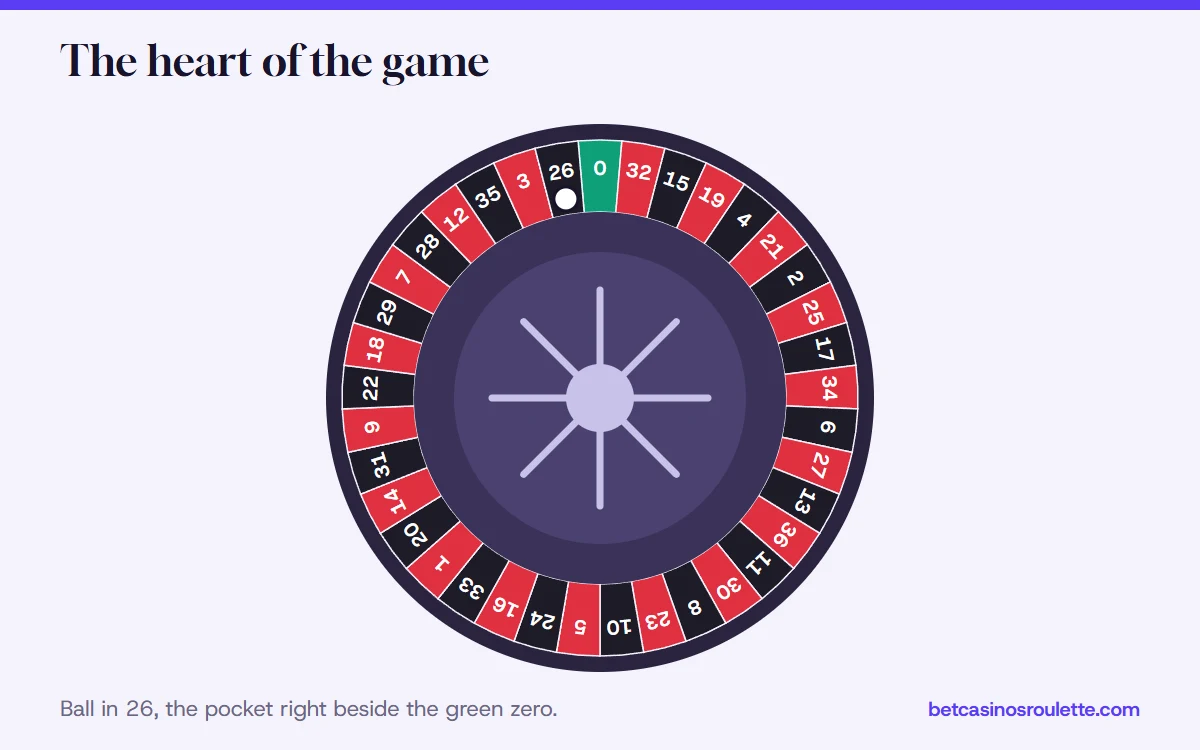
What is roulette in one line: a casino game of pure chance in which a ball spun around a turning wheel drops into one numbered pocket, and everyone who bet on that number, or on a group containing it, gets paid. There is no skill in picking the number and no way to influence it, which is exactly why the game is easy to learn and why its odds can be stated so precisely.
At the table
Word meaning
French for little wheelSaid as
roo-LETType of game
Pure chance, no player decisions affect the resultMain versions
Single zero (European, French) and double zero (American)Run by
A dealer, also called a croupierOrigin
France, well over two centuries back
What is roulette? A plain definition
Roulette is a betting game played on a table with two halves. At one end sits a wheel with 37 or 38 numbered pockets. Along the rest of the table runs a cloth printed with the same numbers, where players set chips to show their bets. The dealer spins the wheel, sends a small ball around its rim the opposite way, and waits for the ball to fall into a pocket. That pocket settles every bet on the table at once.
Unlike card games, nothing you do after betting changes anything. You cannot hold, fold or double. You decide three things only: the bet, its size, and the moment you quit. That simplicity is why the odds can be printed in a short table and checked by anyone with a pencil.
What the word roulette means
In French, roue is a wheel and roulette is its small form, so the name literally means little wheel. English kept the French spelling: r, o, u, l, e, t, t, e, with a double t. The stress falls on the end, roo-LET. In Spanish it is ruleta, in Italian roulette as well, and in German it keeps the French form too.
Away from casinos the word is used for anything left to random choice, such as picking a dish or a destination at random. That everyday use comes straight from the image of a ball landing wherever it lands.
The parts of a roulette game
| Part | What it is | Why it matters to you |
|---|---|---|
| Wheel | A spinning rotor with 37 or 38 pockets inside a fixed wooden bowl | The number of green pockets sets the house edge |
| Ball | A small hard ball, usually white, spun around a track below the rim | Its many bounces make the result unpredictable |
| Layout | The printed cloth: a three column number grid, green zeros on top, outside boxes along the edge | Where you place chips to make a bet |
| Chips | Colored wheel chips, one color per player | The dealer can always tell whose bet is whose |
| Dealer | The casino worker who spins, calls and pays | Runs the pace and settles every bet |
| Dolly | A small marker set on the winning number | While it stands, nobody touches the chips |
For the full map of the cloth, see the roulette table layout; for the wheel itself, see roulette wheel.
What is roulette like to play? One round
Chips go down, the wheel turns, the ball is launched, betting closes, the ball drops, the dolly goes on the winner, losers are cleared and winners are paid. Then it starts again. A live table runs perhaps thirty to forty rounds an hour; a screen can run far more.
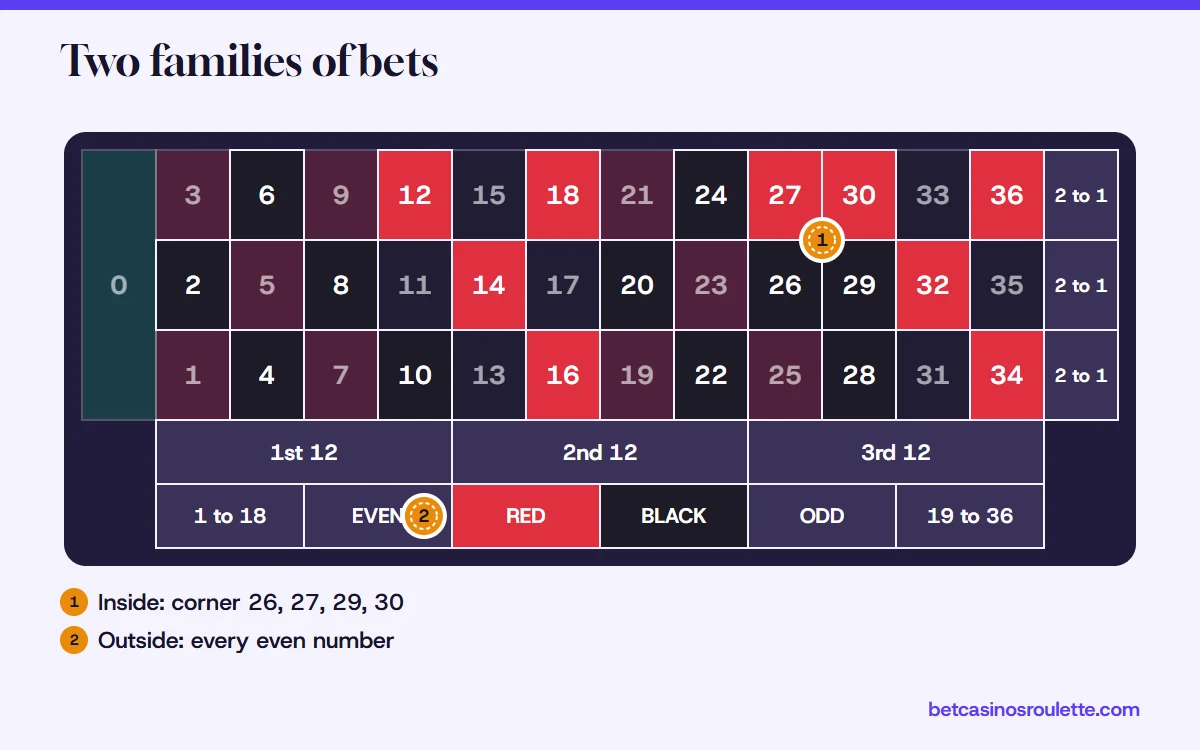
There are two kinds of wager. Chips placed among the numbers themselves are inside bets, holding one to six numbers for a big payout. Chips in the surrounding boxes are outside bets, holding twelve or eighteen numbers for a modest one. The step by step version, with a worked example, is on how to play roulette.
Who invented roulette, and roulette history in brief
No single inventor can be named with confidence. French gaming rooms gave the game its shape over two centuries back, blending ideas from older wheel and lottery style games that were already popular there. The French gave it its name, its layout and the French bet names still printed on some tables.
From France the single zero version spread across Europe. Across the Atlantic, American houses settled on a wheel with an extra 00 pocket, which is why American tables carry 0 and 00 and a higher edge. Some US casinos have since added a third green pocket, the triple zero wheel.
The roulette ball and the dealer's spin
Early balls were ivory or wood. Casino balls are now made of hard non metal materials such as resin or teflon, and regulators set the size and material. Lighter or bouncier balls jump around more before settling.
Ball and rotor always travel in opposite directions. Many rule books require several laps of the track, and a spin that falls short is called no spin and repeated. Can a roulette dealer control the ball? People have long argued that a practiced dealer might favor a section of the wheel, but the bounces off the deflectors and pocket walls scatter the ball widely, and many casinos have dealers vary speed or change direction. There is no reliable way for a dealer to hit a chosen number, and casinos watch results closely.
Roulette terms: a short glossary
| Term | Meaning |
|---|---|
| Croupier | The dealer at a roulette table |
| No more bets | The call that closes betting for the spin |
| Straight up | A bet on one number |
| Split, street, corner, six line | Inside bets on 2, 3, 4 and 6 numbers |
| Dozen, column | Outside bets on 12 numbers |
| Even money | Bets paid 1 to 1, such as red or odd |
| La partage | French rule: zero takes only half your stake on a 1 to 1 bet |
| En prison | French rule: an even money bet is held one more spin after zero |
| Rotor | The turning part of the wheel that holds the pockets |
| Ball track | The groove under the rim where the ball circles |
| Wheel chips | Colored chips valid only at one roulette table |
| House edge | The casino's average share of every bet: 2.70% or 5.26% |
Named bets on parts of the wheel, such as voisins du zero, are covered on call bets.
Is roulette a game of skill?
No. Every spin is independent, and the average cost per bet depends only on which wheel you sit at. What you can control is cost and risk: choose a single zero table, size bets to your bankroll, and stop at a point you chose in advance. Curious how it feels? Open the roulette simulator and play a few dozen rounds on credits.
Questions players ask
What does roulette mean?
It is French for little wheel, from roue, meaning wheel. In everyday English it also means any choice left to chance.
Who invented the roulette wheel?
No single inventor is known for certain. It grew up in France over two centuries back, borrowing from older wheel and lottery style pastimes.
Can a roulette dealer control the ball?
Not in any reliable way. The ball bounces off deflectors and pocket dividers before it settles, and casinos often require dealers to vary spins. Results are monitored, and any odd pattern would be checked.
How do you spell roulette?
R, o, u, l, e, t, t, e, with two t's and an e at the end. It is pronounced roo-LET.
What is the roulette dealer called?
The dealer is often called a croupier, a French word. The dealer spins the wheel and ball, calls no more bets, marks the winner and pays out.
What is a roulette ball made of?
Casino balls are made of a hard non metal material such as resin or teflon. Older balls were made of ivory or wood.